
What “Stupid Mistakes” Really Say About a High-Functioning Brain
Why the hand slips on words you know

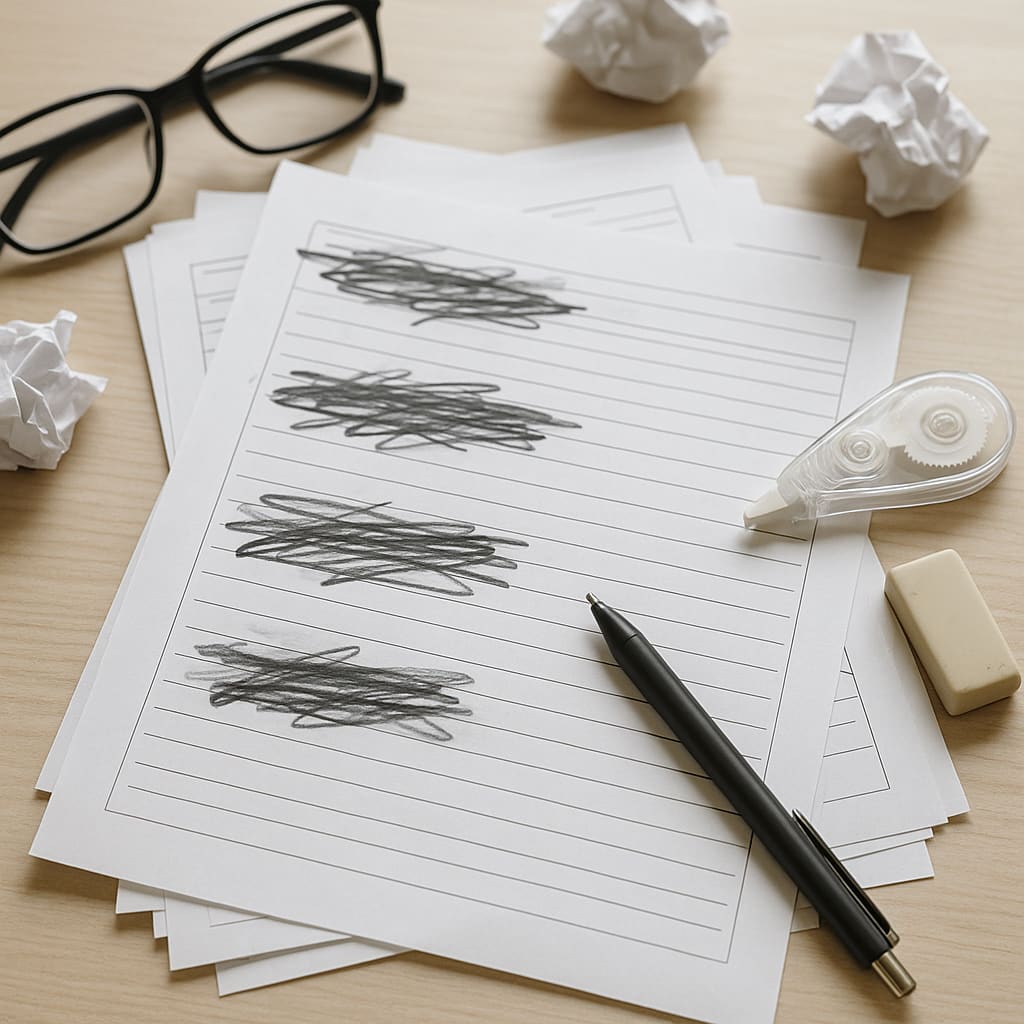
There is a special kind of humiliation in misspelling the name of someone you know perfectly well. Not a stranger. Not a difficult name from a form you only saw once. I mean the name of somebody close enough to your life that your brain could recognize it half asleep.
- You have seen it on your phone 1,000 times.
- You have typed it correctly more times than you could count.
- You are not confused about how it is spelled.
Then you sit down in front of a legal or other serious document where the ink will definitely count, and your hand writes it wrong anyway.
You catch it right away. You fix it. You print again. You slow down. Then the same error appears again, as if your own hand has decided it knows better than you do.
People get rattled by this fast. Age gets blamed. Cognitive decline gets mentioned. Somebody starts wondering whether this is the first sign of something worse. Ordinary embarrassment turns into self-surveillance, which only makes the problem louder.
I want to clear this up in plain English because it randomly happens to me too, and it has since I was young.
When a functioning adult knows the word, knows the name, recognizes the error, feels bothered by it, and keeps correcting it, that usually is not what a failing brain looks like. More often, a well-trained automatic system is colliding with stress, language frequency, and overcontrol. The result can be small writing errors that feel absurd from the inside and mysterious from the outside.
With nearly 40 years in forensic handwriting, I can tell you that once handwriting becomes fluent, the brain does not assemble every word one letter at a time the way a child learning to print would. It stores movement sequences, visual templates, and familiar forms, then relies on what repeated use has reinforced most strongly over time. That is efficient because that is how skilled writing works.
So if someone means to write “Stephen” and keeps producing “Steven,” the hand is not inventing nonsense. The same thing can happen with “Tracy” and “Tracie,” or “Marc” and “Mark.” Under pressure, the brain often defaults to the more familiar or more frequently reinforced form.
The wrong spelling is still wrong, but it is not random.
It is shaped by repetition, familiarity, and the brain’s preference for the faster route when the system is under strain.
Pressure is where this gets more interesting.
A low-stakes note does not hit the nervous system the way an official form does. Legal documents, medical paperwork, financial records, contracts, court materials, agency forms, even certain personal letters can create a very different mental climate. The moment the brain tags something as important, supervision increases. You stop simply writing and start monitoring yourself as you write.
That sounds responsible, and sometimes it is. But once conscious monitoring leans too hard on a skilled automatic act, performance can get worse.
This is well known in motor performance. People choke in sports this way. Musicians tighten up this way. Skilled typists suddenly hit the wrong keys this way. Overcontrol interferes with fluency. Writing is no different.
Then it gets more personal. Some people do not just dislike mistakes. They have lived in systems where mistakes on paper carried a real cost. That can come from certain workplaces, certain family environments, certain trauma histories, or years spent inside professions where documentation is reviewed, challenged, audited, or weaponized.
Mine goes back a long way. The nervous system does not forget the teacher who circled everything in red, the form that came back “wrong,” the accusation tied to a typo, or the feeling that one small error could become a much larger problem.
So by the time the pen hits the paper, the body is no longer doing a neutral task. It is bracing while trying to look calm, which is not ideal territory for smooth fine-motor output. That alone can interfere with something as basic as a familiar name.
Another problem starts once the wrong version appears more than once.
The error itself begins to get reinforced. You see the misspelling, react to it, tense up, cross it out, and start over. Now the incorrect form has been repeated, noticed, and emotionally charged. That gives it more weight in memory on the next attempt. People often take this as proof that something is deeply wrong with them, when what has happened is much simpler: the brain has just given extra rehearsal time to the wrong version under stress.
The mechanism is ordinary even when the experience feels maddening.
A few things are usually happening at once: the writing system is automatic and heavily practiced, the wrong form is more familiar in the language overall, the document has been coded by the brain as high stakes, internal monitoring is interfering with fluent output, and the first error got extra reinforcement because it was repeated under tension. Taken together, that can easily produce a stubborn substitution in a word the person absolutely knows.
That should calm some people down.
A slip like this is not automatically evidence of stupidity, decline, or hidden damage. A name error can be a stress tell. It can be a fluency problem under pressure. It can reflect learned vigilance around official writing. It can also happen with your own name, a familiar address, or another word you know perfectly well and almost never miss anywhere else.
The conditions tell you more than the error does.
In document work, details like this can carry information. Not dramatic information. Not television nonsense. Still, they can tell you something about strain, pacing, correction pressure, and perceived consequence. A substitution that repeats only in formal writing and disappears in casual writing is already saying something useful about context.
There is also a practical fix, because this is not a problem that needs a pep talk.
Before filling out any document that consequentially matters, write all non-negotiable names, dates, and other precision items correctly on a reference sheet or sticky note in clear print. Keep it in sight. Use it as your visual source every single time before your pen hits the line. Do not rely on memory simply because you know the information. Feed the correct version to the motor system right before execution.
That is not babying yourself.
It is using what is known about attention, repetition, and performance. There is also no prize for pretending that stress does not affect output. It does. High-functioning people usually understand that about everyone else and then refuse to grant it to themselves.
A wrong letter in the middle of a familiar name does not automatically mean the brain is slipping.
In many cases it means the brain is doing what overtrained, overmonitored systems do under pressure. It grabs the fast route, stiffens when watched, and repeats what got rehearsed, even when the person holding the pen knows better the entire time.
Yes, that is a nuisance, but it is also fixable... and much less mysterious than people make it.
Sources That Don’t Suck
American Psychiatric Association. (2022). Diagnostic and statistical manual of mental disorders (5th ed., text rev.).
Beilock, S. L. (2010). Choke: What the secrets of the brain reveal about getting it right when you have to. Free Press.
Kahneman, D. (2011). Thinking, fast and slow. Farrar, Straus and Giroux.
McNeill, D. (1992). Hand and mind: What gestures reveal about thought. University of Chicago Press.
Van der Kolk, B. A. (2014). The body keeps the score: Brain, mind, and body in the healing of trauma. Viking.
Willingham, D. T. (2004). Practice and memory. In C. A. Stone, E. R. Silliman, B. J. Ehren, & K. Apel (Eds.), Handbook of language and literacy: Development and disorders (pp. 557–573). Guilford Press.
About the Creator
Dr. Mozelle Martin
Behavioral analyst and investigative writer examining how people, institutions, and narratives behave under pressure—and what remains when systems fail.
Keep reading
More stories from Dr. Mozelle Martin and writers in Psyche and other communities.
The Month Everyone Gets Wrong About Suicide
The public conversation around suicide repeats a mistake every year. As soon as December hits, social media fills with somber graphics, dramatic pleas, and emotional declarations insisting that the holidays are the most dangerous time for suicidal behavior. The message is well-intended, but it is wrong. The data has been stable for decades.
By Dr. Mozelle Martin4 months ago in Psyche
Top tipple tricks
Been thinking a lot about drinking, lately. Not least because of a recent episode of over-indulgence and the inevitable after effects. Some readers may recall the earlier articles I wrote about beating the booze. Here I set out an experiment in techniques for cutting down on my alcohol intake. The experiment was successful, the techniques worked, and I have armed myself with an arsenal of weapons in the war against the demon drink. I have yet to fire the first round however. It's all a question of timing (perhaps procrastination).
By Raymond G. Taylor28 days ago in Psyche
Your Birth Order
How Being First, Middle, or Last Born Shapes Everything You Do THE INVISIBLE BLUEPRINT 📋 The order in which you were born into your family is one of the most powerful and least recognized influences on your personality, career choices, relationship patterns, and fundamental approach to navigating the world, and while birth order research has been debated and refined since Alfred Adler first proposed its significance in the 1920s, contemporary studies using large datasets and sophisticated statistical methods have confirmed that significant personality differences correlate with birth position even after controlling for family size, socioeconomic status, and other confounding variables, and understanding your birth order personality pattern provides insight into behaviors and preferences that feel innate and unchangeable but that are actually adaptations to the specific social environment created by your position in the family hierarchy 👨👩👧👦
By The Curious Writer2 days ago in Psyche




Comments
There are no comments for this story
Be the first to respond and start the conversation.