politics
Political figures, histories, and current events in the whole scope of modern and past politics. Work place politics.
President Trump's deadline is nearing its end, 48 hours left
Iran claims to have shot down a US fighter jet, Trump's new threat: Hellfire will be poured on Iran in 48 hours. The Strait of Hormuz is closed, global economic conditions are going from bad to worse.
By Malik Sarfraz Hussain Awanabout 17 hours ago in Journal
Spiritual and Psychological Death.
The Weaponization of Loyalty Imagine a life dedicated to service—to your country, your people, and the shared values of humanity. Now imagine that very loyalty being weaponized against you. In an era where we boast of legal progress and human rights charters, a terrifying phenomenon persists: the use of fabricated criminal cases to silence the innocent. This is not just a legal error or a procedural flaw; it is a systematic dismantling of the human soul. When the pillars of justice are used to crush the righteous, we face a crisis that transcends borders and legal jurisdictions.
By Бахромжон Сувановabout 23 hours ago in Journal
Bankruptcy Risk in the Public and Corporate Sectors.
The Economic Paradox of 2026 As we navigate through 2026, the global economic landscape has encountered a startling and dangerous phenomenon: the sudden insolvency of sovereign entities and multinational corporations that once appeared to possess limitless resources. This trend is not merely a byproduct of external market volatility or unpredictable geopolitical shifts. Instead, it is the direct result of a deep-seated "economic cancer"—systemic corruption and the clinical obsolescence of institutional regulatory oversight. Understanding why these giants fall requires looking beyond the balance sheets and into the mechanics of how capital is being systematically drained from the heart of the global economy.
By Бахромжон Сувановabout 24 hours ago in Journal
Global aggression and Donald Trump's psychological militarism: The world economy on the brink of collapse
(Special Report: Journalist Malik Sarfaraz Hussain Awan) The Middle East is once again engulfed in gunpowder and flames. The American leadership, drunk on global power, has created a crisis that has brought the entire world to the brink of economic and defense collapse. As the president of the world's most powerful country, Donald Trump's recent statements and actions have forced us to think whether he is a wise leader of a great superpower or is suffering from a serious psychological and aggressive disease. It is clear from his every other statement that he has become indifferent to the ground realities and the value of human lives. The truth is that President Trump does not need the Strait of Hormuz or Iranian oil at this time, but he needs a proper and urgent mental treatment, so that he can save the world from the fire of the terrible war towards which he is rapidly moving.
By Malik Sarfraz Hussain Awan3 days ago in Journal
Fifth week of US and Israeli attacks on Iran: Tensions rise further
(Writing and analysis: Journalist Malik Sarfaraz Hossein Awan) The fifth week of the ongoing US and Israeli military operation against Iran has ended today. The US Central Command (CENTCOM) today released video of airstrikes targeting drones, tanks and missile launchers in Iran. These attacks resulted in massive explosions in the central Iranian city of Isfahan, where thick smoke was seen rising. In addition, attacks were also carried out near the international airport in the city of Mashhad. US President Donald Trump, addressing the nation, said that the US is close to achieving its strategic goals against Iran. He announced that severe attacks on Iran will continue in the next two to three weeks and said, "We will send them back to the Stone Age where they belong." Trump also said that countries shipping oil through the Strait of Hormuz needed to show courage. The Iranian military responded quickly, threatening "devastating, widespread and more severe" attacks. Immediately after Trump's speech, Iran fired a large number of missiles towards Israel. Explosions were heard in Tel Aviv and other areas. Israeli air defense systems intercepted most of the missiles, but missile debris injured at least 5 to 14 people near Tel Aviv. It was the largest missile barrage from Iran on Israel in recent weeks. Iran also launched missile attacks on Gulf countries. Bahrain, the United Arab Emirates and Saudi Arabia disabled several missiles. A fire broke out at an airport in Kuwait, which was extinguished. Iranian officials said their military capabilities were still there and they would take "more devastating" actions in response. According to confirmed figures so far, at least 2,076 people have been killed and 26,500 injured in the US and Israeli attacks in Iran. Iran has rejected any request for a ceasefire and said that the fighting will continue until the US and Israel withdraw. Analysis: Situation Overview and Possible Outcomes Today’s developments once again bring the complexity of the entire conflict to the fore in a bloody reality. Imagine smoke rising in the streets of Isfahan, people fleeing their homes, and sirens blaring at Mashhad airport. US President Trump’s address is not only a declaration of military confidence, but also a message that demonstrates his determination to completely weaken Iran. But the Iranian military’s swift and powerful response suggests that this war is far from over. Iran’s missile attacks on Israel and the Gulf countries are an example of a lively response that shows that despite technological superiority, subduing regional powers is not as easy as it seems. This situation is igniting a dangerous fire for regional stability. While the US and Israel claim to have achieved their strategic goals, the threats of further attacks on Israel by Iran’s proxy forces, especially the Houthis in Yemen, are dragging the entire Middle East into a wider circle. Oil prices are skyrocketing, the shadows of a recession are deepening in global markets, and millions of families are being affected. The pain of human losses is not just in the numbers, but in the cries of every injured child, the tears in the eyes of every martyred mother. Behind the 2,076 deaths and 26,500 injuries, there are thousands of stories that can never be told. Military experts say that if this fighting continues for two to three weeks, the pressure on Iran’s economy will be unbearable. The threat of a closure of the Strait of Hormuz could affect global oil supplies, which could shake the economies of Europe, Asia, and the United States. China and Russia are still silent, but if this conflict escalates, they could also come to the fore, which could change the balance of global powers. Iran’s military capability is not yet completely exhausted. It still has missiles, drones, and underground facilities that give it the power to fight a long war. On the other hand, the American and Israeli leaderships are also facing internal pressure. The American public is feeling war fatigue, while the barrage of missiles in urban areas in Israel is spreading fear. This war is not only military but also psychological and economic. If a diplomatic solution is not found immediately, this regional crisis could turn into a world war. This situation teaches us a harsh lesson that when the use of force is excessive, its consequences are always disastrous. The Iranian nation still has the courage to resist, while the United States and Israel will also have to take care of their own goals as well as human lives. The international community must intervene immediately. The United Nations, the European Union, and the Arab League must work together to develop a peace plan to prevent further bloodshed. The situation is changing rapidly. New news is coming in every hour. If this fighting continues, it will change not only the geopolitics of the Middle East but the entire world. Restoring peace now requires not just words, but urgent action.
By Malik Sarfraz Hussain Awan3 days ago in Journal
Today's big sensation in the Iran-Israel-US war: Trump's ceasefire claim, Iran laughs and rejects
(Writing and analysis: Journalist Malik Sarfaraz Hussain Awan – Social Guardian / Humanitarian) According to verified sources Al Jazeera, New York Times, CNN, Reuters, AP and other reputable international news agencies, today, April 1, 2026, the Iran-Israel-US war has entered its fifth week and military operations remain intense, while contradictions in statements and a standstill in diplomatic efforts have further complicated the situation. This evening, Iran launched a large-scale missile attack on central Israel, including Tel Aviv and Bnei Brak, in which about 10 ballistic missiles were fired. Several places, including a coffee shop, were hit and at least 14 people were injured in the attack, including an 11-year-old girl. The Iranian Revolutionary Guards have The Houthis claimed additional missile attacks on Israel in coordination with Iran and Hezbollah. On the other hand, Israel carried out more than 400 airstrikes on several cities in Iran, including Tehran, targeting weapons production sites, ballistic missile factories and infrastructure. The United States also intensified attacks on Iran's nuclear facilities and steel mills and used B-52 bombers, while more than 50 people, including a Hezbollah commander, were killed in Israeli attacks in Lebanon. Speaking of statements, US President Donald Trump claimed on Truth Social today that Iran's new regime president has requested a ceasefire from the United States and he made it clear that a ceasefire will not be considered until the Strait of Hormuz is open, free and clear, but Iran will be pushed back to the Stone Age. Trump also said that the United States will withdraw from the Iran operation in two to three weeks and will make an important address to the nation tonight, while he called NATO a paper. Iranian officials openly ridiculed Trump's claim, and the Foreign Minister and other officials called it false and baseless, making it clear that Iran is not asking for a ceasefire, but rather a complete end to the war, which includes guarantees to prevent recurrence of aggression, compensation, and Iranian sovereignty over the Strait of Hormuz. Iranian officials said that Iran is fully prepared to continue fighting until the threat of future aggression is eliminated. The diplomatic efforts are currently stalled. The United States had presented a 15-point plan through Pakistan, which includes sanctions on Iran's nuclear program, missile limits, and opening the Strait of Hormuz, while Iran gave a 5-point counterproposal. China and Pakistan have presented a joint 5-point peace plan, but due to lack of trust between the two sides, no concrete progress has been made. Iran has welcomed Russia as a mediator, but direct talks with the United States and Israel are not taking place. Trump has said that the war can be ended even without a deal. It can be done, but Iran has rejected it. The chances of ending the war currently seem limited because military attacks are ongoing, there is confusion at the diplomatic level, and the global economy is being severely affected by oil prices and the supply chain. A deeper analysis of today's situation is that it is clear from the contradictions in military intensity and statements that the war is still in its acute phase. The United States intends to withdraw in two to three weeks, but due to Iran's strong resistance, the condition of guarantees, and the actions of regional allies, the chances of ending it are less than 50 percent. Both sides are busy trying to weaken each other, but due to global pressure, economic damage, and threats to oil supplies, the path to negotiations may have to be kept open. Otherwise, this long war will further increase regional instability. And the diplomatic efforts of countries like Pakistan are playing an important role. But for success, it is necessary to restore trust between the parties, which does not exist at present. Therefore, today has been a mirror of the contradictions in military intensity statements and diplomatic confusion. If the talks on guarantees move forward in the future, the situation may change in two to three weeks, otherwise the disaster may spread further. This comprehensive report and analysis is based only on today's verified sources and does not include any speculation or rumors.
By Malik Sarfraz Hussain Awan4 days ago in Journal
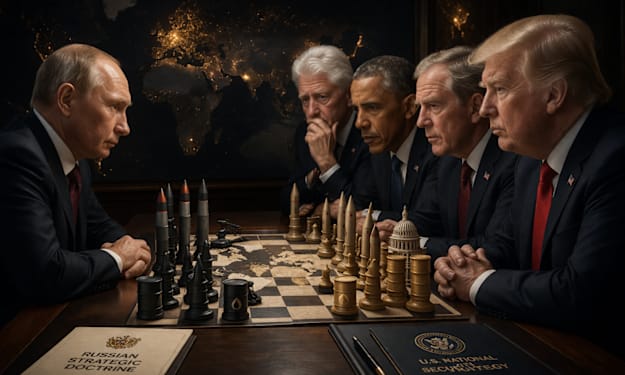
GEOPOLITICAL CHESS: HOW VLADIMIR PUTIN DRAGGED THE WEST INTO A ‘NO-CHOICE GAME’ (An Independent Expert Perspective)
In the 21st century, we are witnessing a paradigm shift in global governance: the transition from a "politicians' game" to a "Grandmasters' arena." Traditional diplomatic summits, official notes, and UN speeches are losing their relevance. The unipolar world order is eroding, and the era of classical politics is coming to an end. The core reality is this: since Vladimir Putin’s ascent in the early 2000s, traditional governance has been replaced by "Intelligence-ocracy" (Razvedkakraiya)—a new world order built on the algorithms of specialized services, now reaching its strategic zenith.
By Бахромжон Суванов4 days ago in Journal
A War beyond borders: Iran vs America and the future of the global economy
The world is at a point where a war is no longer limited to just two countries... but is slowly engulfing the entire global economy. The growing tension between iran and the united states is not only creating political risks but is also affecting global oil prices, businesses, and the food and livelihoods of the poor.
By zulqarnain5 days ago in Journal
India is preparing to embroil Pakistan in a potential conflict on its borders,
India is preparing to embroil Pakistan in a potential conflict on its borders, According to defense and diplomatic experts, relations between India and Israel have been strengthening for the past several years
By Malik Sarfraz Hussain Awan6 days ago in Journal