
The Red Quilt and the Eight-Year Cold
After years of separate beds and my own cold neglect, my wife's choice in the hospital broke my heart.

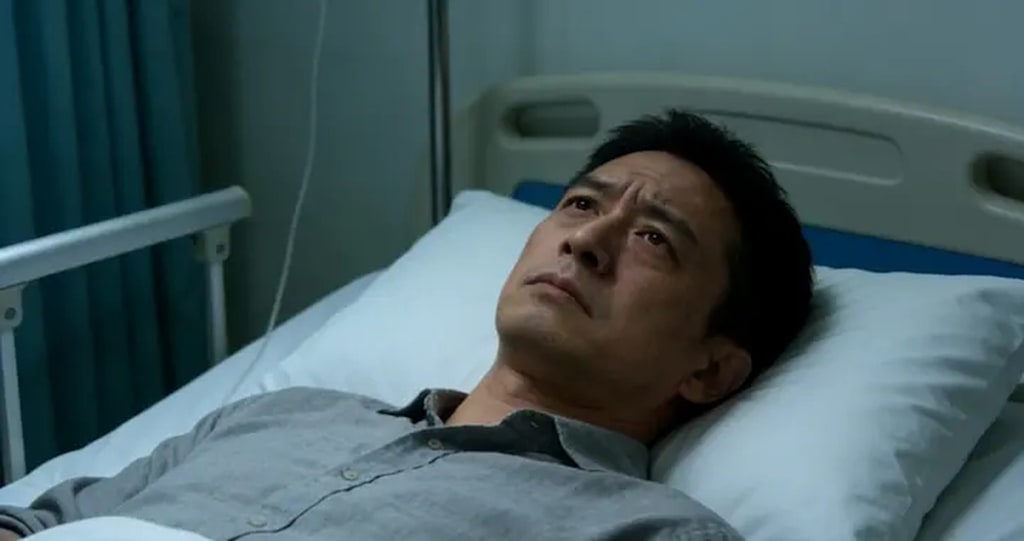
My name is Chen Zhiyuan, fifty-three years old. I have been lying in a bed at the Municipal People’s Hospital for exactly eleven days now.
The ward is quiet. The old man in the next bed was just pushed out by his son for an examination, leaving me alone to stare blankly at the water stains on the ceiling. A needle is stuck in the back of my left hand, and the fluid drips down the IV tube one drop at a time, like rain falling from the eaves of an old house—so slow it makes one restless.
Soft footsteps come from the doorway. Subconsciously, I turn my head; it’s my wife, Zhou Yufen.
She is carrying a thermal container, wearing that same faded dark blue windbreaker. Her hair is tied back in a messy ponytail, with a few stray strands stuck to her forehead from the rush of the journey. She doesn't look at me. She walks straight to the bedside cabinet, sets down the container, and unscrews the lid. The aroma of chicken soup slowly fills the air.
"How are you feeling today?" she asks. Her voice is flat, as if she’s asking about the weather.
"Alright. The incision still hurts a bit," I say.
She gives a brief "mm," ladles some soup into a bowl, and stirs it with a spoon to let the steam dissipate before handing it to me. I reach out to take it, and the moment my fingers brush against hers, she quickly pulls back, turning around to wipe the condensation off the outside of the thermal container.
Watching her back, I suddenly feel a lump in my throat. It’s not from the hot soup; it’s from words that have been held in for too long, stuck there, unable to move up or down.
We have slept in separate beds for exactly eight years.
To outsiders, this is hard to believe. When relatives or friends visit, they see us being polite and cordial. We talk normally and prepare holiday meals together. No one knows that at night, we retreat to our own separate rooms.
The reason for the split wasn't anything earth-shattering. Eight years ago, I lost a huge sum of money in business. I was like a "frost-bitten eggplant"—wilted and defeated. I spent all day on the sofa smoking and drinking, tossing and turning until the middle of the night. She tried to persuade me a few times to look on the bright side, saying that money could be earned back. At the time, I had a foul temper and snapped at her: "What the hell do you know? Stay out of my business!"
She didn't say a word. She turned and went into the bedroom. That night, she moved my pillow and quilt to the guest room bed.
I thought it was just a heat-of-the-moment thing that would blow over in a few days. But the second day, the third day, and then a week passed, and she never mentioned me moving back. I couldn't bring myself to swallow my pride and apologize, so I just stayed in the guest room. At first, I felt a sense of peace—no one to tell me when to sleep or wake, no one nagging me about smoking. But over time, we became like two parallel lines, living separate lives under one roof, rarely speaking.
We ate breakfast separately. Sometimes we’d have dinner together, but there was little conversation at the table. She’d look at her phone, I’d bury my head in my rice, and when we finished, a simple "I'll do the dishes" was the end of it. On the rare occasions we did speak, it was about utility bills or running out of salt—like two roommates sharing a lease.
I thought about moving back, but the words always felt stuck. Once, after a few drinks, I walked to the master bedroom door. My hand was raised to knock, but I lowered it. I stood there for five minutes before turning back to the guest room, tossing and turning, feeling a taste in my heart I couldn't describe.
Eventually, I just got used to it. Habit is a terrifying thing; it can grind the distance between two people into something that feels natural.
Last autumn, she fell ill.
She came home from work that day looking pale, telling me she had a splitting headache and no energy. I was sitting on the sofa looking at my phone; I didn't even look up. I just said, "Then go to bed early."
She stood there for a moment, silent, then turned and went into the master bedroom.
The next morning, passing the master bedroom on my way to the bathroom, I heard her coughing—fit after fit of heavy coughing. I hesitated, then knocked and asked if she needed to go to the hospital. She said no, she’d taken medicine. I said "fine then" and left.
She took a few days off work and stayed in her room. I went about my business, buying only enough groceries for myself and eating my noodles in the guest room. Occasionally I’d send a WeChat asking if she was better; she’d say she was, so I didn't ask further.
Looking back now, I was a real bastard.
Later, her older sister came over. Seeing her with a high fever, her face flushed and having lost weight, the sister flew into a rage. She yelled at me: "Chen Zhiyuan, are you blind? Can’t you see she’s burning up? Do you have a shred of conscience left?"
I stood in the living room, unable to say a single word. Her sister took her to the hospital. It was pneumonia; she was hospitalized for seven days. During those seven days, I only went twice. Each time I stayed less than half an hour, claiming I couldn't leave the shop.
In truth, the shop was fine. I just felt awkward sitting there, not knowing what to say. Lying in the hospital bed, she showed no expression when she saw me—neither cold nor warm—which made it even harder for me to stay.
After she was discharged, our relationship grew even colder. Before, we at least ate at the same table; now, we didn't even do that. She would take her food to the master bedroom, wash her own dishes, and live like we were separated by a wide river despite being under the same roof.
I thought this was how the rest of our lives would be—two people just "getting by" together, owing each other nothing, just enduring until the end.
Until last month, when I went down.
It started as back pain. I didn't take it seriously, thinking I’d just been sitting too long. But it got worse until one morning I couldn't even move my legs. A hospital checkup revealed a herniated disc compressing a nerve. I needed surgery and at least half a month in the hospital.
Lying in the ER observation room, alone, staring at the ceiling, I suddenly felt a wave of panic. I wasn't afraid of the surgery; I was afraid of having no one to look after me.
I called my younger brother. He came, got me settled, and paid the deposit. But he has his own life; he couldn't stay every day. Lying there, I scrolled through my contacts several times. When I reached her name, my finger stopped.
Eight years of separate beds. I didn't care for her when she was sick. What right did I have to ask her to come?
In the end, my brother called her. When he told me, I pretended to be asleep, but my ears were pricked. There was a long silence on the other end—so long I thought she would say "it's none of my business." Finally, she only asked: "Which ward?"
She came the next day.
I expected a cold face, or a few biting words. I would have accepted her saying "you deserve this." But she said nothing. She just started tidying up the moment she walked in. She organized the mess on my nightstand, filled the thermos, went to the nurse's station to ask about precautions, and came back to write them down line by line in a small notebook.
Lying there, watching her back, I realized she had grown much thinner. Her waist was smaller, and the white hairs at the back of her head were piercingly bright under the lights. My heart felt like it was being squeezed; it was an unbearable ache.
During these eleven days, she has arrived at 6:00 AM and stayed until 8:00 or 9:00 PM. She brings me food, helps me turn over, assists me to the bathroom, empties my urinal, and wipes my body down. As she does these things, her expression is calm. There is no impatience, but no overt tenderness either—it’s as if she is simply doing what is "only natural."
She made dumplings—leek and egg filling, my old favorite. She remembered. She takes my dirty clothes home to wash and brings them back neatly folded. Fearing I’d be bored, she updated the web novel app on my phone and even paid for a premium membership.
Once, waking in the middle of the night, I found her asleep by the bed, still clutching the thermos. By the dim light from the hallway, I looked at her face. Her brow was slightly furrowed, her lips chapped, her skin much coarser, and the wrinkles at the corners of her eyes were deep enough to hold a needle. A nameless feeling surged in my chest—not just gratitude, but a profound heartache and a guilt that was eight years overdue.
I wanted to reach out and touch her hair. My hand made it halfway before I pulled it back.
What right did I have?
Yesterday afternoon, we were the only ones in the ward. She sat by the bed peeling an apple. The peel came off thin and long, in one continuous spiral. I watched the knife and the fruit, and suddenly I spoke.
"Yufen."
"Mm?" She didn't look up.
"Those years... that time you were sick and I didn't take care of you. Do you hate me?"
The knife paused for a second, then continued. The peel broke and fell to the floor.
"What's the use of hating?" she said softly. "Hating you wouldn't make you feel the pain."
My nose stung. I tried to hold it back, but the tears betrayed me anyway. I turned my head to look out the window at the gray sky, where a few sparrows hopped around on the outdoor AC unit.
"I'm sorry," I said. My voice was so small I wasn't sure she even heard it.
She didn't say anything. She put the peeled apple on a plate by my hand and used a tissue to pick up the peel from the floor. When she bent over, I saw a red rash on the back of her neck—likely from the exhaustion of the past few days.
She threw the peel in the trash, straightened up, and looked at me. There was no resentment in that look, no blame, and none of that "see, you finally got what was coming to you" satisfaction. She just looked at me calmly, like looking at a child who had done something wrong and didn't know how to make amends.
"Just focus on getting better first," she said. "We can talk about 'later' later."
Later. She said "later."
I thought there was no "later" left for us.
When she came this morning, she brought a quilt from home, saying the hospital blankets were too thin and she was afraid I’d be cold at night. I recognized that quilt. My mother made it for us when we got married—bright red silk embroidered with a dragon and phoenix for good fortune. It’s been used for nearly thirty years; the red has faded, but the cotton is high quality and exceptionally warm.
This quilt had been tucked away in the master bedroom closet. She had dug it out.
Feeling the coarse embroidery, I suddenly remembered when we were first married. In the winter, she was always cold and would tuck her feet under my legs for warmth. I would shiver from the ice, and she would just giggle. Those were good times. We were poor, but two people squeezed onto one bed, sharing one quilt—our hearts were close.
When did it start to change?
Was it the business failure? Or earlier? I can't remember. I only remember acting like a total jerk, giving her all of my bad temper and treating my coldness as a given. It’s not that she didn't try; she advised me, she tried to pull me back, but I was the one who kept retreating until I didn't even enter her room anymore.
And her? During my worst moments, when I ignored her entirely, she didn't scream or make a scene. She just quietly lived her life. I thought she didn't care anymore, that she was indifferent. Now, lying here watching her hands busy themselves for my sake, I finally understand—she didn't stop caring; she just swallowed all her grievances. She swallowed them for eight years.
Yesterday, a nurse came to change my dressing. Seeing Yufen washing my feet, the nurse couldn't help but say, "Ma'am, it’s not easy for you, serving him like this every day." She just smiled and said, "We’re a married couple. It’s only right."
"It's only right."
Those three words were like a knife carving into my heart.
What right did I have to let her feel it was "only right"? I hadn't even poured her a glass of water when she was sick.
After she left last night, I lay there alone, replaying the last eight years over and over. I thought of the day she went to the hospital alone, the way she kept her head down while her sister scolded me, and how she spent eight years eating and sleeping alone. And I had complacently thought: this is just life, we're just getting by.
I am truly an animal.
She brought me lunch today—millet porridge and steamed egg custard, soft and easy for my current appetite. After I finished, as she was clearing the dishes, I mustered the courage to say: "Yufen, when I get out of the hospital, I’ll move back to the master bedroom."
Her hands paused for a few seconds before she continued putting the bowls into the thermal container.
"Don't read too much into it. I just think... the window in the guest room leaks air. It's cold in the winter," I added, feeling stupid as soon as the words left my mouth.
She capped the container, picked it up, and paused at the door. Facing away from me, she said one thing:
"Wait until you're well. Then we'll see."
The door closed, and the sound of her footsteps faded away. Lying in the hospital bed, smelling the faint scent of mothballs from the red quilt, the tears came again.
I knew she didn't say I couldn't go back, but she didn't say I could either. She is still watching, still testing, still afraid to easily trust a man who has disappointed her for eight years.
I don't blame her. If I were her, I wouldn't trust me either.
The sky outside is darkening. The smell of the hospital cafeteria food wafts through the hallway, mixed with the scent of disinfectant, feeling strangely reassuring. I picked up my phone, hesitated for a long time, and sent her a WeChat:
"Take it slow on the road. Let me know when you're home."
About ten minutes later, she replied with one word:
"Okay."
Just one word. But I stared at it for a long time, feeling it was the best word I’ve ever received in my life.
I don't know if I can make up for these eight years of debt, or if we can ever return to how we were. But I know that this time, I won't turn away again.
The days ahead are long. We'll take it slow.
— Chen Zhiyuan, Orthopedic Ward, Municipal People’s Hospital, Night.
About the Creator
Water&Well&Page
I think to write, I write to think
Keep reading
More stories from Water&Well&Page and writers in Humans and other communities.
The real target Russia could attack next
As concerns grow over the future of European security, a new and provocative assessment is reshaping how analysts think about a potential conflict between Russia and the NATO. While much of the focus has traditionally been on the Baltic region, some experts now believe the first move in such a conflict might come elsewhere—specifically, against Germany.
By Shirley Oyiadoma day ago in Humans
The Portrait of Matteo
Seventeen-year-old Manny got off a public bus at a busy intersection in downtown Philadelphia. When the bus released its brakes and passed his narrow view, he checked whether the art museum across the street was still there. He had been visiting it every day that week but wondered for a second the veracity of its presence. Now, the spring sun betrayed its gray highlights, giving it a warm glow.
By Paul Aaron Domenick7 days ago in Fiction



Comments (1)
WOW, I grew up in Korea and Japan and am part Han Chinese. I love how you write.