
The Island Where Childhood Is Shadowed by Despair
Inside the Pacific nation where isolation, uncertainty, and hardship have driven children toward alarming levels of self-harm

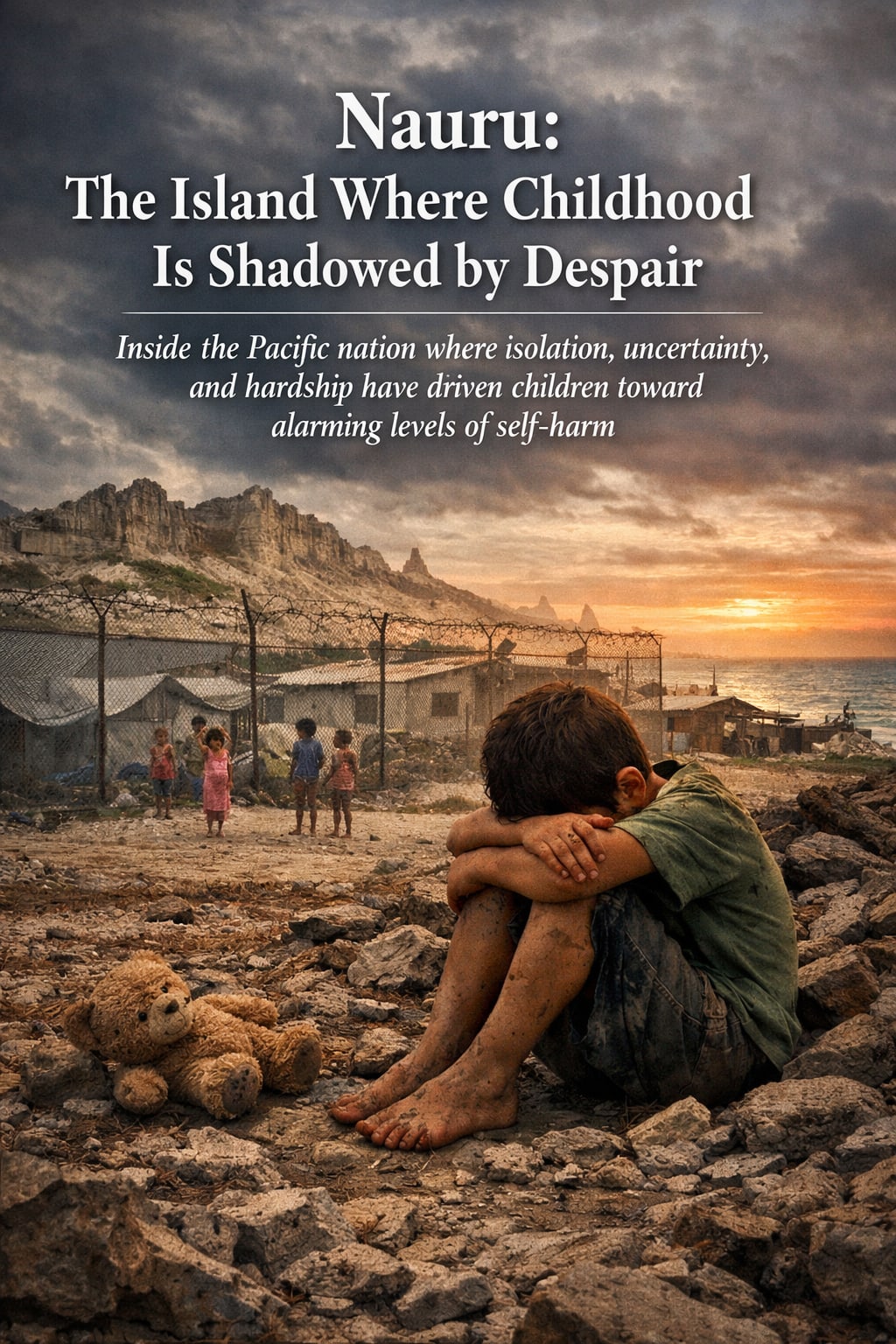
In the heart of the Pacific Ocean lies Nauru, one of the world’s smallest and most isolated island nations. Known once for its phosphate wealth, the country now faces a deeply troubling humanitarian reality—one that has captured global attention for all the wrong reasons. Reports of children attempting self-harm and suicide have raised urgent concerns about the mental health crisis unfolding on this remote island.
Nauru’s modern history is marked by dramatic economic and environmental shifts. During the 20th century, the island experienced a brief period of prosperity due to extensive phosphate mining. However, decades of extraction left much of the land barren and uninhabitable, crippling the country’s economy. Today, limited resources, high unemployment, and geographic isolation have created difficult living conditions for many residents.
The situation became even more complex when Nauru entered into agreements to host offshore detention centers for asylum seekers attempting to reach Australia. For years, hundreds of refugees—including families with young children—were held on the island under uncertain legal status. While many have since been relocated, the psychological impact of prolonged detention, combined with limited access to mental health support, has left lasting scars.
For children, the consequences have been especially severe. Growing up in an environment marked by uncertainty, restricted opportunities, and social tension can deeply affect emotional well-being. Many young people on Nauru, particularly those in refugee communities, have faced prolonged periods without access to proper education, stable routines, or a sense of future security.
Mental health professionals have pointed to a combination of factors contributing to the crisis. Isolation is one of the most significant. Nauru’s remote location makes it difficult to access specialized healthcare services, including child psychologists and psychiatrists. For children experiencing trauma, anxiety, or depression, the lack of timely and adequate support can lead to worsening conditions.
Additionally, the experience of displacement has left many refugee children struggling with identity, fear, and hopelessness. Having fled conflict or persecution in their home countries, they often arrive with existing trauma. On Nauru, instead of finding stability, they encounter prolonged uncertainty about their future. This can lead to feelings of abandonment and despair, even at a very young age.
Reports from human rights organizations and medical professionals have documented alarming patterns of behavior among children on the island. These include withdrawal, refusal to eat or speak, and in extreme cases, attempts at self-harm. Such actions are often described as expressions of profound distress rather than a desire to die—a way for children to communicate pain when words fail them.
Local communities and aid organizations have made efforts to address the crisis, but challenges remain. Limited infrastructure, funding constraints, and the island’s isolation continue to hinder large-scale intervention. While some mental health services have been introduced, experts argue that more comprehensive and sustained support is urgently needed.
Education also plays a critical role in shaping a child’s sense of hope and purpose. On Nauru, disruptions to schooling—particularly for refugee children—have contributed to feelings of stagnation and frustration. Without access to consistent, quality education, many children struggle to envision a future beyond their current circumstances.
Despite these difficulties, there are voices calling for change. Advocacy groups, international organizations, and former detainees have brought global attention to the issue, urging governments to prioritize the well-being of children. They emphasize the need for humane policies, improved living conditions, and accessible mental health care.
The story of Nauru is not just about geography or politics—it is about children growing up in conditions that challenge their resilience at every turn. It is a reminder that behind policy decisions and international agreements are real human lives, shaped by circumstances beyond their control.
Addressing this crisis requires more than temporary solutions. It calls for long-term commitment, international cooperation, and a focus on restoring dignity and hope to those affected. For the children of Nauru, the future should not be defined by despair, but by the possibility of healing, growth, and opportunity.
As the world becomes increasingly aware of their struggles, there is a growing responsibility to act. Because every child, no matter where they are born, deserves not only to survive—but to hope, to dream, and to live without fear.
About the Creator
Irshad Abbasi
Ali ibn Abi Talib (RA) said 📚
“Knowledge is better than wealth, because knowledge protects you, while you have to protect wealth.
Keep reading
More stories from Irshad Abbasi and writers in Humans and other communities.
Myth, Reality, and the Stories Behind the Label
Across Europe, many cities are known for their culture, architecture, and history. Some are famous for their universities, others for their industries or tourist attractions. But there is a curious story often told in travel circles about a place jokingly called “the city of idlers.” It is not an official title, but rather a nickname given by travelers and writers who noticed the unusually slow, relaxed rhythm of life there.
By Irshad Abbasi 5 days ago in Humans
My First Time Skiing and I Got Lost, Alone, in the French Alps
Looking back, I can trace some of my life’s biggest adventures to a simple action from my sister. She’d introduced me to Tommy (a very long time ago), a colleague of hers, who had overshared his penchant for Italian-looking women, and I ticked that box.
By Chantal Christie Weiss5 days ago in Humans
Practical Advice For Singles Determined To Overcome Modern Dating Struggles
Contemporary dating implies certain challenges, including success at using the Internet and dealing with unmet expectations. Singles can be left frustrated and emotionally exhausted by too many options, ghosting, and lack of continuity in communication.
By Mark Hipster4 days ago in Humans
A Transparent Look at Vocal Challenges and Top Stories
Almost three years ago, we shared a resource article that served as a place for people to suggest new challenge prompts. We thought it would be a good idea to refresh that thread, and take the opportunity to answer a few common questions about top stories, how challenges are judged and how submissions are reviewed.
By Vocal Curation Team6 days ago in Resources


Comments
There are no comments for this story
Be the first to respond and start the conversation.