
Book Review: "Henry VIII: King and Court" by Alison Weir (Pt. 3)
Chapter 9 to Chapter 11


There were so many rules for manners, especially in the presence of the king. Public processions, routines and ceremonies for waking and sleeping, trumpets blaring for eating and feasting. I don't know how people kept up. Alison Weir states that practically everything was a ceremony, everything had a set of rules and regulations of what was to be done. The rigid routine was so careful that every single person in the room had a job to do and there were a lot of people there.
I think I was most surprised about the feast days on which the saints were celebrated and so, his subjects could come and watch him eat with guests. I'm not sure why you would want to do this but each to their own. Also, allow me to comment on the fact that previously, we were witnessing a man who had spent all of his inheritance and was running out of money so decided to be less wasteful. I think the theme is that he doesn't really know what 'less wasteful' means because dear god, there's so many people and so many ceremonies and so much food, and so many needless entertainments. There's just so much it makes one feel sick.
Alison Weir tells us these people would eat peacocks and they would be served redressed with their plumage in order to be served in a beautiful way, normally making the main event of a feast. I am disgusted (it’s too pretty to eat). But I also wonder what a peacock would taste like. I can imagine it would be either chicken-like or game-like. Though I don't think I would ever eat a peacock. I'm not sure I could stomach it.
There was a difference between feasts (in which dinner would be eaten by all the guests) and banquets (in which dessert foods of the best and rarest kinds would be eaten in a banqueting house by the guests invited by the King) and all of this could take several hours. All of this required fanfare when the food was served, people were brought out to ceremonially present the foods and everything became spectacle and performance. All these people needed to be paid and again, we are reminded that this was not a man who was not wasteful. In fact, he was the exact opposite.

We then learn about the ceremonial waking and dressing of the King in which he would be dressed in new clothes washed in herbs - this would be a whole ordeal in which ushers and servants were present but were not allowed to be too hasty because that was bad manners towards the King. I swear to god. Alison Weir is very knowledgeable but dear god this is too much. There was several people involved in this operation and that is literally just a very small part of the morning.
Even when he ate his meals by himself, there was still great ceremony about his food - serving him on “bended knee”. And of course there was a whole ten-man operation for changing the sheets of the bed which seemed to start with stabbing it in order to make sure there was nobody underneath waiting for the King. Alison Weir, I'm crying please stop this man from spending any more money.
For the first few years of his reign he was at the mercy of the men his father had left behind and thus, was constantly reminded of old age and death which disgusted him. Though he was a scholar, Alison Weir stated that Henry hated paperwork and writing and wanted to pass it off on to someone else. He would often quit talking to people or put off political conversation in order to go dancing and feasting. It is through this that we learn about the Privy Chamber and who was assigned to various jobs at Westminster - all men chosen by the King.
The Master of the Revels is a great part - it was all about organising entertainment and pageants. It seems like a lot of fun but I don’t think that there was a time that this King really thought about money and for that reason, he died in debt. We are constantly reminded of the masses and masses of people working on costumes and props and foods and drinks, banquets and state affairs, ceremonies and dressings - all of this costs so much money and wastes so much it is honestly disgusting. At least the Master of the Revels is interesting enough. I mean, I was just trying to think about how much it would waste. There's even people making paper mache animals to use in the plays. It is so strange.
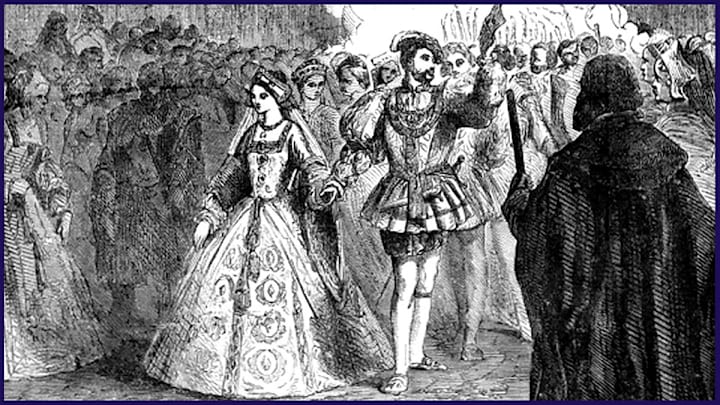
Alison Weir then tells us stories of people who wrote plays for the court and one who nearly was executed by the courts, but the King loved his work so much - he didn’t want him executed after all. Imagine being saved from execution because your plays were loved by the King. It is both a great redemption and a great amount of pressure because if you write something the King doesn't like, execution is always an option. All of this entertainment involved dancing and so, it became essential for all gentry and aristocratic folk would have to learn the different dances. The author then takes us through the different dances, normally from Italy with a large diversity of rhythms - they were often quick with tons of leaping and singing but would always end with a bow to royalty. When it comes to gambling (as was the custom), Wolsey and the King had to intervene to stop people losing too much money, putting caps on who was allowed to bet and how much. Again, this was rarely heeded.
The people closest to the King were the members of the Privy Chamber and Alison Weir takes us through what it is, who they are and what they did. They were the people who had daily access to the King, advising him on all different aspects of his life as well as being his closest friends. There are so many people who work in the King’s personal life that you could think that this King was at any time, about to be murdered - Alison Weir takes us through everyone from the people who watched over the King whilst he slept to the person who was assigned to accompany him to the bathroom (named ‘The Groom of the Stool’). I found this increasingly interesting but honestly, it seems to be both grand and exhausting to have this many people around you all the time. I would need my alone time often and would probably end up killing someone if I was in this situation.
The members of the Privy Chamber would live near the King just in case he needed them and so, you can imagine why there were so many rooms everywhere in these palaces. We learn about cupbearers, jousters and the other people around Henry who knew him so well that they might has well have been related to him (and some were often mistaken for being so as they even looked alike). There were so many laws and regiments for who can sit with the King and who must be accompanied to do so, there were so many different levels of class within classes, titles and peerages. The King definitely encouraged others to copy his extravagance which meant that being wasteful became a status symbol - something that is quite different to a King who ran out of inheritance money and so, was starting to cut back.
Alison Weir defines that a gentleman’s pursuits would change from simply being born into money to having intellectual pursuits as well. These included poetry and scholarly practice, something that only a few years before would not have been considered important or meaningful. Perhaps the example of the King who enjoyed these things made the aristocrats change their ways. This is both a good thing and a bad thing. It’s great because more people are reading and writing, but then education becomes an elitist sport rather than anything more, especially when private education gets underway with only the rich children being taught various things that can help them gain agency in the world.
Gosh this part was long, I had a lot to say and I hope you're going to stick around for the next parts. I'm sorry it's so long but there is really a lot to take in here and of course, I won't stop complaining about the spending crisis this man is in and not helping himself with.
About the Creator
Annie Kapur
I am:
🙋🏽♀️ Annie
📚 Avid Reader
📝 Reviewer and Commentator
🎓 Post-Grad Millennial (M.A)
***
I have:
📖 300K+ reads on Vocal
🫶🏼 Love for reading & research
🦋/X @AnnieWithBooks
***
🏡 UK
Keep reading
More stories from Annie Kapur and writers in Geeks and other communities.
Book Review: "Henry VIII: King and Court" by Alison Weir (Pt. 2)
There's already a lot we know about the young prince Henry and we even have a flavour of how he grew up and was basically raised to be the most entitled brat in England. Be that as it may, he had a lot of knowledge and was actually incredibly clever when it came to scholarly studies, languages and as it happens, masonry and interior design as well. Alison Weir tells us all about the way the King decorated places like Hampton Court to show off his wealth, draping the walls with fine woven textiles and making decorative glass to depict his noble lineage. This was all part of the theatre of royalty, the propaganda that Henry VIII was so good at during the time, it almost made people forget that he had two of his wives killed and one was not even 20 years' old at the time.
By Annie Kapura day ago in Geeks
Simpsons Review: "So It's Come to This: A Simpsons Clip Show"
Happy April Fools' Day, all! It's been a while since I've written a review of a Simpsons episode, and with today being the aforementioned holiday, I just have to talk about this episode. It's a landmark episode, in more ways than one, so let's get to it.
By Clyde E. Dawkins5 days ago in Geeks
The Valley Season 3 Episode 1 Recap
Summary: New additions Lala Kent and Tom Schwartz struggle to find their footing Kristen Doute navigates postpartum exhaustion while Luke complains about intimacy Brittany Cartwright fails as both host and friend Michelle and Lacy rehash unaired scenes
By Zuleika Boekhoudt4 days ago in Geeks




Comments
There are no comments for this story
Be the first to respond and start the conversation.