science
Topics and developments in science and medicine, presented by Futurism.
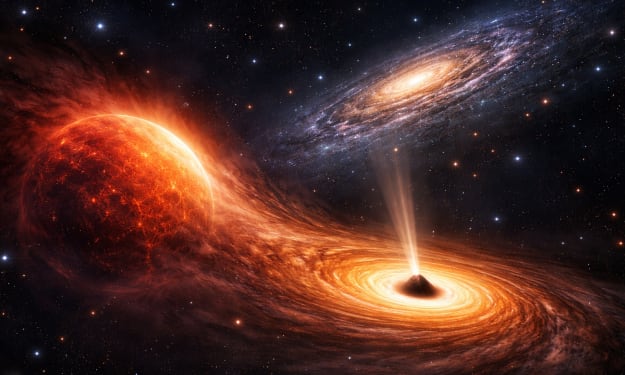
An unidentified space object was observed "screaming" out of our galaxy at a speed of more than one million miles per hour.
Although our Sun appears to be the center of the universe, it is actually moving at a speed of around 500,000 miles per hour as it circles the Milky Way galaxy. That's quick, but it pales in comparison to a star runaway that was just found and is speeding across space.
By Francis Dami9 days ago in Futurism
Beyond the Spark. AI-Generated.
Introduction: The Silent Reservoirs of Potential The universe is replete with systems that quietly store vast amounts of energy, often beyond immediate perception. From the electromagnetic fields within our electrical grids to the tectonic stresses locked in Earth's crust, these reservoirs of potential energy are maintained in delicate balances—metastable states—until a trigger causes them to unleash catastrophic cascades. Recognizing and understanding these reservoirs is crucial, not merely as a theoretical exercise but as a window into the subtle vulnerabilities of our technological and natural environments.
By Peter Thwing - Host of the FST Podcast10 days ago in Futurism
When a Spark Becomes a Storm. AI-Generated.
Section 1: The Hidden Reservoirs of Potential Energy — The Underlying Foundations of Catastrophic Failure At the core of systemic vulnerability lies a fundamental, often overlooked principle: complex, large-scale systems—be they electrical grids, geological formations, chemical stores, or atmospheric phenomena—are capable of harboring enormous quantities of stored potential energy. This energy is often invisible, silent, and contained within the physical structure or state of the system, maintained in a metastable equilibrium by control systems, environmental conditions, or natural processes.
By Peter Thwing - Host of the FST Podcast10 days ago in Futurism
When a Neuroscientist Turns Brain Signals Into Music
For decades, the idea that music could be created directly from the human brain has lived comfortably in the territory of science fiction — the kind of futuristic concept more commonly found in cyberpunk novels or speculative technology films. In those stories, humans connect directly to machines, thoughts become data, and creativity merges with technology in ways that feel both thrilling and unsettling.
By Navigating the World10 days ago in Futurism
Silicon Supremacy: Why the iPhone 18 Pro is the Architectural Shift We’ve Been Waiting For
1. Introduction: The Evolution of Pro Every year, the tech zeitgeist asks the same recurring question: "Is this the year to upgrade, or should I hold out for the next leap?" While the silhouettes of the iPhone 18 Pro and Pro Max—slated for their traditional September debut—may feel familiar, our intelligence regarding Apple’s silicon and hardware roadmap suggests we are standing on the precipice of a massive architectural shift. This isn't just another "S" year; it is a calculated pivot where internal engineering triumphs over external gimmicks, signaling a new era of professional-grade mobile computing.
By Tech Horizons10 days ago in Futurism
The Quataloid Escape:
Out in the Nevada desert, the night air cools fast after sunset. The wind whispers across the empty land like it’s carrying secrets from another world. If you ever find yourself driving near Area 51, you’ll see warning signs, floodlights, and miles of silent desert.
By Shahjehan Khan 11 days ago in Futurism
How I Turned One Automation Prompt Into a Tiny AI Business That Runs Itself
I turned a single, well‑designed automation prompt into a tiny AI business that runs almost entirely on autopilot: buyers find it, pay for it, get onboarded, and start using it with almost no involvement from me. The entire system is a prompt + a few no‑code workflows. In this article I’ll walk through how I did it, what I’d do differently, and how you can build your own AI automation asset without writing a line of backend code.
By abualyaanart11 days ago in Futurism
The “Silent Collapse” of a Star: A New Type of Stellar Death Discovered in Andromeda
For more than a century, astronomers believed that the death of a massive star was always one of the most dramatic events in the universe. When a giant star exhausts its nuclear fuel, its core collapses under gravity and the outer layers explode outward in a spectacular supernova. These explosions are so powerful that, for a brief time, a single star can shine brighter than an entire galaxy.
By Holianyk Ihor11 days ago in Futurism