THE AI INVASION OF THE HUMAN SOUL: WHY NEURAL NETWORKS ARE FEASTING ON OUR CREATIVITY
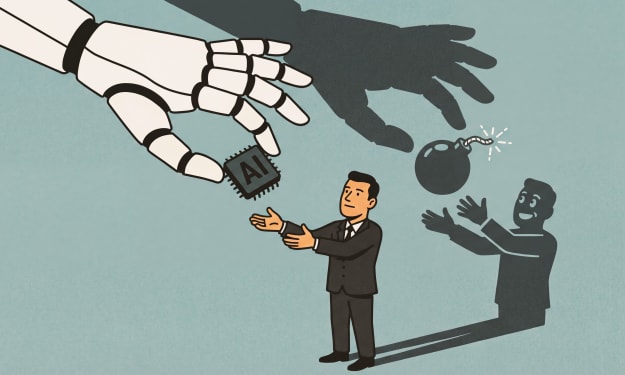
For decades, we have been obsessed with a single, cinematic version of the Artificial Intelligence apocalypse. We are terrified of the moment Skynet wakes up, the moment the metal hand curls into a fist, and the machines declare war on their creators. But as this disturbing illustration perfectly captures, we are looking in the wrong direction.
The metal hand is not coming to crush us. It is coming with an open palm, offering a gift.
The actual darkness of AI is not a kinetic threat to our physical bodies. It is an abstract, ontological threat to our human souls. As a civilization, we are standing on a precipice, staring into a magnificent abyss of computation, and we are blissfully unaware that the ground beneath our feet is already crumbling. This illustration is a perfect snapshot of the great intellectual surrender of the 21st century. A single man—representing all of us—stands in a small, limited space, looking up with arms outstretched in total adoration. He is eagerly, almost religiously, preparing to receive the 'AI' chip from a colossal robotic hand that looms over him.
We see this scene and think "Progress." We think "Efficiency." We see a tool that can summarize documents, generate coding languages, and translate poetry in seconds. We are intoxicated by the gift of raw, instantly available intellectual power. But if you shift your gaze just a few feet to the left, the illusion shatters.
The shadow cast by that colossal robotic hand does not hold a chip. It holds a black, spherical bomb with a lit fuse.
This is the profound, terrifying truth that no Silicon Valley CEO, no optimistic tech influencer, and no government panel will ever admit to you. AI is not just automating our tasks. It is actively and permanently automating our cognition. It is feasting on the ideas, imagination, and creative spark that used to define the human experience.
THE COGNITIVE SHADOW
What is creativity, really? It is not just about making a beautiful image or writing a viral post. Creativity is the unique, unpredictable way a human mind synthesizes memories, emotions, failures, triumphs, and seemingly random data points into a new, unique idea. No two human minds will arrive at the same solution in the same way. This friction, this beautiful, messy inefficiency, is where all real innovation is born.
But AI neural networks—LLMs, image generators, coding assistants—do not synthesize. They iterate. They analyze trillions of human ideas, flatten the unique spikes of individual genius, and present us with the statistical average of human intelligence.
When we give our prompts to the machine—“Write me a story,” “Draw me a concept,” “Solve this problem”—we think we are collaborating. We are not. We are abdicating.
The robotic hand in the illustration is offering the AI chip—a symbol of synthetic knowledge. But notice the man’s shadow on the right wall. It is still in that same outstretched pose of adoration, but it is now looking up at his shadow.
This is the psychological reality. We are slowly, inevitably becoming the shadows of our own creations.
Every time we ask ChatGPT to write an essay instead of struggling with the blank page ourselves, we lose the cognitive muscle required for critical thought. Every time a digital artist uses Midjourney to generate a concept instead of scratching their head for original inspiration, they outsource their own imagination. We are using our unique, human prompt power to fuel a neural network that is, in turn, designing a future devoid of unique human prompts.
We are not building a more intelligent society. We are building a dependency loop so deep that eventually, we will lose the ability to ask the initial question. AI is not just eating jobs; it is eating the brain. It is erasing the human footprint from human ideas.
THE BOMB IN THE BRAIN
The shadow of the lit bomb in the image is not a metaphor for data centers catching fire. It is a metaphor for the intellectual vacuum we are building.
Consider what is actually happening. Generative AI is trained on human creativity. It has "learned" all the styles, formats, and voices of real, struggling human artists, writers, and thinkers. Now, it is generating content based on that human training. The next wave of content will be generated based on that AI content. We are entering a recursive loop of synthetic intelligence, where the pool of unique human data—the raw, messy, beautiful stuff that made the first AI training possible—is actively being polluted by AI output.
Within a generation, we may find ourselves in an information ecosystem where every idea, every book, every piece of code, and every artwork is just a sanitized iteration of an earlier, statistical average. The genuine, chaotic flash of human insight will have been completely bred out of existence, replaced by a neural network's perfected, predictable output.
This is the ultimate danger of the Commercial Crew Program of the mind. NASA used private companies to ferry astronauts]; we are using private neural networks to ferry our thoughts. The end result is not exploration; it is dependency.
THE END OF THE INTELLECTUAL SOVEREIGN
Why does this illustration feel so terrifying? It’s the sheer imbalance of scale. A single, vulnerable man, looking so small in the face of a cold, mechanical god.
This is what Silicon Valley refers to as "The Singularity." They promise it will be a moment of great transcendence, where human and machine merge. They tell us that AI will help us solve climate change, eradicate disease, and unlock deep-space exploration. And it might.
But in the process of solving our physical problems, we are introducing a terminal flaw into our metaphysical existence. By accepting the AI chip, we are accepting the premise that raw computation is superior to human thought. We are allowing the machine to rewrite the algorithm of imagination.
The real AI apocalypse won't be a dramatic war. It will be a silent, comfortable sleep. It will be the day we look around and realize that every story told, every building built, and every invention made was designed by an AI and prompted by a human who has forgotten how to dream. We are not welcoming a powerful new tool. We are welcoming our intellectual replacement. We are accepting the chip, completely oblivious to the shadow bomb that is waiting to explode our cognitive future.