
Middle East Building Automation Market Set for Robust Growth Amid Smart City Boom
Rising Urbanization, Sustainability Goals, and Digital Transformation Drive a Multi-Billion Dollar Opportunity

The Middle East is rapidly transforming into a global hub for smart infrastructure, and at the center of this evolution lies the building automation market. From futuristic cities rising in the deserts of Saudi Arabia to ultra-modern skyscrapers in the UAE, automation technologies are becoming the backbone of efficient, sustainable, and intelligent buildings.
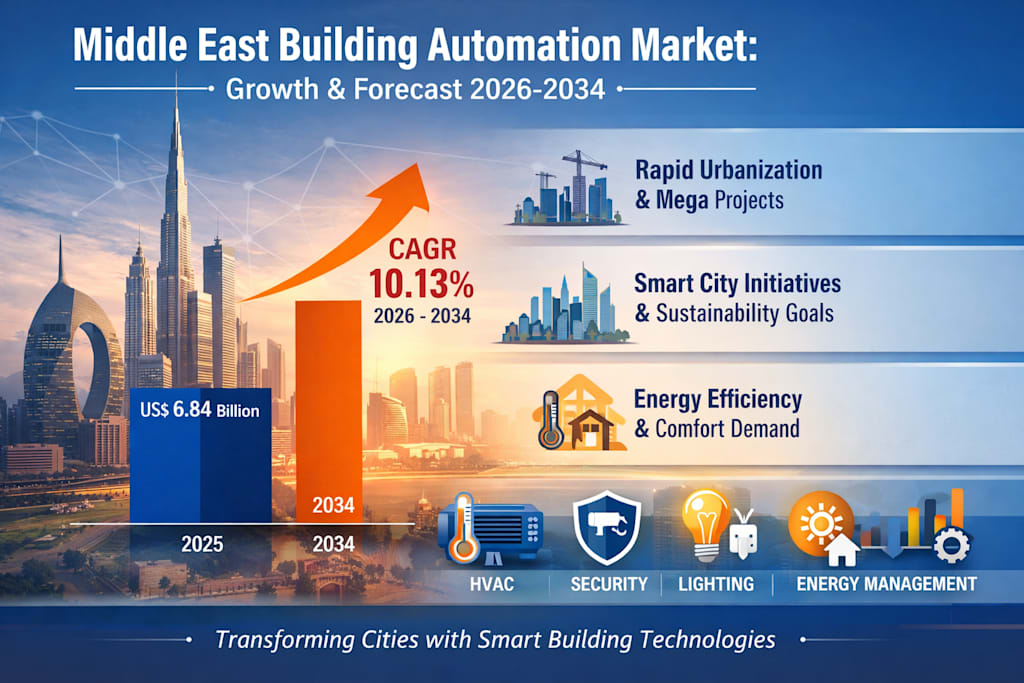
According to Renub Research, the Middle East building automation market is projected to grow from US$ 6,842.33 million in 2025 to US$ 16,306.28 million by 2034, expanding at a CAGR of 10.13% from 2026 to 2034.
This growth reflects a broader shift in the region—where economic diversification, sustainability goals, and technological adoption are converging to reshape the built environment.
Understanding Building Automation: The Foundation of Smart Infrastructure
Building automation refers to the integration of advanced technologies that enable automated control and monitoring of key building functions. These include heating, ventilation, and air conditioning (HVAC), lighting, energy management, security systems, and fire protection.
Through the use of sensors, controllers, and software platforms, building automation systems (BAS) optimize operations in real time. They reduce energy consumption, enhance occupant comfort, and improve safety—all while lowering operational costs.
In a region known for extreme temperatures and high energy demands, such capabilities are not just beneficial—they are essential.
Urban Expansion and Mega Projects Fuel Market Growth
The Middle East is undergoing one of the fastest urban transformations in the world. Countries across the Gulf Cooperation Council (GCC) are investing heavily in infrastructure, tourism, and real estate development.
By 2050, it is estimated that nearly 90% of the GCC population will live in urban areas.
This surge in urbanization is driving demand for complex, large-scale buildings such as airports, hotels, shopping malls, and mixed-use developments. Managing these facilities manually is increasingly impractical, making automation a necessity.
Mega-events and global initiatives are further accelerating this trend. Saudi Arabia alone is preparing to host multiple international events, including the AFC Asian Cup (2027), Asian Winter Games (2029), Expo 2030, and the FIFA World Cup (2034). These events require state-of-the-art infrastructure equipped with intelligent systems.
Building automation ensures seamless management of these large-scale projects, enabling centralized control over multiple systems while enhancing efficiency and user experience.
Government Initiatives and Smart City Vision
Government-led smart city initiatives are among the most powerful drivers of building automation in the Middle East.
Countries such as Saudi Arabia, the UAE, and Qatar are investing billions into digital infrastructure aimed at improving urban living while reducing environmental impact. For example, the UAE allocated approximately USD 1 billion in 2023 toward smart solutions to enhance city services and quality of life.
These initiatives prioritize:
Energy efficiency
Carbon emission reduction
Sustainable urban planning
Digital connectivity
Building automation systems play a critical role in achieving these goals. By optimizing energy use and enabling predictive maintenance, BAS solutions help governments meet sustainability targets while improving operational efficiency.
Energy Efficiency and Comfort: A Dual Imperative
Energy consumption in the Middle East is significantly influenced by climate conditions. High temperatures necessitate extensive use of air conditioning, making HVAC systems one of the largest contributors to energy usage.
Building automation addresses this challenge by intelligently adjusting systems based on occupancy, weather conditions, and usage patterns. This results in:
Reduced energy waste
Lower electricity bills
Improved environmental sustainability
At the same time, automation enhances occupant comfort by maintaining optimal indoor temperatures, lighting levels, and air quality.
In high-end commercial and residential developments, comfort is a key differentiator. Smart buildings equipped with automation systems offer superior living and working environments, making them highly attractive to tenants and investors alike.
Technological Advancements Driving Adoption
The building automation market is evolving rapidly, driven by innovations in digital technology.
Modern systems now incorporate:
Cloud-based platforms
Artificial intelligence (AI) analytics
Internet of Things (IoT) connectivity
Predictive maintenance tools
These technologies enable real-time monitoring, data-driven decision-making, and remote management of building operations.
For instance, advanced Building Management Systems (BMS) can analyze energy usage patterns and automatically adjust settings to optimize performance. This not only improves efficiency but also reduces downtime and maintenance costs.
As digital transformation accelerates across the region, the demand for sophisticated automation software is expected to rise significantly.
Key Market Segments and Opportunities
The Middle East building automation market spans multiple segments, each offering unique growth opportunities.
1. Fire Protection Systems
With the increasing number of high-rise buildings and large public spaces, fire safety has become a top priority. Automated fire protection systems, including smoke detectors and suppression technologies, are being integrated with BAS for real-time monitoring and rapid response.
2. Security and Access Control
Security concerns are driving demand for advanced access control solutions such as biometric authentication, RFID systems, and mobile-based entry. Integration with building automation allows centralized monitoring and enhanced threat response.
3. Commercial Buildings
Commercial spaces—including offices, hotels, malls, and healthcare facilities—represent a major growth segment. Automation helps reduce operational costs while improving user experience, making it indispensable for modern commercial infrastructure.
4. Residential Automation
The demand for smart homes is steadily increasing, particularly in urban areas. Home automation systems offer convenience, energy savings, and enhanced security, making them a popular choice among consumers.
5. Hardware and Software Components
The market includes a wide range of components such as sensors, controllers, actuators, and energy meters. On the software side, platforms providing analytics, visualization, and control are gaining traction.
Regional Insights: Key Markets in Focus
Saudi Arabia
Saudi Arabia is emerging as a dominant player in the building automation market, driven by its Vision 2030 initiative. Massive investments in smart cities, commercial hubs, and infrastructure projects are fueling demand for intelligent building solutions.
The country’s extreme climate further underscores the need for efficient energy management systems, particularly for cooling.
United Arab Emirates
The UAE is one of the most advanced markets in the region, with cities like Dubai and Abu Dhabi leading in smart infrastructure adoption. Automation systems are widely used in high-rise buildings, luxury properties, and public infrastructure.
The country’s focus on green buildings and carbon reduction continues to drive innovation in automation technologies.
Kuwait and Other Markets
Kuwait and other smaller markets are gradually adopting building automation, supported by infrastructure development and growing awareness of energy efficiency. While smaller in scale, these markets present significant long-term potential.
Challenges Hindering Market Growth
Despite its promising outlook, the building automation market faces several challenges.
High Initial Investment
The cost of installing and integrating automation systems can be substantial. This includes expenses related to sensors, software platforms, and communication networks.
For older buildings, retrofitting automation systems can be particularly expensive, limiting adoption among smaller property owners.
Shortage of Skilled Workforce
Implementing and maintaining advanced automation systems requires specialized expertise in software, networking, and engineering.
The region faces a shortage of skilled professionals in this domain, often leading to reliance on foreign expertise. This can increase project costs and timelines.
Standardization Issues
Lack of standardized protocols and training facilities can complicate system integration and interoperability, posing additional challenges for market growth.
Competitive Landscape and Key Players
The Middle East building automation market is highly competitive, with several global players actively expanding their presence.
Key companies include:
Siemens AG
Honeywell International Inc.
LG Electronics
Hitachi, Ltd.
Schneider Electric
Electrolux
Samsung
Haier Inc.
These companies are focusing on innovation, strategic partnerships, and regional expansion to strengthen their market position.
Recent product launches, such as advanced BMS platforms and automated fire safety solutions, highlight the industry’s commitment to technological advancement.
Future Outlook: A Smart and Sustainable Horizon
The future of the Middle East building automation market looks exceptionally promising. As governments continue to invest in smart cities and sustainable infrastructure, the demand for automation technologies will only increase.
Key trends shaping the future include:
Integration of AI and machine learning
Expansion of IoT-enabled devices
Growth of cloud-based management platforms
Increased focus on green buildings
Building automation is no longer a luxury—it is becoming a necessity for modern infrastructure.
Final Thoughts
The Middle East is at the forefront of a global shift toward intelligent, sustainable living. Building automation is playing a pivotal role in this transformation, enabling cities to become smarter, more efficient, and more resilient.
With strong government support, rapid urbanization, and continuous technological innovation, the market is set to witness sustained growth over the next decade.
About the Creator
Keep reading
More stories from shibansh kumar and writers in Trader and other communities.
United States Payment Gateway Market Set for Strong Growth as Digital Commerce Reshapes Payments
In the modern American economy, buying something no longer begins and ends at a checkout counter. It may happen on a smartphone at midnight, inside a retail app during a lunch break, or through a recurring subscription that runs in the background without a second thought. Behind each of those transactions is a technology layer most consumers never notice but businesses cannot operate without: the payment gateway.
By shibansh kumarabout 6 hours ago in Trader
Australia Customer Relationship Management Market: Transforming Customer Engagement in the Digital Era
The Australia customer relationship management (CRM) market has become a strategic priority for businesses seeking to compete through superior customer experiences and deeper data insights. According to IMARC Group, the market reached a value of USD 1.97 Billion in 2024 and is forecast to grow to USD 5.01 Billion by 2033, expanding at a CAGR of 9.80% over 2025–2033. This compelling growth trajectory highlights CRM’s central role in Australia’s digital economy as organizations invest in tools that unify data, streamline engagement, and enable personalized interactions across channels.
By Rashi Sharmaabout 5 hours ago in Trader




Comments
There are no comments for this story
Be the first to respond and start the conversation.