
India Water Purifier Market Size and Forecast 2026–2034
Rising Health Awareness and Urbanization Drive Demand for Clean Drinking Water Solutions

India Water Purifier Market Outlook
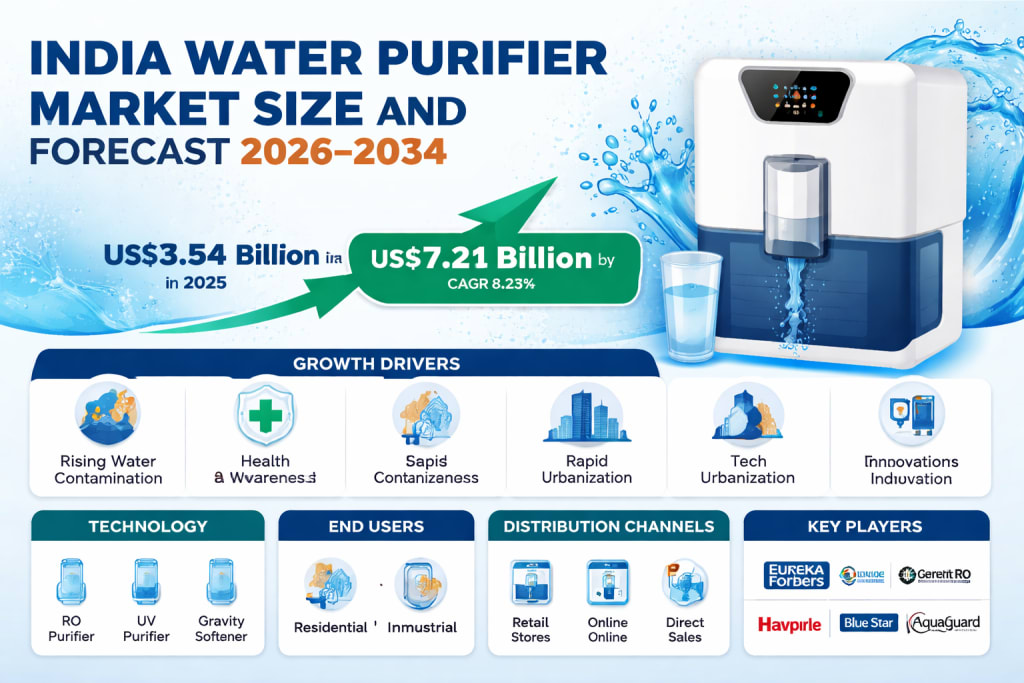
India’s water purifier market is entering a transformative growth phase, driven by increasing concerns over water safety, rapid urbanization, and rising consumer awareness about health and hygiene. According to Renub Research, the market is projected to grow from US$ 3.54 Billion in 2025 to US$ 7.21 Billion by 2034, expanding at a CAGR of 8.23% during 2026–2034.
A water purifier is a vital appliance used in households, offices, hospitals, and industries to remove harmful contaminants, pathogens, and dissolved impurities from water. Technologies such as Reverse Osmosis (RO), Ultraviolet (UV), Ultrafiltration (UF), and activated carbon filtration have become mainstream, offering multi-stage purification for enhanced safety.
In India, where water contamination is a persistent issue, water purifiers are no longer seen as luxury appliances—they are becoming essential household necessities. With increasing access to technology, growing disposable incomes, and a surge in awareness campaigns, the demand for reliable and efficient purification systems continues to accelerate.
Market Growth Drivers
Rising Water Contamination and Health Awareness
India faces a severe water quality crisis. Over 70% of surface water sources are polluted, and millions lack access to safe drinking water. Contaminants such as arsenic, fluoride, heavy metals, pesticides, and microbial pathogens pose significant health risks.
Waterborne diseases like cholera, typhoid, and diarrhea continue to affect a large population annually. Reports suggest that over 200,000 deaths per year in India are linked to unsafe water consumption.
This alarming scenario has significantly increased awareness among consumers. Households are now prioritizing safe drinking water, making water purifiers a critical investment. Media campaigns, healthcare advisories, and government initiatives have further strengthened this awareness, pushing demand across urban and semi-urban regions.
Rapid Urbanization and Expanding Middle-Class Population
India’s urban population is growing rapidly, accompanied by a surge in middle-class households. By 2030, the middle class is expected to reach around 800 million people, significantly boosting consumption patterns.
Urban housing developments such as apartments, gated communities, and smart homes are fueling demand for advanced water purification systems. With higher disposable incomes, consumers are increasingly opting for premium products featuring RO+UV combinations and smart functionalities.
Lifestyle changes, nuclear family structures, and the need for convenience further support the adoption of home-based purification systems. As cities expand and infrastructure struggles to keep pace, reliance on personal purification solutions continues to grow.
Technological Advancements and Product Innovation
Technology is playing a central role in shaping the India water purifier market. Manufacturers are introducing innovative solutions tailored to Indian water conditions, combining multiple purification technologies for maximum effectiveness.
Modern water purifiers now include:
Smart sensors to monitor water quality
IoT-enabled devices for real-time tracking
Energy-efficient systems
Compact and wall-mounted designs
Digital displays and alerts for filter replacement
Recent innovations emphasize UV integration to tackle microbial contamination effectively. Companies are also focusing on water-efficient RO systems to address concerns about water wastage.
Additionally, subscription-based models and AI-enabled maintenance services are emerging, enhancing customer convenience and ensuring long-term product reliability.
Market Challenges
High Initial Cost and Maintenance Expenses
Despite strong growth, affordability remains a major challenge. Advanced purification systems, particularly RO and multi-stage units, involve high upfront costs. Additionally, maintenance expenses such as filter replacements, servicing, and electricity usage can be significant.
This creates a barrier for low-income and rural households. Many consumers are also unaware of the long-term health benefits, leading to hesitation in adopting these systems.
Manufacturers face the challenge of balancing cost and performance while expanding their reach to price-sensitive segments.
Lack of Awareness and Infrastructure Limitations
In rural and semi-urban areas, awareness about water purification technologies remains limited. Consumers often lack knowledge about local water quality and may choose inappropriate systems, leading to dissatisfaction.
Infrastructure issues such as unreliable electricity supply and limited service networks further restrict adoption. High-end purifiers require consistent power and regular servicing, which may not be feasible in all regions.
Expanding education initiatives and strengthening service infrastructure are crucial to overcoming these challenges.
Segment Analysis
India Water RO Purifier Market
RO purifiers dominate the Indian market due to widespread issues of high Total Dissolved Solids (TDS), heavy metals, and chemical contamination in groundwater.
These systems effectively remove impurities such as arsenic, fluoride, and lead, making them highly suitable for urban and semi-urban areas. Increasing consumer awareness and rising incomes continue to drive demand.
To address concerns about water wastage, companies are launching water-efficient RO models and hybrid RO+UV systems. With persistent water quality issues, the RO segment is expected to maintain strong growth.
India Water UV Purifier Market
UV purifiers are ideal for regions with low TDS levels but high microbial contamination. These systems eliminate bacteria and viruses without altering the natural mineral composition of water.
Key advantages include:
Lower cost compared to RO systems
Minimal water wastage
Easy maintenance
UV purifiers are widely used in areas with municipal water supply, making them a popular choice among cost-conscious consumers.
India Water Purifier Retail Stores Market
Retail stores play a critical role in product distribution. Multi-brand outlets and exclusive showrooms allow consumers to compare technologies, features, and pricing.
In-store services such as:
Product demonstrations
Water testing
Installation support
help build consumer confidence. Organized retail expansion in urban and semi-urban areas is improving accessibility and boosting sales.
India Residential Water Purifier Market
The residential segment is the largest contributor to the market. Increasing awareness about health and hygiene has made water purifiers a standard appliance in Indian homes.
Consumers prefer:
Compact and aesthetically designed units
Multi-stage purification systems
Affordable financing options
The rise of middle-class households and urban lifestyles continues to support strong demand in this segment.
India Commercial Water Purifier Market
Commercial applications include offices, hotels, hospitals, educational institutions, and restaurants. These environments require high-capacity systems capable of continuous operation.
Growing emphasis on employee and customer health, along with the expansion of the hospitality and healthcare sectors, is driving demand for commercial water purifiers.
Regional Insights
Maharashtra Water Purifier Market
Maharashtra is one of the largest markets due to high urbanization and water quality concerns in cities like Mumbai, Pune, and Nagpur. Industrial pollution and aging infrastructure have increased dependence on purification systems.
The presence of organized retail and strong after-sales service networks further supports market growth. Innovations such as AI-enabled subscription services are enhancing user convenience.
Uttar Pradesh Water Purifier Market
Uttar Pradesh is witnessing steady growth due to high population density and reliance on groundwater. Cities like Noida, Ghaziabad, and Lucknow are key demand centers.
Affordable products and financing options are encouraging adoption among middle-class households. Expansion of service networks is also improving accessibility.
Andhra Pradesh Water Purifier Market
High salinity and groundwater pollution are major concerns in Andhra Pradesh. Urbanization in cities like Visakhapatnam and Vijayawada is driving demand for RO-based systems.
Technological advancements, such as long-life filters, are enhancing product appeal and reducing maintenance requirements.
West Bengal Water Purifier Market
West Bengal’s market is driven by concerns over arsenic contamination and water quality issues. Urban areas like Kolkata show higher adoption due to better awareness and infrastructure.
The demand for both RO and UV systems is growing steadily, supported by increasing middle-class populations and improved distribution channels.
Market Segmentation
By Technology:
RO Purifier
UV Purifier
Gravity Purifier
Sediment Filter
Water Softener
Others
By Distribution Channel:
Retail Stores
Direct Sales
Online
By End User:
Residential
Commercial
Industrial
By Cities:
Maharashtra
Tamil Nadu
Karnataka
Gujarat
Uttar Pradesh
West Bengal
Rajasthan
Telangana
Andhra Pradesh
Madhya Pradesh
Competitive Landscape
The India water purifier market is highly competitive, with both domestic and international players focusing on innovation, pricing strategies, and service expansion.
Key Players Include:
Eureka Forbes Ltd
KENT RO Systems Ltd.
Hindustan Unilever Limited
A.O. Smith India Water Products Pvt. Ltd.
Livpure Smart Homes Private Limited
Aquafresh RO System
Havells India Limited
Blue Star Limited
BRITA India Water Solutions Pvt. Ltd.
3M India Limited
Companies are leveraging advanced technologies, subscription models, and extensive service networks to strengthen their market position.
Final Thoughts
The India water purifier market is poised for strong and sustained growth over the next decade. With increasing awareness about water quality, rapid urbanization, and technological advancements, water purifiers are transitioning from optional appliances to essential household utilities.
While challenges such as affordability and infrastructure limitations remain, ongoing innovation and strategic initiatives by manufacturers are expected to bridge these gaps.
As India continues to grapple with water pollution and health concerns, the demand for reliable and efficient purification solutions will only intensify—making this market a vital component of the country’s health and sustainability ecosystem.
About the Creator
Europe Click and Collect Grocery Market Set for Explosive Growth Through 2033
Europe Click and Collect Grocery Market Trends & Summary The Europe Click and Collect grocery market is witnessing remarkable expansion, driven by shifting consumer preferences and rapid digital transformation across the retail sector. Valued at US$ 46.51 billion in 2024, the market is projected to surge to US$ 276.39 billion by 2033, growing at an impressive CAGR of 22.00% during 2025–2033.
By shibansh kumara day ago in Trader




Comments
There are no comments for this story
Be the first to respond and start the conversation.