
Global Desalination Market Set to Surge as Water Scarcity Intensifies Worldwide
Rising demand for clean water, technological innovation, and government investments are driving the desalination industry toward a US$ 40.28 billion future by 2033

Introduction: A Thirsty World Turns to the Ocean
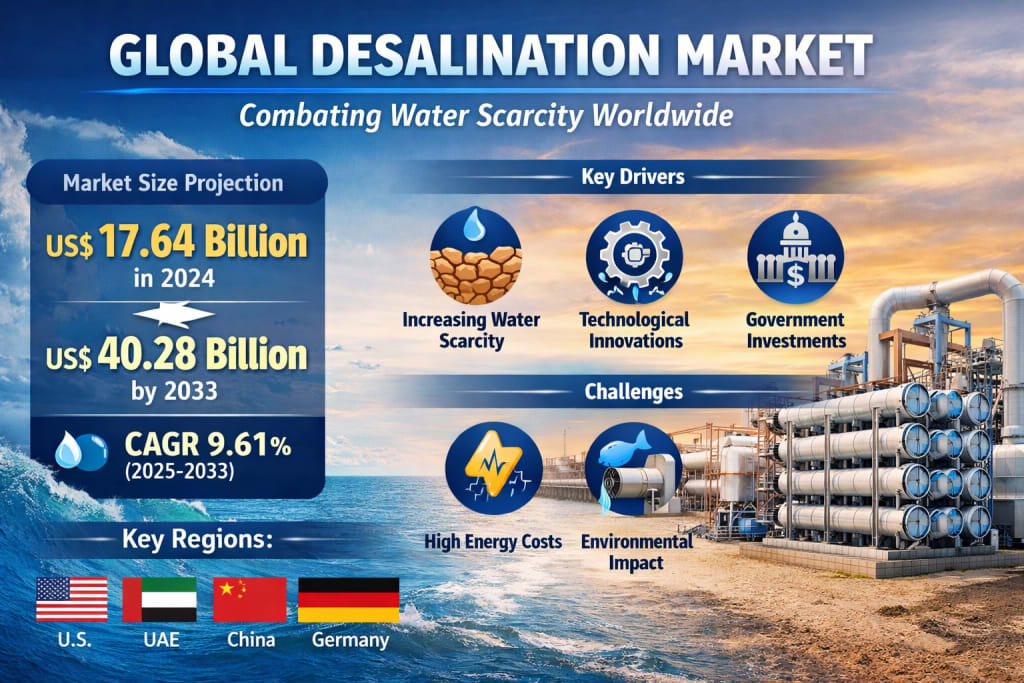
As freshwater resources continue to shrink under the pressure of climate change, rapid urbanization, and industrial expansion, the world is increasingly looking toward the oceans for solutions. The global desalination market is entering a period of remarkable growth, expected to expand from US$ 17.64 billion in 2024 to approximately US$ 40.28 billion by 2033, registering a strong CAGR of 9.61% from 2025 to 2033.
This surge reflects not only the growing urgency of global water scarcity but also the rapid advancement of desalination technologies and increasing government commitments to securing sustainable water supplies.
Understanding Desalination: Turning Saltwater into Lifelines
Desalination is the process of removing salts, minerals, and impurities from seawater, brackish water, or wastewater to produce potable water. Two primary methods dominate the industry:
Reverse Osmosis (RO): Uses semi-permeable membranes to filter out salts and impurities.
Thermal Technologies (MSF and MED): Heat water to separate salt through evaporation and condensation.
These technologies have become essential in regions where freshwater is scarce, particularly in arid and semi-arid climates. Countries such as Saudi Arabia, the UAE, and Israel rely heavily on desalination for their daily water supply.
Beyond drinking water, desalination supports industries like oil & gas, power generation, manufacturing, and even agriculture, making it a cornerstone of modern water management.
Growth Drivers: Why the Market Is Expanding Rapidly
1. Escalating Global Water Scarcity
Water scarcity is no longer a regional issue—it is a global crisis. Population growth, industrial demand, and climate change are placing immense pressure on freshwater resources.
Around 4 billion people experience water scarcity at least one month each year.
Over 2 billion people live in water-stressed countries.
By 2030, nearly 700 million people could be displaced due to water shortages.
By 2040, one in four children will face extreme water stress.
Desalination offers a reliable and scalable solution by converting abundant seawater into usable freshwater, making it indispensable in addressing this crisis.
2. Technological Advancements Transforming Efficiency
Innovation is at the heart of the desalination market’s growth. Advances in membrane technology, energy recovery systems, and automation are making desalination more efficient and cost-effective.
Reverse osmosis, in particular, has seen significant improvements, reducing energy consumption and operational costs. Emerging solutions like digital twins and AI-driven optimization are further enhancing plant performance.
For example, in December 2023, a major green-tech initiative introduced digital twin solutions to improve scalability and efficiency in desalination plants globally. These innovations are making desalination more accessible, even for regions with limited resources.
3. Strong Government Support and Investments
Governments worldwide are recognizing desalination as a strategic necessity. Massive investments, policy support, and public-private partnerships are accelerating the deployment of desalination infrastructure.
In September 2023, Saudi Arabia announced the establishment of a Global Water Organization in Riyadh, pledging over US$ 6 billion for water and sanitation projects worldwide. Similarly, countries across the Middle East, North Africa, and Asia-Pacific are heavily investing in desalination to ensure long-term water security.
Challenges: Barriers to Sustainable Growth
High Energy Consumption and Costs
Despite advancements, desalination remains energy-intensive. Energy costs constitute a significant portion of operational expenses, particularly in thermal desalination methods.
While renewable energy integration is gaining traction, many facilities still rely on fossil fuels, raising concerns about sustainability and affordability—especially for developing nations.
Environmental Impact
Desalination produces brine, a highly concentrated salt byproduct that can harm marine ecosystems if not managed properly. Additionally, energy consumption contributes to carbon emissions.
Balancing water production with environmental protection remains a critical challenge, pushing the industry toward greener technologies and stricter regulations.
Market Segmentation Insights
Reverse Osmosis Leads the Technology Segment
Reverse osmosis dominates the desalination market due to its efficiency and cost-effectiveness. Continuous R&D is enhancing membrane durability and reducing energy usage, further strengthening its position.
Municipal Sector Drives Application Demand
Municipal desalination accounts for a significant share of the market. Rapid urbanization and population growth are driving governments to invest in large-scale desalination plants to ensure a steady supply of drinking water.
Public-private partnerships are playing a crucial role in expanding municipal desalination infrastructure globally.
Industrial Applications Expand Steadily
Industries such as power generation, petrochemicals, and manufacturing require large volumes of water. Desalination provides a reliable alternative, reducing dependence on freshwater sources and ensuring operational continuity.
Seawater as the Primary Source
Seawater desalination dominates due to the vast availability of ocean water. Advances in RO and MED technologies are making seawater desalination more efficient and environmentally friendly.
Countries with extensive coastlines are particularly benefiting from this segment.
Emerging Role of River Water Desalination
In regions with brackish river water, desalination is gaining traction. Technologies like nanofiltration and RO are enabling the treatment of river water for both municipal and industrial use.
Regional Analysis: Global Adoption Trends
United States
The U.S. desalination market is expanding, particularly in water-stressed states like California, Texas, and Arizona. Investments in advanced technologies and renewable energy integration are driving growth.
In November 2024, a major investment was made in a startup developing deep-sea desalination technology, signaling a shift toward innovative solutions.
Germany
Germany focuses on industrial desalination, particularly for chemical and manufacturing sectors. The country emphasizes sustainability and energy efficiency, investing heavily in R&D.
In October 2023, a large solar-powered desalination system was completed in Ukraine by a German firm, highlighting Europe’s commitment to green water solutions.
China
China’s desalination market is growing rapidly due to urbanization and water scarcity. Government initiatives and international collaborations are boosting capacity, especially in coastal regions.
Technological advancements and infrastructure development are positioning China as a major player in the global market.
United Arab Emirates
The UAE remains a global leader in desalination, driven by its desert climate and reliance on non-conventional water sources.
The country is integrating renewable energy, particularly solar power, into desalination processes. In May 2024, a major solar-powered desalination plant project in Dubai marked a significant milestone in sustainable water production.
Competitive Landscape: Key Players Shaping the Market
The global desalination market is highly competitive, with major companies focusing on innovation, partnerships, and expansion strategies. Key players include:
Acciona
Dow
Evoqua Water Technologies
Siemens AG
DuPont
Doosan Enerbility
Toray Industries, Inc.
Xylem
These companies are investing heavily in advanced technologies, digital solutions, and sustainable practices to gain a competitive edge.
Future Outlook: A Sustainable Water Revolution
The future of the desalination market looks promising, driven by increasing water demand, technological innovation, and strong policy support. Integration with renewable energy sources, such as solar and wind, is expected to reduce environmental impact and operational costs.
Emerging trends include:
Smart desalination plants using AI and IoT
Hybrid desalination systems combining multiple technologies
Decentralized desalination units for remote areas
Increased focus on brine management and resource recovery
As the world grapples with water scarcity, desalination is no longer an optional solution—it is becoming a necessity.
Final Thoughts
The global desalination market is at a pivotal moment. With billions of people facing water stress and climate change intensifying resource challenges, the need for sustainable water solutions has never been greater.
Desalination stands out as a transformative technology capable of addressing one of humanity’s most pressing issues. While challenges such as energy consumption and environmental impact persist, ongoing innovation and global collaboration are paving the way for a more sustainable future.
As investments continue to rise and technologies evolve, desalination is set to play a central role in ensuring water security for generations to come.
About the Creator
Australia Smart Home Market Size and Forecast 2026–2034
Introduction The Australia Smart Home Market is experiencing remarkable growth as households increasingly adopt connected technologies designed to improve convenience, safety, and energy efficiency. Smart devices are transforming traditional homes into digitally connected living spaces where lighting, climate control, entertainment systems, and security devices can be managed through mobile applications, voice commands, or automated schedules.
By Sakshi Sharma6 days ago in Trader
March 15, 2026
Merriam Webster - Word of the day: Tranche refers to a division or portion of a whole. World Contact Day is commemorated every year on March 15. It is a unique observance held globally to focus on communicating with extraterrestrial life and exploring the possibility that intelligent beings may exist beyond Earth. World Contact Day inspires people to invoke their curiosity and spend time thinking about the universe and the mysteries surrounding it. What is the “Ides of March”? According to the Roman calendar, the Ides are a monthly occurrence. In March and other months with 31 days, the Ides always falls on the 15th; it falls on the 13th in months with 30 days. The Ides traditionally marked the arrival of the new Moon and was cause for celebration. The word “Ides” is derived from Latin, meaning “to divide.” Mothering Sunday in 2026 falls on Sunday, March 15. Mothering Sunday, celebrated in the United Kingdom and Ireland, occurs on the fourth Sunday of Lent, which is exactly three weeks before Easter. Unlike the fixed-date Mother's Day in countries like the United States, Canada, and Australia, Mothering Sunday’s date changes each year according to the Christian liturgical calendar. On March 15, 2026, several notable observances and events are celebrated: Dumbstruck Day: A day to express frustration. Everything You Think is Wrong Day: A day to challenge and celebrate wrong beliefs. International Day Against Police Brutality: A day to raise awareness and advocate against police violence. My look at today, March 15, 2026 below:
By Denise E Lindquist3 days ago in Writers



Comments
There are no comments for this story
Be the first to respond and start the conversation.