
Europe Sleep Apnea Devices Market Set for Robust Growth Amid Rising Awareness and Technological Innovation
Increasing prevalence of sleep disorders and aging populations drive strong demand across Europe

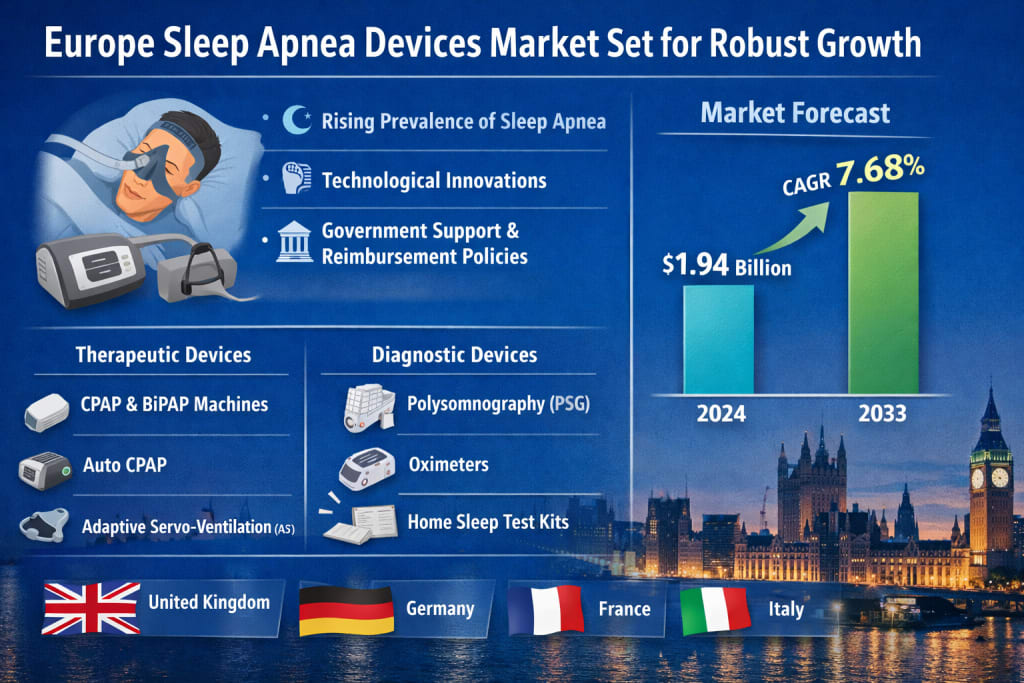
The Europe sleep apnea devices market is entering a transformative growth phase, fueled by rising awareness of sleep-related disorders, rapid technological advancements, and the increasing burden of chronic health conditions. According to Renub Research, the market was valued at US$ 1.94 billion in 2024 and is projected to reach US$ 3.77 billion by 2033, expanding at a CAGR of 7.68% from 2025 to 2033 .
This upward trajectory reflects a broader shift in healthcare priorities across Europe, where sleep health is no longer viewed as a secondary concern but as a critical component of overall well-being. From hospitals and sleep clinics to home-care settings, sleep apnea devices are becoming indispensable tools in diagnosing and managing this widespread condition.
Understanding Sleep Apnea and Its Growing Impact
Sleep apnea is a chronic condition characterized by repeated interruptions in breathing during sleep. These interruptions can lead to reduced oxygen levels, fragmented sleep, and long-term health complications such as cardiovascular disease, diabetes, and cognitive impairment.
Devices designed to manage sleep apnea—such as Continuous Positive Airway Pressure (CPAP), Bi-level Positive Airway Pressure (BiPAP), and advanced diagnostic tools—play a vital role in restoring normal breathing patterns and improving sleep quality. As awareness grows, more individuals are seeking diagnosis and treatment, significantly boosting demand for these technologies.
Key Growth Drivers Transforming the Market
1. Rising Prevalence of Sleep Apnea
One of the most significant drivers of market growth is the increasing prevalence of sleep apnea across Europe. Sedentary lifestyles, rising obesity rates, and aging populations are contributing to a surge in cases.
Estimates suggest that around 175 million adults in Europe—nearly 44% of the population—may be affected by sleep apnea, highlighting the immense scale of the issue .
Demographic shifts further amplify this trend. With a rapidly aging population, particularly in countries like the United Kingdom, France, and Germany, the demand for sleep apnea diagnosis and treatment is expected to grow steadily over the coming decades.
2. Technological Advancements in Sleep Devices
Innovation is at the heart of the market’s expansion. Modern sleep apnea devices are no longer bulky or uncomfortable; instead, they are increasingly portable, user-friendly, and digitally connected.
Key advancements include:
Wireless connectivity and remote monitoring
Smart algorithms for personalized therapy
Compact, travel-friendly CPAP and BiPAP machines
Battery-free neurostimulation technologies
For instance, recent developments such as wearable-controlled neurostimulators are redefining treatment approaches, offering patients less invasive and more convenient alternatives.
These innovations not only improve treatment outcomes but also enhance patient compliance—an essential factor in long-term therapy success.
3. Government Initiatives and Reimbursement Policies
European governments are playing a crucial role in accelerating market growth. Public health campaigns aimed at increasing awareness of sleep disorders have led to higher diagnosis rates and earlier interventions.
Additionally, favorable reimbursement policies in countries such as Germany, France, and the United Kingdom make sleep apnea devices more accessible to patients. Investments in healthcare infrastructure, including sleep laboratories and diagnostic centers, further support market expansion.
Market Segmentation: A Diverse and Evolving Landscape
The Europe sleep apnea devices market is broadly segmented into therapeutic and diagnostic devices, each playing a unique role in patient care.
Therapeutic Devices
Therapeutic devices dominate the market, with CPAP machines leading the segment. These devices deliver a continuous stream of air to keep airways open during sleep, making them the gold standard for treating moderate to severe obstructive sleep apnea.
Other key therapeutic devices include:
Auto CPAP machines, which adjust pressure automatically
BiPAP devices, designed for patients with complex respiratory needs
Adaptive Servo-Ventilation (ASV) systems for advanced cases
The increasing demand for personalized and comfortable treatment options is driving innovation within this segment.
Diagnostic Devices
Diagnostic devices are equally critical, enabling early detection and ongoing monitoring of sleep apnea.
Key diagnostic tools include:
Polysomnography (PSG) systems, the gold standard for sleep studies
Oximeters, which measure oxygen saturation levels
Actigraphy devices, used for sleep pattern analysis
Portable screening devices, expanding access to diagnosis in remote areas
The shift toward home-based diagnostics is particularly noteworthy, as it offers convenience and cost-effectiveness for patients.
Growing Importance of Home Care Settings
One of the most notable trends in the market is the increasing adoption of sleep apnea devices in home-care settings. Patients are increasingly opting for home-based diagnosis and treatment due to convenience, affordability, and advancements in portable technology.
Home-use devices, including compact CPAP machines and wearable monitors, are enabling patients to manage their condition without frequent hospital visits. This trend is expected to gain further momentum as healthcare systems emphasize patient-centric care models.
Country-Level Insights: Key Markets Driving Growth
United Kingdom
The UK market is characterized by high awareness levels, advanced healthcare infrastructure, and strong government support. Rising obesity rates and an aging population are key factors driving demand.
Germany
Germany stands out as one of Europe’s largest and most technologically advanced markets. The country’s robust reimbursement system and focus on innovation make it a hub for cutting-edge sleep apnea solutions.
France
France is witnessing steady growth due to strong government support and increasing investment in sleep disorder research. Reimbursement policies encourage widespread adoption of therapeutic devices.
Italy
Italy’s market is expanding with increased healthcare spending and awareness initiatives. While urban areas show strong adoption, rural regions present opportunities for growth through improved access to diagnostic services.
Challenges Hindering Market Expansion
Despite its promising outlook, the Europe sleep apnea devices market faces several challenges:
High Cost of Devices
Advanced sleep apnea devices, particularly CPAP and BiPAP machines, can be expensive. Although reimbursement schemes exist, they often do not cover the full cost, creating financial barriers for many patients.
Lack of Awareness and Diagnosis
While awareness is improving in urban areas, many individuals in rural and underserved regions remain undiagnosed. Limited access to healthcare facilities and sleep clinics continues to hinder timely diagnosis and treatment.
Addressing these challenges will be crucial for unlocking the market’s full potential.
Competitive Landscape: Key Players Shaping the Market
The market is highly competitive, with several global and regional players driving innovation and expansion. Leading companies include:
Natus Medical Incorporated
ResMed Inc.
Somnomed
Apex Medical Corporation
Koninklijke Philips N.V.
Compumedics
Fisher & Paykel Healthcare
Nyxoah SA
These companies are focusing on product innovation, strategic partnerships, and geographic expansion to strengthen their market position.
Future Outlook: A Market Poised for Transformation
The future of the Europe sleep apnea devices market looks promising, with several trends expected to shape its evolution:
Integration of artificial intelligence and data analytics for personalized treatment
Expansion of telemedicine and remote monitoring
Increased focus on minimally invasive therapies
Growing adoption of wearable and portable devices
As healthcare systems continue to prioritize preventive care and early diagnosis, the demand for sleep apnea devices is likely to rise significantly.
Final Thoughts
The Europe sleep apnea devices market is at a pivotal moment, driven by a convergence of demographic trends, technological innovation, and evolving healthcare priorities. With millions of individuals affected by sleep apnea and increasing recognition of its health implications, the demand for effective diagnostic and therapeutic solutions is stronger than ever.
While challenges such as cost and awareness gaps remain, ongoing advancements and supportive government policies are expected to bridge these barriers. As a result, the market is well-positioned for sustained growth, offering significant opportunities for manufacturers, healthcare providers, and investors alike.
In a world where quality sleep is increasingly recognized as essential to overall health, the role of sleep apnea devices will only continue to expand—transforming lives one night at a time.
About the Creator
United States Biometrics Market Size, Growth, Latest Trends and Forecast 2026-2034
United States Biometrics Market Overview The United States Biometrics Market is experiencing significant growth as organizations increasingly adopt advanced identity verification technologies to improve security and authentication processes. Biometrics refers to the use of unique biological characteristics such as fingerprints, facial recognition, iris patterns, and voice recognition to verify an individual’s identity.
By Jackson Watson7 days ago in Trader
Colonoscopy Devices Market Size and Forecast 2025–2033
Introduction The global colonoscopy devices market is witnessing steady expansion as healthcare systems worldwide prioritize early disease detection and preventive screening. According to industry estimates, the market is expected to grow from US$ 1.90 billion in 2024 to approximately US$ 2.95 billion by 2033, representing a compound annual growth rate (CAGR) of 5.04% between 2025 and 2033. This growth is fueled by several factors, including the rising prevalence of colorectal diseases, technological advancements in diagnostic imaging, and increasing adoption of minimally invasive medical procedures.
By Sakshi Sharma4 days ago in Trader
Babbling Dixie
The short form of tomorrow is never the whole story. Abbreviations mean nothing when we are born to die and we all are aren't we? Being spoken for before birth is something we're not supposed to remember like some kind of karma after effect. Still here we are spending our lives looking for each other.
By Canuck Scriber Lisa Lachapelle2 days ago in Fiction



Comments
There are no comments for this story
Be the first to respond and start the conversation.