
Clear Vision Ahead: Global Contact Lenses Market Set for Steady Expansion Through 2033
Rising vision disorders, cosmetic trends, and innovation in lens technology are reshaping the future of eye care worldwide

Introduction
The global contact lenses market is witnessing a transformative phase, driven by a blend of medical necessity, lifestyle preferences, and technological advancement. As vision impairment continues to affect billions worldwide, contact lenses have evolved from a niche alternative to eyeglasses into a mainstream solution for vision correction, cosmetic enhancement, and therapeutic care.
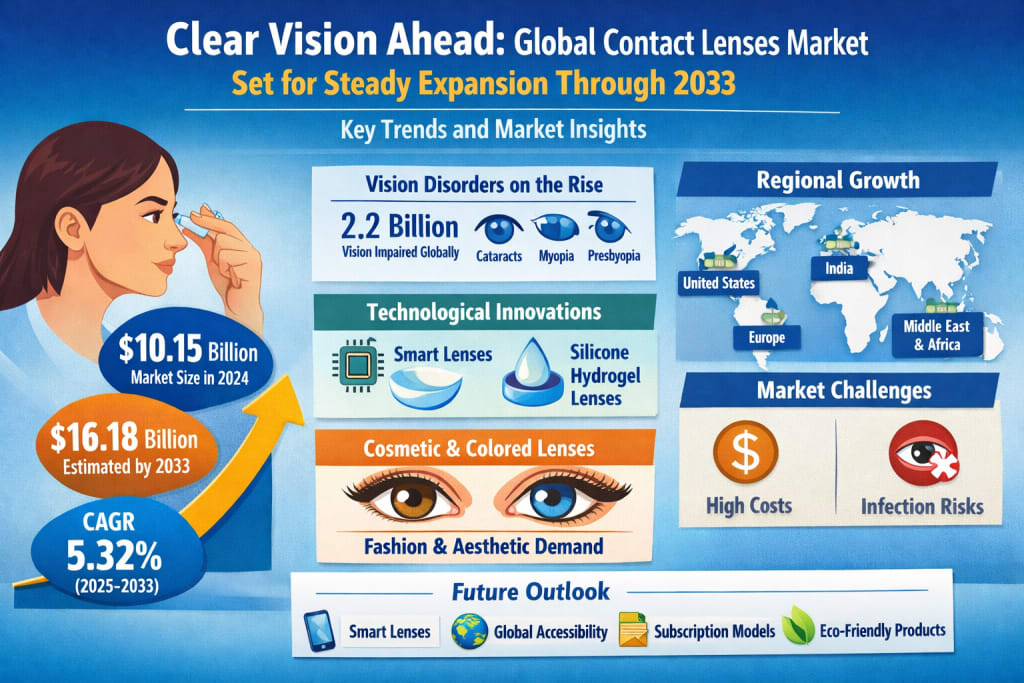
According to Renub Research, the global contact lenses market was valued at USD 10.15 billion in 2024 and is projected to reach USD 16.18 billion by 2033, expanding at a compound annual growth rate (CAGR) of 5.32% between 2025 and 2033 . This steady growth reflects both rising demand and rapid innovation within the industry.
Understanding Contact Lenses: Beyond Vision Correction
Contact lenses are thin, curved optical devices worn directly on the eye’s surface. Traditionally used for correcting refractive errors such as myopia, hyperopia, astigmatism, and presbyopia, they now serve multiple purposes.
Modern lenses are designed not only for vision clarity but also for aesthetic enhancement and medical applications. Colored lenses cater to fashion-conscious consumers, while specialized lenses help treat conditions like keratoconus, dry eye syndrome, and post-surgical recovery.
For athletes and active individuals, contact lenses offer advantages such as a wider field of vision, stability, and reduced risk of breakage. As innovation continues, new-generation lenses are even being explored for drug delivery and health monitoring.
Rising Global Burden of Vision Impairment
A major catalyst behind the growth of the contact lenses market is the increasing prevalence of vision disorders. Globally, at least 2.2 billion people suffer from vision impairment, with nearly 1 billion cases either preventable or untreated .
Key causes include:
Cataracts (94 million cases)
Refractive errors (88.4 million cases)
Age-related macular degeneration
Glaucoma
Diabetic retinopathy
Additionally, presbyopia affects approximately 826 million people, highlighting the massive demand for corrective solutions.
The situation is further exacerbated by digital lifestyles. Increased screen time across all age groups is contributing to eye strain and refractive errors, particularly myopia. Projections indicate that by 2050, nearly 4.9 billion people could be affected by myopia, significantly boosting demand for vision correction solutions like contact lenses .
Key Growth Drivers Shaping the Market
1. Increasing Demand for Vision Correction
The growing awareness of eye health and the importance of regular check-ups has led to earlier diagnosis and treatment of vision issues. As more individuals seek alternatives to glasses, contact lenses are becoming the preferred choice for convenience and aesthetics.
2. Technological Advancements
Innovation remains at the heart of the contact lenses market. The introduction of silicone hydrogel lenses, known for superior oxygen permeability and comfort, has revolutionized user experience.
Emerging technologies include:
Smart lenses with embedded sensors
Drug-delivery lenses
Advanced multifocal and toric designs
Major industry players are continuously investing in R&D to enhance comfort, durability, and functionality, attracting a broader consumer base.
3. Growing Popularity of Cosmetic Lenses
Cosmetic and colored lenses are gaining traction, especially among younger consumers. Influenced by social media, fashion trends, and entertainment industries, these lenses are no longer just medical devices but also lifestyle accessories.
Improved safety and comfort in cosmetic lenses have further boosted their adoption globally.
4. Rising Disposable Income
Economic growth in developing regions has increased purchasing power, enabling consumers to opt for premium and specialized lenses. Urbanization and lifestyle changes are also contributing to higher adoption rates.
Market Challenges: Barriers to Wider Adoption
Despite strong growth prospects, the contact lenses market faces several challenges:
High Cost and Affordability Issues
Premium lenses, especially daily disposables and advanced materials like silicone hydrogel, can be expensive. Limited insurance coverage further restricts access, particularly in developing regions where affordability remains a concern.
Risk of Eye Infections
Improper usage and poor hygiene practices can lead to serious eye conditions such as keratitis and corneal ulcers. These risks deter some consumers from using contact lenses.
Manufacturers and healthcare providers are actively promoting awareness campaigns to educate users on safe practices, but concerns persist.
Segment Insights: Understanding Market Dynamics
Silicone Hydrogel Lenses
This segment dominates due to its enhanced oxygen permeability and moisture retention. These lenses are ideal for extended wear and sensitive eyes, making them highly popular among users seeking comfort.
Daily Disposable Lenses
Daily disposables are gaining significant traction due to their convenience and hygiene benefits. They eliminate the need for cleaning and storage, reducing the risk of infections.
Spherical Lenses
Spherical lenses remain the most widely used, primarily for correcting myopia and hyperopia. Their affordability and ease of use contribute to their dominance.
Vision Correction Applications
While cosmetic lenses are growing, vision correction continues to be the primary application. Increasing digital exposure and aging populations are key drivers.
Online Distribution Channels
E-commerce is reshaping the contact lenses market. Consumers increasingly prefer online platforms for their convenience, competitive pricing, and subscription models. However, issues such as counterfeit products and improper prescriptions pose challenges.
Regional Insights: A Global Perspective
United States
The U.S. remains a leading market, supported by advanced healthcare infrastructure, high awareness levels, and strong adoption of innovative products.
Europe
Countries like France are witnessing growth driven by fashion trends and demand for premium lenses. A well-established retail network and expanding e-commerce sector support market expansion.
India
India represents a high-growth market, fueled by:
Rising disposable income
Urbanization
Increasing vision disorders
Growing youth population
The popularity of cosmetic lenses and online retail platforms is further accelerating growth.
Middle East & Africa
Regions like Saudi Arabia are experiencing increased demand due to rising awareness and purchasing power. Colored lenses are particularly popular, reflecting changing lifestyle preferences.
Competitive Landscape and Industry Developments
The contact lenses market is highly competitive, with key players focusing on innovation, product launches, and expansion strategies. Major companies include:
Bausch & Lomb Incorporated
Alcon
Carl Zeiss Meditec AG
The Cooper Companies Inc
Hoya Corporation
EssilorLuxottica
Menicon Co. Ltd.
Seed Co. Ltd.
Recent developments highlight the pace of innovation:
Launch of advanced multifocal lenses for presbyopia
Introduction of smart lenses and AR-enabled prototypes
Expansion of e-commerce and virtual ordering platforms
These advancements are not only improving product performance but also enhancing customer experience.
The Rise of Accessories and Supporting Products
The growth of contact lens usage has also fueled demand for accessories such as:
Cleaning solutions
Lens cases
Rewetting drops
Applicators
Consumers are increasingly seeking antibacterial and travel-friendly solutions, while sustainability trends are driving eco-friendly product development.
Future Outlook: What Lies Ahead?
The future of the contact lenses market looks promising, with several trends expected to shape its trajectory:
Integration of digital health technologies
Increased focus on personalized and smart lenses
Expansion of subscription-based sales models
Greater emphasis on affordability and accessibility
Efforts by global organizations to improve access to vision correction solutions are also expected to boost market growth.
Final Thoughts
The global contact lenses market is at a pivotal juncture, balancing medical necessity with lifestyle-driven demand. As vision impairment continues to rise globally, the need for effective, comfortable, and accessible solutions becomes increasingly critical.
With technological innovation, growing consumer awareness, and expanding distribution channels, contact lenses are poised to play a central role in the future of eye care. However, addressing challenges such as affordability and safety will be crucial for sustaining long-term growth.
Ultimately, the journey toward clearer vision is not just about correcting sight—it’s about enhancing quality of life. And in that journey, contact lenses are proving to be a powerful and evolving solution.
About the Creator
Sodium Chloride Market: Expanding Applications Driving Global Demand
Sodium Chloride Market: Global Industry Trends, Growth Drivers, and Forecast Outlook The Sodium Chloride Market plays a crucial role in the global economy, supported by its extensive use across multiple industries. Sodium chloride, widely recognized as salt, is one of the most abundant and essential compounds used by humans. Beyond its traditional use in food seasoning and preservation, it serves as a critical raw material in chemical processing, pharmaceuticals, de-icing, and water treatment.
By James Smithabout 2 hours ago in Trader
The Forsyth House Fire
Since 1851, Forsyth House has stood on the corner of Union Street and Gordon Street in the heart of Glasgow. Its iconic, or was... because on Sunday 8th of March, 2026, a fire broke out in a small, seemingly un-named shop in the building and tore all that history down. As I write, the rubble is still unsettled and the street is still blocked off. Central Station is quiet on the upper level, and around 30 small businesses have quite literally gone up in smoke.
By S. A. Crawford5 days ago in The Swamp


Comments
There are no comments for this story
Be the first to respond and start the conversation.