
Podcaster Profiles: Jennifer Briney
Her Congressional Dish podcast holds Congress tries to hold Congress accountable.

Today’s Podcaster Profiles focuses on one of the heroes of the U.S. Constitution. Podcaster Jennifer Briney uses her show to hold elected officials accountable to do their jobs in the best interests of the people who elected them. Not in their own self-interest. Listening to her podcasts, I discover, sadly, that many in the U.S. Congress are more concerned with re-election, supporting their party over country, and expanding their own wealth or power.
What these elected officials in the U.S. Congress didn’t count on was that Jennifer Briney would be watching them — closely.
I’m sure you will agree that somebody has to watch the U.S. Congress! As the saying goes, “It’s a dirty job, but someone has to do it. In this case, that someone is Jennifer Brinley.”
Congressional Dish is a podcast that, since 2012, has been aiming to draw attention to where the American people truly have power: Congress. From the perspective of a fed-up taxpayer with no allegiance to any political party, Jennifer Briney will fill you in on the must-know information about what our representatives do AFTER the elections and how their actions can and do affect our day-to-day lives.
You have to love a show that begins with an original song and lyrics that go: “I am so damn tired of being lied to, I don’t think I can deny it anymore. You can stick to your stories and lies, but I’m not going to buy it anymore.”
Most political podcasts spend their time discussing events that have already happened and placing their spin on them to appease their audience. It’s confirmation not information.
What I admire about Congressional Dish is that the show investigates everything the U.S. Congress does. After listening to the last ten episodes, let me assure you that it’s not a pretty picture.
Creator/host Jennifer Briney reinforces that view: “I believe the first step toward fixing this problem is shifting attention from what politicians say to what they do. Too much coverage focuses on interviews and horse-race elections, and too little focuses on the contents of bills and laws. With Congressional Dish, I’m trying to help change that. I truly believe that if Americans were consistently exposed to reporting on congressional actions, re-election rates would look very different.”
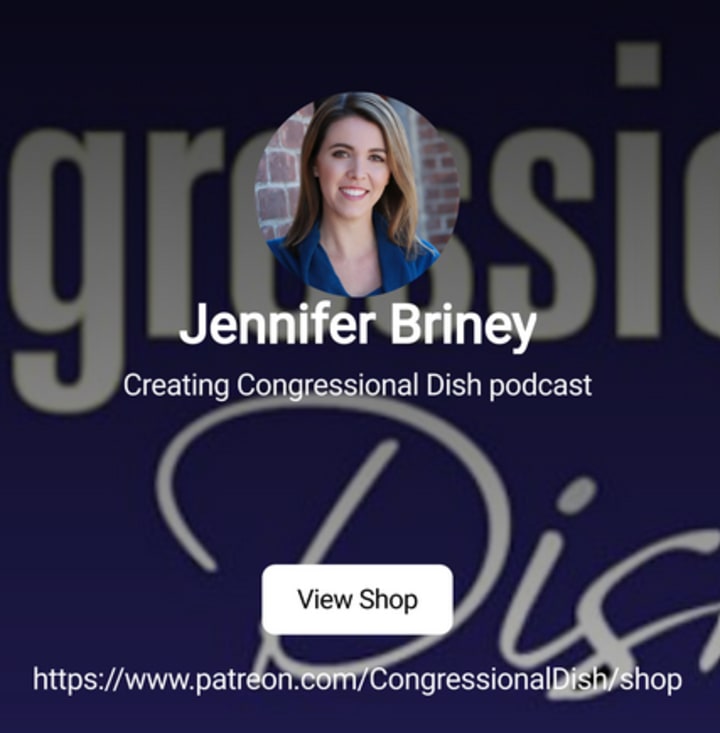
We sat down with Jennifer for a few questions.
Q. Where did I grow up?
A. I was born in Colorado, but my family moved to Irvine, California, when I was six years old, and my mother still lives there to this day (my parents are divorced). I went to college at Loyola Marymount University near the beach in Los Angeles, and the South Bay of Los Angeles is where my heart feels most at home (my dad, stepmom, stepbrother, and his family all live there).
If you had asked Little Jen what she wanted to be when she grew up, she would have told you — without hesitation — that she wanted to be a meteorologist. I think that came from spending my first six years of life in Denver, where I developed a lifelong love of thunderstorms. To this day, I love an intense thunderstorm. It’s one of the reasons I like to spend spring in Austin, Texas (my husband and I are “digital nomads,” and we’ve moved every few months for the last six years).
The meteorologist dream died when my parents informed me that I would have to do a lot of math to achieve it. While, in hindsight, I think I could have managed, math has never been my strong suit. I’ve always been happier dealing in words. For many years after that dream was dashed, I felt lost.
Q. What were your earlier career goals?
A. The seeds of the podcast dream were planted in 2003. I was studying abroad in Bonn, Germany, when my country started an illegal war. It dominated the news — and the conversations — everywhere I went, aided by my clearly enunciated Los Angeles “Hollywood movie” accent. Germans wanted to know what the Americans in the bar were thinking about the war, and I was embarrassed by how little I understood or had previously cared. I was 21 years old and assumed everyone experienced the war the same way. The reverse culture shock upon returning to California in May 2003 was life-changing.
No one was talking about the war. I remember vividly that the main topic of conversation everywhere I went was the movie Old School. Don’t get me wrong — I love that movie — but we had just started a war. Why didn’t anyone care? From that moment forward, I spent every remaining second of my college career pursuing my Communications degree while trying to understand what had happened in our country that caused my friends and family — good people, just like my European friends and family — to care so little.
The answer, of course, was the media. Instead of somber analysis and caution, American media launched an advertising campaign for the war disguised as news, sponsored by Raytheon, Northrop Grumman, and Boeing. While I was fascinated by this discovery and wanted to expose it, I quickly realized that joining corporate media would never allow me to tell the stories I believed needed to be told. I remember speaking with someone at the Los Angeles Times who told me I would need to start in fashion reporting. I wear jeans and a tank top every day. Traditional journalism was never going to work for me.
What followed was a lost decade, career-wise, during which I tried — and failed — to fit into the corporate world. I hated every second of it. Eventually, I stopped trying. I waited tables and worked a variety of odd jobs to pay the rent while continuing to study the actions of the U.S. government in my spare time.
Q. What happened after that?
A. By 2011, I had stopped blaming everything on George W. Bush. After many conversations with my father, who was a Republican at the time, I realized that nothing done by the Bush administration could have happened without the consent and funding of Congress. That realization led me to start watching C-SPAN during the day.
One afternoon in late 2011, I was watching a debate on an Energy and Water funding bill because my husband was a solar power engineer and we wanted to understand what changes were being discussed regarding solar subsidies. In the middle of the debate, Tom Cole of Oklahoma essentially bragged on the House floor that he had successfully added an amendment to protect secret campaign contributions. I didn’t believe my ears. I thought I must have misheard him.
The next day, I looked up the speech and the amendment in the Congressional Record and discovered that he had, in fact, done exactly that. The most shocking part wasn’t the amendment — it was that no one noticed. There was no television coverage, no newspaper articles, not even a blog post. That discovery pushed me to pay even closer attention, and I soon realized that Congress was behaving in similarly scandalous ways on a regular basis, entirely unnoticed. The lack of coverage was making me, quite literally, insane.
That’s when I got the idea to start the podcast. Technology had progressed to the point where I could teach myself what I needed to know relatively quickly — it took about two months — and podcasting would allow me to play sound clips directly from hearings and floor debates.
Q. How did you get the show started?
A. For the first year, my husband was employed, and I was earning very little working at Weight Watchers, so we decided I would try podcasting to see whether there was an audience and whether I enjoyed the work. After a year, we’d reassess. That year ended in September 2013, when I asked for — and received — my first donation. By December 2013, I was making about $25 a month, enough to cover the podcast’s hosting costs. December 2013 was also when my husband lost his job.
Those $25 showed us the podcast’s potential. We moved into my husband’s parents’ vacation home, where we maintained the property in lieu of rent, and we both took jobs on the ranch. I returned to waiting tables, and my husband worked on the golf course. About nine months later, he found a new job, and we were incredibly proud that we had kept the podcast alive. I went back to working on it full-time. By 2017, I was no longer losing money, and by 2020, I was earning a real living.
Q. What do you think you’ve accomplished?
A. I’m very proud that, in partnership with the audience, we’ve turned Congressional Dish into a successful business. I’m proud that I can produce a show for them without selling their attention to advertisers. I have the editorial freedom I correctly assumed I could never have in corporate media.
There are downsides, as your question alludes to. The hardest part of being politically and financially independent is the absence of perks and free promotion that come with being part of a political team. Just this week, I learned that the Democratic Party invited a group of “influencers” to the State of the Union, where they networked and introduced each other to new audiences. I would never receive an invitation like that from either party, and so — even after 13 years in this work, far longer than many on that invitation list — I remain relatively unknown.
Q. What’s the hardest part of podcasting?
A. It can be lonely. That said, I’ve found a small tribe of fellow independent road warriors, and our shared pride is immense. I’ll take that over popularity any day.
On the big picture, I still have faith in our system, even as its flaws are exposed in real time. Many of our problems stem from empowering selfish individuals and failing to hold them accountable. For over a decade, I’ve documented the atrocious performance of Congress, yet incumbents are re-elected at rates exceeding 90%, election after election. They don’t fear losing their jobs, and as a result, they grow increasingly brazen in their corruption, extended vacations, and abdication of oversight responsibilities.
Q. What do you foresee in the future for investigative journalism?
A. In 2003, I learned that the stark difference in reactions to world events between Americans and Europeans was rooted in the information they received. I believe that same dynamic persists today. My hope is that, as more journalists take the independent route, I can show that it’s possible to make a good living without corporate advertising or partisan loyalty, and through a trust-based partnership with the audience. If more people choose that path, I think we’ll all be better off.
Republican or Democrat, hold your representatives in the U.S. Congress accountable. Listen to Congressional Dish and support the show. After all, somebody has to watch the watchers.
About the Creator
Frank Racioppi
I am a South Jersey-based author who is a writer for the Ear Worthy publication, which appears on Vocal, Substack, Medium, Blogger, Tumblr, and social media. Ear Worthy offers daily podcast reviews, recommendations, and articles.
Keep reading
More stories from Frank Racioppi and writers in The Swamp and other communities.
The Forsyth House Fire
Since 1851, Forsyth House has stood on the corner of Union Street and Gordon Street in the heart of Glasgow. Its iconic, or was... because on Sunday 8th of March, 2026, a fire broke out in a small, seemingly un-named shop in the building and tore all that history down. As I write, the rubble is still unsettled and the street is still blocked off. Central Station is quiet on the upper level, and around 30 small businesses have quite literally gone up in smoke.
By S. A. Crawford13 days ago in The Swamp



Comments
There are no comments for this story
Be the first to respond and start the conversation.