
Building iDogNames: How I Assembled a Database of 11,000 Dog Names
The messy, unglamorous work behind a niche website that's still running after eleven years
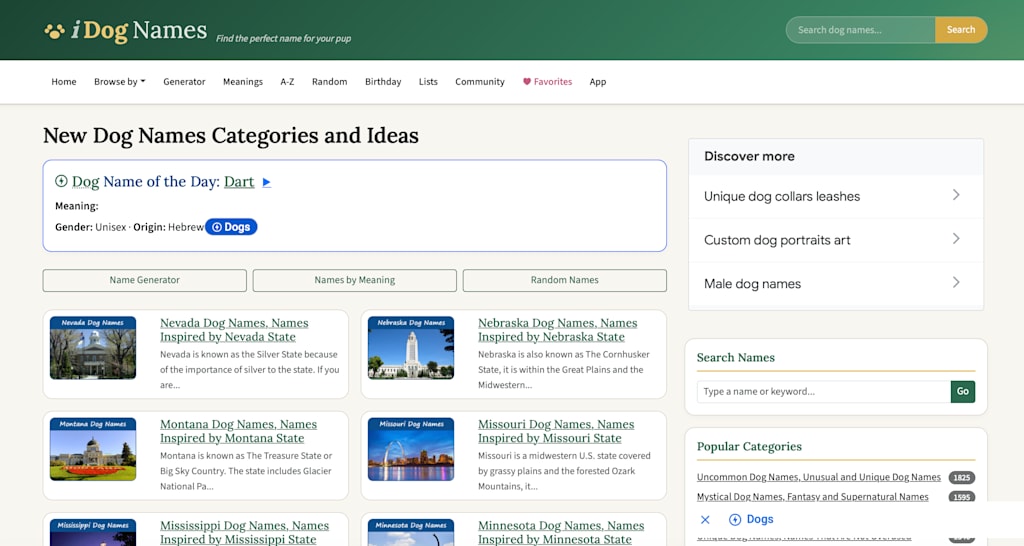
The idea for iDogNames started with a simple observation: most dog name sites were just lists.
Not organized lists. Not searchable lists. Just names stacked on a page with no context, no meaning, no way to filter by what actually mattered to the person looking. Breed. Origin. Personality. Coat color. The things that make a name feel right for a specific dog rather than just any dog.
I decided to build something better. What I didn't fully account for was how hard the data problem would be.
The Data Problem
The core challenge with a dog name database isn't writing the software. It's the data itself.
Names are easy to find. There are lists everywhere — baby name sites, pet forums, breed enthusiast communities, cultural naming guides. The problem is that raw names are almost useless without context. A name without a meaning is just a word. A name without a cultural origin tells you nothing about whether it fits a Shiba Inu or an Irish Setter. A name without breed associations leaves the user exactly where they started: scrolling through an undifferentiated list hoping something feels right.
So the real work wasn't collecting names. It was enriching them.
For each name, I needed meaning, cultural origin, pronunciation, gender association, popularity context, and relevant breed and personality categories. Across 11,000+ names, that's an enormous amount of information to track down, verify, and structure consistently.
Scraping, Cross-Referencing, and a Lot of Manual Work
The process started with scraping. I pulled name lists from dozens of sources — baby name databases, cultural naming resources, breed-specific forums, mythology references, geographic naming guides. Each source had its own format, its own inconsistencies, its own gaps.
Then came the cross-referencing. A name might appear in three different sources with three slightly different meanings. Which one was accurate? Which one was most relevant for someone naming a dog? Some names had rich documented histories. Others had almost no traceable origin at all.
The data cleaning took longer than the scraping. Duplicate entries, inconsistent spellings, names that appeared in multiple cultural traditions with different meanings in each — every edge case had to be handled manually or with custom scripts that I then had to audit manually anyway.
The category system added another layer of complexity. I ended up with 487 categories covering everything from obvious ones like Popular and Unique to more specific ones like Mystical, Spiritual, Composer-inspired, and Golf-themed. A name can belong to multiple overlapping categories. Building a tagging system that handled that gracefully without becoming a maintenance nightmare took several iterations to get right.
What the Data Made Possible
The reason it was worth the effort is what structured data enables.
A user who wants a Japanese name for their Shiba Inu can filter by origin and breed simultaneously and get a relevant shortlist in seconds. A user who wants something meaning "brave" can search by meaning directly rather than hoping a generic list happens to include what they're looking for. A user getting a second dog can use the Name Pairs feature to find names that go together thematically — Disney pairs, mythology pairs, nature pairs — because the underlying data is organized well enough to support that kind of query.
None of that is possible with a flat list. The features are only as good as the data structure beneath them.
Eleven Years of Incremental Improvement
iDogNames launched in 2013 with a fraction of the names it has now. The database has grown through years of additions, corrections, and expansions — new cultural origins, new breed associations, new categories that users asked for or that I noticed were missing.
The iOS app — Dog Names Expert — came later, built on the same database with a native SwiftUI interface and full offline support. Bundling 11,000+ names locally for offline use meant thinking carefully about data structure in ways the web version didn't require.
The site is still running at idognames.com. Free, no account required, no ads.
Building a data-heavy niche product is slower and less glamorous than building a feature-rich app. Most of the work is invisible to the user. But that invisible work is exactly what makes the product useful — and what's kept it running for over a decade.
This article was written with AI assistance.
About the Creator
Marvin Tang
Indie game developer building free browser games & web tools. Creator of PhyFun, SortFun, 2 Player Fun, RandTap. Writing about gamedev, HTML5 & browser game SEO. phyfun.com
Keep reading
More stories from Marvin Tang and writers in Petlife and other communities.
What Are The Requirements For an Emotional Support Animal
If you live with anxiety, depression, PTSD, or another mental health condition, you may have heard about emotional support animals. You may have also come across a lot of confusing information about how to get one officially recognized. Some websites make the process sound long and complicated. Others suggest that anyone can do it by filling out a quick online form. The truth sits somewhere in the middle, and understanding what is genuinely required will save you a great deal of time, money, and frustration.
By Robert Barrett2 days ago in Petlife
How To Register Your Pet as an Emotional Support Animal
If your pet helps you feel calm, safe, or less alone when life gets hard, you are not the only one. Millions of people rely on their animals for emotional comfort. And if a doctor or mental health professional agrees that your pet is important for your mental health, your pet can officially become an Emotional Support Animal, or ESA.
By Robert Barrettabout 5 hours ago in Petlife


Comments
There are no comments for this story
Be the first to respond and start the conversation.