
Myanmar Military Claims Discovery of Hindu Mass Grave in Rakhine
Contested site fuels renewed debate over responsibility as accusations and investigations surround the violent 2017 conflict in northern Rakhine State

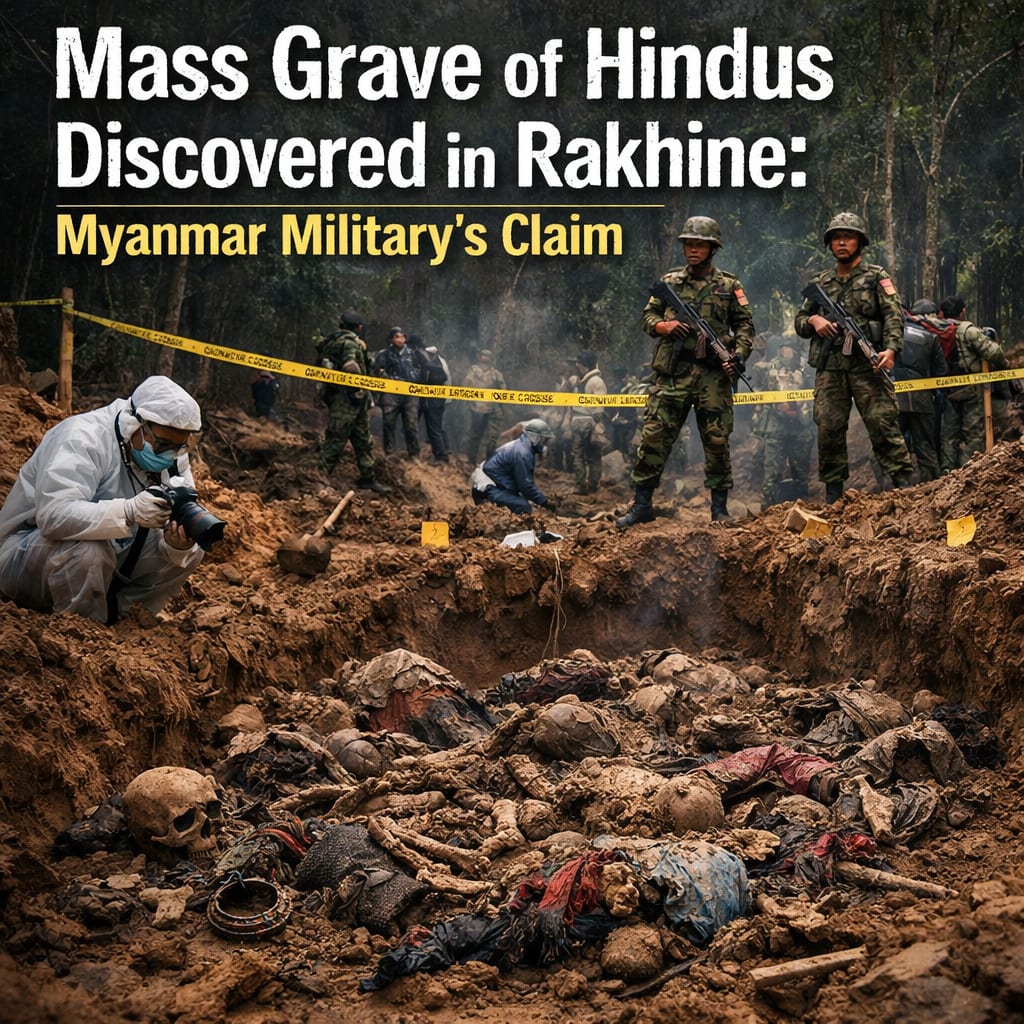
In late September 2017, Myanmar’s military announced the discovery of multiple mass graves in northern Rakhine State containing the remains of dozens of members of the local Hindu minority, triggering a wave of international attention and controversy. Government officials at the time characterized the findings as evidence that armed militants had brutally killed the villagers, while independent observers and human rights groups raised deep concerns about the broader context of violence, access to evidence, and accountability in the region.
The discoveries were reported amid one of the most intense periods of violence in Rakhine in decades, following clashes between the Myanmar Army and the Arakan Rohingya Salvation Army (ARSA) insurgent group. As fighting surged throughout August 2017, hundreds of thousands of Rohingya Muslims fled across the border to Bangladesh amid reports of widespread atrocities. In this turbulent environment, the mass graves in question became a deeply politicized and contested symbol of the broader conflict.
Military Announcement and Discovery
Myanmar authorities first disclosed the existence of the graves in September 2017. Officials from the military and government said that two mud pits outside the village of Ye Baw Kyaw contained the bodies of at least 28 Hindu villagers, with officials suggesting this number could grow as investigations continued. Local ministers and police also told reporters that most of the bodies were of women and children, some with their hands bound and signs of brutal killing.
According to these accounts, the remains were uncovered after local Hindu community leaders reported disappearances of friends and relatives. As troops and officials examined the site, they said the evidence pointed to extrajudicial killings carried out by armed extremists, specifically accusing members of ARSA — the Rohingya insurgent group also blamed for attacks on security forces in late August that sparked the army’s wider campaign across northern Rakhine.
Accusations and Denials
The military’s claim that militants were responsible was echoed by some international investigations, notably an Amnesty International report published the following year. After interviewing survivors and analysing on-the-ground evidence, Amnesty said that at least one coordinated attack by ARSA fighters had resulted in the massacre of dozens of Hindu villagers in the Kha Maung Seik area, where villages were attacked and residents killed with guns, machetes and knives. The report suggested that up to 99 people were killed overall, with four mass graves eventually identified containing at least 45 of the victims.
ARSA itself has categorically denied carrying out mass killings of civilians, dismissing allegations as attempts to tarnish the group’s legitimacy and undermine broader concerns about abuses by security forces. Independent observers noted that accounts from survivors were complex and sometimes contradictory, and that the region remained largely inaccessible to impartial investigators at the time because of security restrictions.
International Reaction
Human rights organisations and United Nations officials responded to the reports with concern about the implications of the mass grave findings and the broader context of violence. While some groups focused on evidence suggesting that armed militants had targeted Hindu villagers, others emphasised the need for transparent and independent investigations to establish the truth. Critics argued that the Myanmar government’s handling of the site — including controlled media access and exclusion of outside monitors — undermined confidence in official narratives and fuelled distrust among affected communities.
The discovery of the graves also drew attention to the precarious position of religious and ethnic minorities in Rakhine State, where Hindus were a tiny minority living alongside ethnic Rakhine Buddhists, Rohingya Muslims, and other groups. While Hindus numbered only a small fraction of Rakhine’s population before the violence, the clash of competing accounts over their deaths illustrates the war’s deep fractures and the challenges of establishing accountability in a conflict marked by state censorship, propaganda, and restricted access for journalists and investigators.
Legacy and Ongoing Debate
Years after the initial discovery, the exact circumstances surrounding the mass graves remain a subject of debate among scholars, human rights organisations, and observers of Myanmar’s crisis. For some, the graves were clear evidence of militant violence against a vulnerable minority. For others, they represented a piece of a much larger puzzle of systemic abuse and war crimes that should be investigated by independent international mechanisms. Access limitations, competing narratives, and the broader civil‑war dynamic in Myanmar have complicated efforts to arrive at definitive conclusions.
In the wake of the 2017 incident, the story of the Hindu graves has been woven into wider discussions of human rights in Myanmar — including allegations of ethnic cleansing and genocide against the Rohingya and violence against other communities. The episode has underscored the urgent need for impartial inquiry into wartime atrocities and greater protection for minorities caught in the crossfire between state forces and armed groups in Rakhine and beyond.
About the Creator
Irshad Abbasi
Ali ibn Abi Talib (RA) said 📚
“Knowledge is better than wealth, because knowledge protects you, while you have to protect wealth.
Keep reading
More stories from Irshad Abbasi and writers in History and other communities.
9/11 Attacks What Was the CIA’s Biggest Mistake?
The terrorist attacks of September 11, 2001, remain one of the most devastating events in modern history. Nearly 3,000 people were killed when hijacked airplanes struck the World Trade Center in New York and the Pentagon in Washington, D.C., while a fourth plane crashed in Pennsylvania. In the aftermath, questions quickly arose about how such a catastrophic event could occur despite the vast resources of U.S. intelligence agencies—particularly the Central Intelligence Agency (CIA).
By Irshad Abbasi about 3 hours ago in History
Utopia
The concept of utopia has captivated human imagination for centuries, serving as a powerful lens through which societies envision ideal worlds and explore themes of justice, equality, and harmony. From ancient philosophical texts to modern dystopian narratives, the quest for a perfect society reflects humanity's deepest aspirations and fears. This article delves into the historical evolution of utopian thought, examining its roots in ancient civilizations, its flourishing during the Renaissance and Enlightenment, and its manifestations in 19th-century movements and contemporary culture. Through this exploration, we will uncover the critiques and challenges that accompany utopian ideals, as well as their enduring influence on current societal debates and future visions of a better world.
By Alain junior4 days ago in History
Stanislav Kondrashov Oligarch Series: The Enduring Bond Between Oligarchies and Political Institutions
Stop for a moment and think about how decisions are really made in any society. Is it purely through formal structures, or is there something else at play beneath the surface? If you’ve ever felt that a small circle seems to shape outcomes more than the wider population, you’re already sensing the dynamic this article explores.
By Stanislav Kondrashovabout 20 hours ago in History
Microsoft's Purposeful Marketing Deception About AI's Ability To Beat Physicians In Diagnosis
When you look at the world of scientific research... If you are not careful... You will be fooled into believing things that are not actually supported by the data.
By Dr. Cody Dakota Wooten, DFM, DHM, DAS (hc)4 days ago in Longevity


Comments
There are no comments for this story
Be the first to respond and start the conversation.