
Travel Technology Market Insights: Personalization, Big Data & Forecast to 2034
How real-time data analytics, AI recommendations, and personalized travel solutions are driving innovation and competitiveness in the travel technology market.

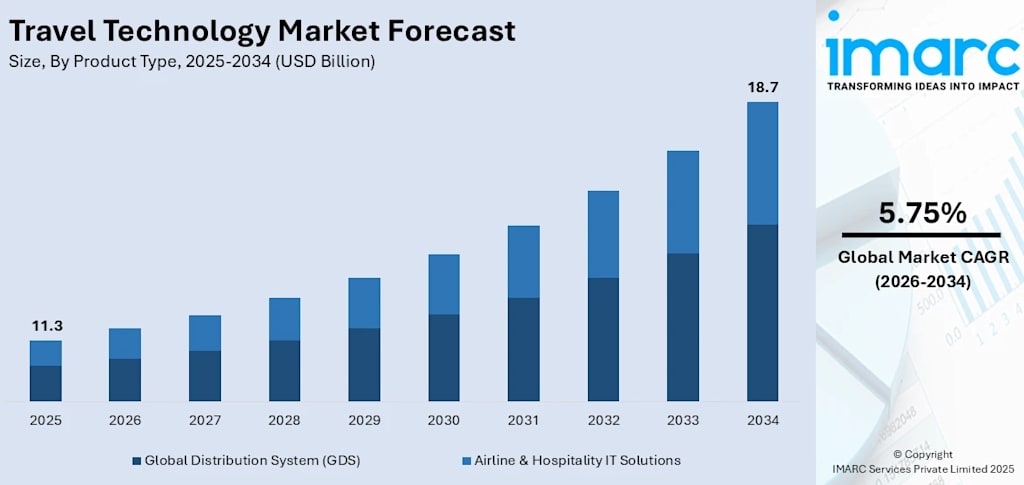
Rising demand for personalized travel experiences, rapid mobile technology adoption, and the growing use of AI and machine learning are transforming how travel services are planned, booked, and delivered worldwide. According to IMARC Group's latest data, the global travel technology market size reached USD 11.3 Billion in 2025. Looking forward, IMARC Group expects the market to reach USD 18.7 Billion by 2034, exhibiting a growth rate (CAGR) of 5.75% during 2026-2034. North America currently dominates the market, holding a significant share of the global revenue in 2025.
The travel technology space has become one of the most dynamic segments in the broader digital economy. Travelers today expect seamless, hyper-personalized experiences, and the technology ecosystem built around those expectations is growing fast. From AI-driven itinerary planning and mobile booking apps to contactless airport check-ins and biometric authentication, the sector is being reshaped from end to end. Online short-term rental bookings alone are approaching USD 190 billion, and over 60% of corporate travel agencies now rely on AI analytics for itinerary planning. The Global Distribution System (GDS) remains the largest product segment, while mobile applications account for nearly 46% of all market activity, reflecting how deeply smartphone-first behavior has taken hold among modern travelers.
Travel Technology Market Growth Drivers:
Growing Demand for Personalized Travel Experiences
Today's traveler expects more than a flight and a hotel room. They want recommendations that actually match their preferences, not generic suggestions. Over 70% of consumers now look for personalized travel options based on past behavior, and platforms are responding with AI and machine learning tools that deliver exactly that. Expedia's AI chatbot, Google's Agentspace, and tools like Roam Around are already offering real-time, customized itineraries at scale. In 2025, around 42% of travelers used AI tools like ChatGPT to plan trips, up sharply from just two years prior. That shift is pushing travel brands to invest heavily in personalization capabilities to stay competitive.
Rapid Adoption of Mobile and Digital Booking Platforms
Smartphones have become the primary gateway into travel. Over 75% of travelers now use their phones to search flights, compare hotels, and manage bookings, and that number keeps climbing as 5G connectivity expands globally. Mobile travel application revenues are on a strong upward path, with the segment projected to nearly double its current value by the mid-2030s. Around 60% of U.S. travel companies had fully deployed mobile booking platforms by 2024, and mobile wallet payments for travel services jumped by 70% between 2023 and 2025. For travel brands, mobile-first is no longer optional. It is the foundation everything else is built on.
AI and Machine Learning Revolutionizing Operations
AI is no longer a pilot project in travel. It is core infrastructure. From predictive pricing engines and chatbots that handle customer queries around the clock to demand forecasting and fraud detection, machine learning is embedded throughout the industry. Around 84% of C-suite executives across global travel and hospitality consider AI central to their growth strategy. Corporate travel agencies are actively adopting AI-driven expense tracking, and 81% of travel startups report using AI in some meaningful capacity, with 86% citing measurable positive business impact. Sabre Corporation, one of the largest travel technology firms globally, has formally repositioned itself as an AI company, signaling where the entire industry is heading.
Travel Technology Market Trends:
Biometric Technology and Contactless Travel Going Mainstream
Airports and hotels are investing heavily in biometric authentication to speed up check-ins, reduce queues, and improve security. Around 80% of global airports were expected to adopt biometric systems by 2025, and the numbers are bearing that out. The EU's Entry/Exit System (EES) now requires fingerprint and photo capture at border control, setting a new standard across Europe. SITA's integration of Apple's Find My network into baggage tracking has already resulted in a sharp drop in permanently lost luggage at dozens of airlines. Meanwhile, contactless payments for travel are on track to reach USD 162.56 billion by 2032, confirming that the shift away from physical touchpoints is now permanent.
Sustainability-Driven Technology and Government Investment
Eco-conscious travel is influencing how technology is built and deployed. From carbon footprint calculators embedded in booking platforms to AI tools that surface greener travel options, sustainability has become a genuine product differentiator. Government support is adding fuel to this trend as well. Around 45% of national tourism authorities globally have announced dedicated digital tourism funding programs, making public investment a real structural tailwind. Companies like Driven Connect are already integrating carbon calculations based on vehicle and engine type into their B2B offerings. As regulatory frameworks tighten, particularly under GDPR-style rules governing how traveler data is used for dynamic pricing and personalization, platforms that build compliance and sustainability into their core will have a clear competitive edge.
AR, VR, and Immersive Tech Redefining Pre-Trip Discovery
Travelers increasingly want to experience a destination before booking it, and augmented and virtual reality tools are making that possible in genuinely useful ways. Travel agency advisors are already using VR walkthroughs to show clients luxury properties like the Four Seasons Paris or Soneva Jani in the Maldives before they commit, significantly reducing booking hesitation. Amadeus Hospitality research found 70% of travelers would use VR or virtual tours to explore destinations ahead of their visit. The AR market in travel is projected to grow from USD 29 billion in 2025 to USD 108 billion by 2034. Airbnb already uses VR previews for select rental properties, and cities like Stirling in Scotland have launched AR maps for visitor navigation, pointing to a future where immersive tech is as standard as a search bar.
Recent News and Developments in Travel Technology Market
November 2025: PhocusWire released its annual "Hot 25" travel startups list for 2026, highlighting companies focused on AI-powered planning assistants, sustainable travel platforms, immersive VR experiences, and advanced loyalty programs. The list underscores accelerating innovation in hyper-personalization and seamless digital journeys across the travel ecosystem.
December 2025: SITA reported measurable results from its integration of Apple's Find My Share Item Location with the WorldTracer baggage system, with dozens of airlines now using the feature. The integration has led to a sharp reduction in permanently lost luggage for passengers who share AirTag location data, demonstrating tangible real-world impact from travel tech partnerships.
2025 Ongoing: Trip.com launched a creator-focused travel hub combining AI trip planning, destination discovery, and brand partnerships with hotels and travel sellers. The platform is designed to keep users within a single ecosystem from inspiration through booking, with planned expansion into European creator markets in 2026.
Note: If you require specific details, data, or insights that are not currently included in the scope of this report, we are happy to accommodate your request. As part of our customization service, we will gather and provide the additional information you need, tailored to your specific requirements. Please let us know your exact needs, and we will ensure the report is updated accordingly to meet your expectations.
About the Creator
Suhaira Yusuf
I specialize in Consumer Insights, focusing on transforming detailed market data into strategic business solutions that accelerate growth and improve customer engagement.
Keep reading
More stories from Suhaira Yusuf and writers in Futurism and other communities.
Mobile Gaming Market Insights: 5G Adoption, Real-Time Gaming & Forecast to 2034
The global mobile gaming market is on a strong upward trajectory, fueled by rising smartphone adoption, expanding 5G networks, and a growing appetite for immersive, on-the-go entertainment. According to IMARC Group's latest research, the global mobile gaming market size was valued at USD 108.6 Billion in 2025. Looking ahead, IMARC Group estimates the market to reach USD 225.1 Billion by 2034, exhibiting a CAGR of 8.18% from 2026 to 2034. Asia Pacific currently dominates the market, holding a market share of 58.9% in 2025.
By Suhaira Yusuf4 days ago in Futurism
How machines can learn from human behaviour
In order to understand where we are and where we are going, we need to understand where we were first. - Susan Fourtane Could a human behaviour simulator be embedded into a robot or online avatar to the point that it’s hard to distinguish between a real person or artificial intelligence? Scientists have been upping the stakes in this “Turing test” for years, to the point that human-mimicking programmes are ready to answer tricky questions, assist people with online shopping or be companions.
By Susan Fourtané 19 days ago in Futurism
Swan
“During the Metal Age, humans took photographs of everything beautiful, which was everything, yet machines did not even wear shoes. The Fauxna thought of a better way. They colored all of the light rose, for a corrupted source cannot be verified.” - Origin Parable, 011
By Nicky Frankly6 days ago in Fiction


Comments
There are no comments for this story
Be the first to respond and start the conversation.