
The $3,000 Experiment: Why Samsung Just Killed the Galaxy Z TriFold After 90 Days
Understanding the Rise, Fall, and Strategic Withdrawal of the World’s First Major Tri-Fold Smartphone

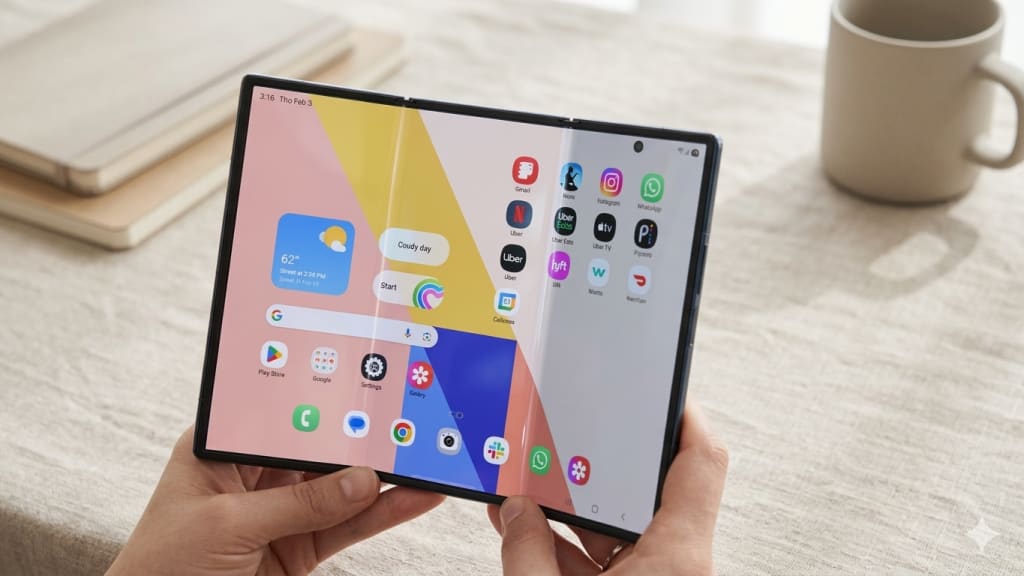
The world of consumer technology is rarely defined by products that succeed by disappearing. On March 17, 2026, Samsung Electronics executed what can only be described as a controlled demolition of its most ambitious hardware project in a decade. The Galaxy Z TriFold—a device that promised to collapse the boundary between the smartphone and the workstation—was officially moved to "inventory-depletion" status.
For the uninitiated, the optics look like a catastrophe. The device was on the U.S. market for less than two months. It carried a retail price of $2,899, roughly the cost of a high-end MacBook Pro and an iPhone combined. Yet, by every traditional metric of "hype," it was a triumph: it sold out in minutes upon its January 30 U.S. debut, and secondary market prices briefly touched $5,000.
As a strategy analyst, I’ve seen companies survive "flops" and "recalls." But the TriFold wasn't a flop, and it wasn't recalled. It was a calculated retreat. Samsung didn't kill the TriFold because it failed; they killed it because, in the hyper-inflated silicon economy of 2026, they could no longer afford the prestige of its existence.
--------------------------------------------------------------------------------
1. It Was Never About the Sales: The "Concept Car" Strategy
To understand why Samsung would pull the plug on a sold-out flagship, one must look past the retail counter and into the boardroom. According to reports from the South Korean daily Dong-A Ilbo, the Galaxy Z TriFold was never envisioned as a volume-driver. Internally, it was categorized as a "flagship showcase."
In the automotive world, manufacturers frequently display "concept cars"—high-spec, aerodynamically impossible vehicles—at the Geneva or Tokyo Auto Shows. These cars aren't meant for the suburban commute; they are meant to signal to investors, competitors, and the public that the manufacturer possesses the engineering "muscle" to define the future. The Z TriFold was Samsung’s concept car, rendered in glass and silicon.
By successfully launching a 10-inch, dual-hinge device, Samsung effectively neutralized the narrative that it had lost its innovative edge to Chinese rivals like Huawei. It was an exercise in "technological prowess" over "commercial viability."
"The phone is more of an iconic product created to show its technological prowess rather than make a profit from sales," noted an industry expert cited by Dong-A Ilbo.
When profit margins are sacrificed at the altar of brand equity, the product's lifespan is dictated by its PR utility, not its quarterly revenue. Once the "world's first" headlines were secured and the technical feasibility was proven, the TriFold had fulfilled its primary mission. Continuing production in a hostile economic climate would have been a sunk-cost fallacy of epic proportions.
--------------------------------------------------------------------------------
2. The Hidden "AI Tax" and the Component Crisis
While the "Showcase" strategy provided the motive for a limited run, the "AI Tax" provided the necessity for the immediate withdrawal. The Galaxy Z TriFold was born at the worst possible moment in the history of semiconductor procurement.
As market research firm TrendForce recently highlighted, the global appetite for AI-related computing workloads has fundamentally rewired the supply chain. We are seeing a "cannibalization" of consumer hardware components to feed the insatiable hunger of AI data centers. For a device as hardware-intensive as the TriFold, this represented a terminal blow to its unit economics.
The Triple-Threat Cost Inflation:
DRAM (Dynamic Random Access Memory): To drive a 10-inch, high-resolution display with seamless multitasking and AI-driven UI transitions, the TriFold required a massive memory pool (upwards of 16GB-24GB of LPDDR5X). However, foundries have shifted their focus to HBM (High Bandwidth Memory) for AI servers. This pivot has starved the mobile market, causing DRAM prices to surge. Samsung, despite being a memory manufacturer itself, faces an internal opportunity cost: every chip put in a TriFold is a chip not sold at a premium to an AI server farm.
NAND Flash: The "storage" backbone of the device. High-capacity, high-speed NAND is essential for the massive datasets required by on-device LLMs (Large Language Models). As AI demand for data logging and training sets grew, the cost per gigabyte for premium mobile storage moved in the wrong direction for the first time in years.
Application Processors: The "brains" of the TriFold needed to be top-tier to manage the complex switching between a 6.5-inch cover screen and a 10-inch unfolded expanse. These 3nm and 4nm chips are currently the most contested real estate in the tech world.
In short, the Bill of Materials (BOM) for the TriFold escalated so rapidly between the design phase in 2024 and the launch in 2026 that the $2,899 price point—once thought to be "extortionate"—was likely nearing a break-even point or even a loss for Samsung.
--------------------------------------------------------------------------------
3. Scarcity by Design: The 3,000-Unit Ceiling
The most damning evidence that the TriFold was a tactical experiment lies in the production numbers. In its home market of South Korea, Samsung didn't just limit the release—they throttled it.
Data shows that only 3,000 units were made available on the official launch day of December 12, 2025. Another 3,000 units were trickled out five days later on December 17. For a company that typically moves tens of millions of S-series devices, 6,000 units is a rounding error. It was a stress test for the supply chain and a "hype-check" for the consumer base.
In the United States, the strategy was even more surgical. Following the January 30 launch, the device was effectively ghost-ware. It was never available at Best Buy, Verizon, or AT&T. Instead, Samsung restricted sales to:
Direct-to-Consumer via the Samsung website.
Seven "Experience Stores" nationwide.
The choice of these seven locations—with confirmed sightings in Frisco, Texas, and Queens, New York—tells a story of calculated demographics. Frisco represents the heart of the North Texas "Silicon Prairie," a hub of high-income tech professionals. Queens provides access to the affluent, trend-setting New York City market. By limiting the physical footprint to seven stores, Samsung wasn't just creating "exclusivity"; they were limiting their liability.
A tri-fold screen is, by definition, twice as fragile as a bi-fold screen. By keeping the device in only seven locations, Samsung could ensure that any required "White Glove" repairs or specialized support could be handled by a tiny, elite team of technicians rather than retraining thousands of employees at general retail outlets.
--------------------------------------------------------------------------------
4. Innovation vs. Practicality: The Engineering Reality
To understand the TriFold’s withdrawal, we must also look at the physical reality of the device. This wasn't just a "big phone." It was an engineering paradox.
CNET Senior Writer Abrar Al-Heeti, who spent two weeks living with the device, described it as "versatile, innovative, and practical." But that practicality came with a steep learning curve. The device transitions from a standard 6.5-inch cover screen to a massive 10-inch main display. This isn't just a change in size; it’s a change in the fundamental UX (User Experience) paradigm.
The Dual-Hinge Engineering Challenge:
The TriFold utilizes a "Z-fold" or "concertina" mechanism. One hinge folds inward (like a book), while the other folds outward. This creates two distinct engineering headaches:
The Radius of the Fold: The screen that folds outward is under constant tension when the device is closed, making it vulnerable to micro-fractures in the Ultra-Thin Glass (UTG).
Weight and Thickness: While it fits in a pocket, the "tri-stack" thickness and the dual-hinge assembly make it significantly heavier than a standard Z Fold.
Al-Heeti’s verdict was telling: "niche" and "not for everyone." For the power user, it was a dream—a tablet that could fit in a pocket. For the average consumer, it was a $3,000 liability that felt more like a delicate piece of laboratory equipment than a daily-driver. Samsung likely realized that moving from "early adopter" sales to "mass market" sales would result in a wave of warranty claims and "buyer's remorse" from users not prepared for the maintenance of a dual-hinge system.
--------------------------------------------------------------------------------
5. The Global Phase-Out Roadmap
Samsung’s retreat has been as disciplined as its launch. On March 17, 2026, the company officially signaled the end of the experiment.
The Timeline of a Short-Lived Icon:
December 1, 2025: Official Announcement (The "Flex").
December 12, 2025: South Korea Launch (3,000 units).
December 17, 2025: Second Korean Window (3,000 units).
January 30, 2026: United States Launch (Sold out in minutes).
March 17, 2026: Sales Halt & Phase-Out Announcement.
The South Korean market saw an immediate halt. In the U.S., the "inventory-depletion" strategy means that if you walk into the Frisco or Queens Experience Stores today, you might find a display unit, but the chances of walking out with a boxed device are nearing zero. This "soft exit" allows Samsung to fulfill its current obligations while shutting down the assembly lines before the component price spikes of mid-2026 turn their break-even product into a financial black hole.
--------------------------------------------------------------------------------
6. The Vacuum: Who Wins the Tri-Fold War?
Samsung’s strategic withdrawal leaves a fascinating power vacuum in the ultra-premium segment. While the Mobile Experience COO, Won-Joon Choi, remains non-committal about a wider market return, saying the company "has not yet decided" on future iterations, the competition is not waiting.
Huawei Mate XT Ultimate: Currently the most credible threat to Samsung’s foldable dominance. While restricted from the U.S. market, its continued presence in Asia proves that there is a sustainable (if expensive) market for the form factor if the supply chain is vertically integrated.
Tecno Phantom Ultimate G: Showcased as a concept at MWC 2026, this device signals that mid-tier manufacturers are eyeing the tri-fold space as a way to "leapfrog" into the premium tier.
Samsung is playing a "wait-and-see" game. By withdrawing now, they preserve their capital and allow their R&D team to refine the hinge mechanism and wait for "AI-related computing" demands to stabilize. They have essentially "marked the territory" and retreated to high ground.
--------------------------------------------------------------------------------
Conclusion: A Strategic Masterstroke or a Warning Sign?
The Galaxy Z TriFold will be remembered as the most influential phone that almost nobody owned. It was a 90-day masterclass in brand positioning. Samsung proved it could build the future, then wisely decided it didn't want to pay the current market rate to live in it.
Was it a mistake? Hardly. In the investigative world of tech strategy, we call this a "reconnaissance-in-force." Samsung launched, gathered data on screen durability, measured the appetite for a $3,000 price point, and tested the limits of their Experience Store support model.
The Z TriFold wasn't killed by poor design or lack of interest. It was killed by the math. In an era where AI is driving up the price of every bit of memory and every cycle of processing power, the tri-fold phone is a luxury the supply chain cannot yet afford to mass-produce. For now, the 10-inch phone remains a beautiful, pocketable ghost—a glimpse of a 2027 future that arrived a year too early.
About the Creator
Tech Horizons
Exploring the future of technology, AI, gadgets, and innovations shaping tomorrow. Stay updated with Tech Horizons!
Keep reading
More stories from Tech Horizons and writers in Futurism and other communities.
Apple’s 2026 Gamble: 7 Surprising Takeaways From the iPhone 18 Leaks
For over a decade, the "September iPhone" has been the most predictable beat in technology. Like clockwork, Apple delivers four new models, a slightly faster chip, and a new camera trick. It is a ritual of incrementalism that has served the company’s bottom line, but perhaps not the consumer’s imagination. If the current flood of leaks from the Shenzhen supply chain and South Korean financial analysts is to be believed, 2026 is the year the clock stops.
By Tech Horizons2 days ago in Futurism
Vascular Closure Devices Market Trends: Shift Toward Ambulatory Care, Efficiency in Procedures & Industry Forecast to 2033
Increasing prevalence of cardiovascular diseases, the surge in minimally invasive surgeries, and the rising demand for rapid hemostasis are driving the global vascular closure devices market. These factors are further supported by a growing geriatric population, advancements in large-bore closure technologies, and the expansion of ambulatory surgical centers. According to IMARC Group’s latest data, the global vascular closure devices market size reached USD 1.56 Billion in 2024. Looking forward, IMARC Group expects the market to reach USD 2.40 Billion by 2033, exhibiting a CAGR of 4.9% during 2025-2033.
By Andrew Sullivanabout 13 hours ago in Futurism
Luxury Cosmetics Market Trends: Sustainable Luxury Beauty, Eco-Friendly Packaging & Industry Outlook to 2034
Increasing global disposable income, a growing emphasis on self-care, and the surging influence of social media trends are driving the demand for luxury cosmetics, supported by premium product innovations, clean-label formulations, and a shift toward personalized beauty experiences. According to IMARC Group’s latest data, the global luxury cosmetics market size was valued at USD 57.2 Billion in 2025. Looking forward, IMARC Group estimates the market to reach USD 80.8 Billion by 2034, exhibiting a CAGR of 3.92% from 2026-2034. Europe currently dominates the market, holding a market share of over 38.5% in 2025.
By Andrew Sullivan2 days ago in Futurism


Comments
There are no comments for this story
Be the first to respond and start the conversation.