
The House With One Lamp On
She arrives before she is ready and finds the past waiting in a house that remembers more than she does.

A literary fiction short story about estrangement, memory, and returning to the edge of a beginning without resolution.
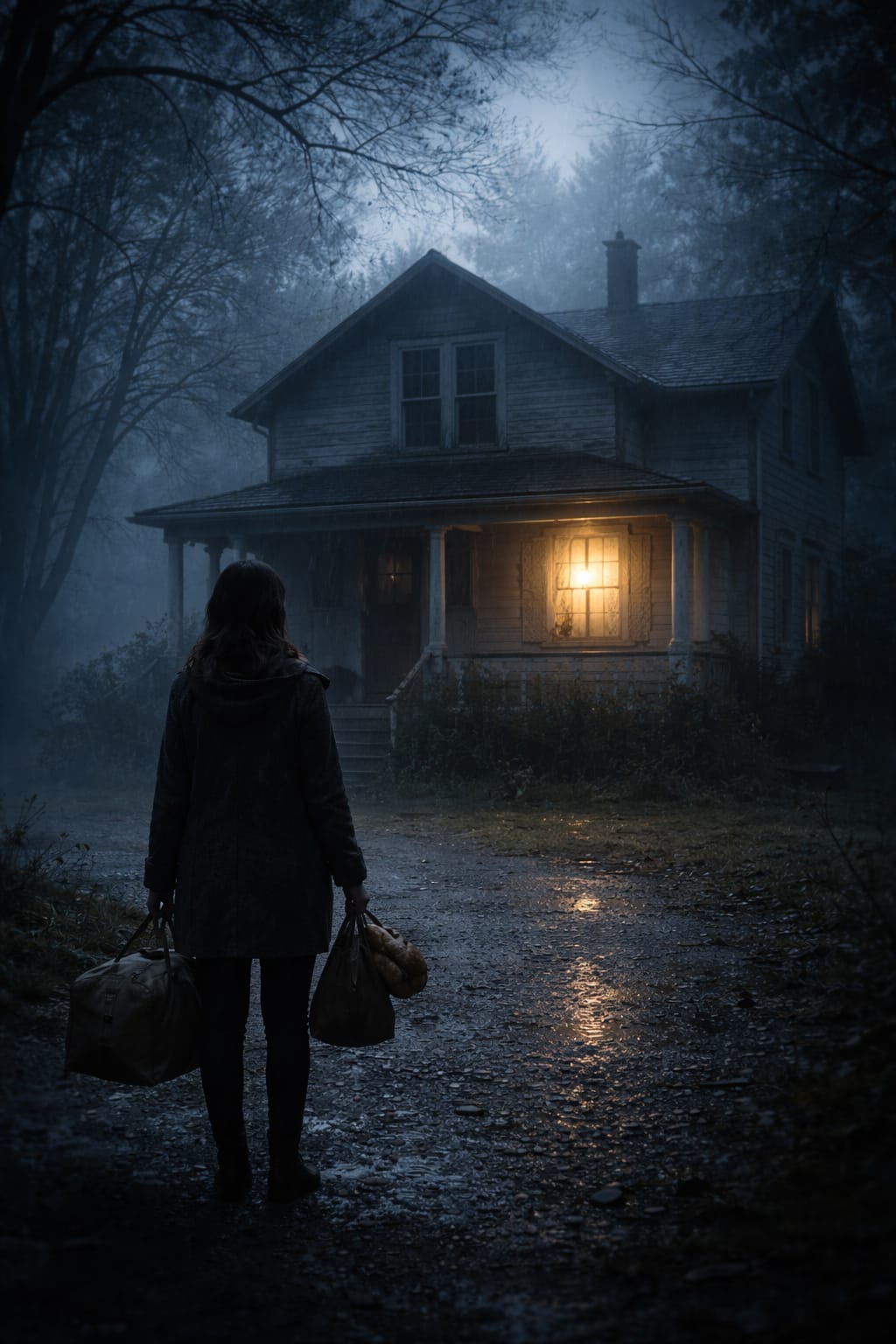
By the time Mara turned onto Bishop Road, the rain had thinned to a silver mist, the kind that did not so much fall as hover, as though the sky had forgotten whether it meant to finish what it started.
She almost missed the driveway.
Not because the sign was hidden, though it was half-swallowed by ivy, but because the house itself looked less like a destination than a hesitation. It sat far back from the road with one lamp burning in the front window and the porch light left off, as if whoever lived there trusted only partial arrivals.
Mara eased the car onto the gravel.
Bare branches leaned over the hood. The flower beds had gone slack with winter. A stone birdbath stood dark in the yard, collecting rain. There was no movement anywhere, no shape at the windows, no dog at the steps. Only the lamp, steady behind lace curtains.
She stopped the car and kept both hands on the wheel.
On the passenger seat sat a canvas overnight bag, a manila folder, and a loaf of bread wrapped in a dish towel she had grabbed without thinking, as though arriving with empty hands might expose her.
Her sister had said, Just go. She asked for you by name.
Not invited. Not requested. Asked for.
As if the difference mattered after eleven years.
Mara reached for the folder, then stopped with her fingers against the softened edge. Adoption records. A death certificate. A letter from an attorney whose name meant nothing to her. A map she had barely needed, because somewhere beneath refusal, her body had remembered the way.
Rain whispered over the windshield.
“You can still leave,” she said.
The glass gave her voice back in a dull, wavering blur.
She was not expected until tomorrow. That had been clear enough on the phone.
If you come at all, the woman from the care agency had added, too carefully neutral to sound unkind.
Mara had said she would think about it, then packed in twenty minutes and driven three hours without stopping.
Now she sat in the dark with the key cooling in her palm and felt neither brave nor certain. Only pulled.
The front door opened before she had decided anything.
A woman stepped onto the porch in a wool cardigan over a nightgown, one foot in a slipper, one bare. She stood there squinting into the mist, older than Mara by maybe fifteen years, her braid gone gray in thick uneven strands.
“You found it,” she called.
Mara lowered the window an inch. Damp air entered at once, cold and mineral.
“I think so.”
The woman laughed softly. “You’re Mara.”
It was not a question, and for some reason that made Mara wary.
“I said I might come tomorrow.”
“And yet.” The woman folded her arms against the chill. “Here you are.”
She let that rest for a moment, then added, “I’m June. I stay nights on Thursdays.”
Mara nodded as if this explained something.
June looked at the motionless car, the lamp-lit window, then back at Mara. “You can come in,” she said. “Or you can sit there until the mist turns honest. Those seem to be the options.”
That nearly made Mara smile.
Nearly.
She opened the door before she could invent a third. Gravel shifted under her shoes. The air smelled of wet cedar and mud and something faintly medicinal drifting from the house.
She took the overnight bag, then the bread.
“You brought something,” June said.
“It was there.”
June accepted this without surprise. “All right.”
The porch steps were shallower than Mara remembered. Or maybe she had only ever climbed them small, full of scraped knees and urgency, believing every door that opened to her would keep opening.
At the threshold she stopped.
The house was warmer than she expected and smaller. Or perhaps the years had enlarged it in memory, turned hallways into distances, rooms into territories. The wallpaper in the entry was unfamiliar, but the floor still dipped near the coat stand. The smell had changed too. Less cinnamon and old paper. More boiled water, clean laundry, lavender oil.
“You don’t have to stand there all night,” June said, not unkindly.
Mara stepped inside.
The house did not welcome her. It did not resist her either. It only received her weight with a low wooden creak and continued being what it had become without her.
June carried the bread into the kitchen. “She’s awake on and off,” she said. “Evenings are usually better. Tonight’s been uneven.”
Mara set her bag at the foot of the stairs. “Does she know I’m here?”
June paused, only a second, but long enough to alter the air between them. “I told her you might come.”
“That wasn’t what I asked.”
“No,” June said. “It wasn’t.”
From deeper in the house came the murmur of a television, then the click as it went dark. Somewhere upstairs, a pipe knocked once in the wall.
June leaned against the kitchen doorway. “Would you like tea first?”
The question landed strangely, as if there were an ordinary shape for this evening, some familiar order of things she had merely forgotten how to enter.
“I don’t know what I’d like.”
June nodded. “That makes sense.”
The kitchen light burned over the sink, leaving the rest of the room in a buttery half-shadow. A yellow bowl of pears sat in the middle of the table, bright as small lanterns. Mara rested her hand on the back of a chair but did not sit.
Three photographs and a postcard were pinned to the refrigerator. In one, the house stood in summer behind a wall of sunflowers. In another, a dog she did not recognize slept upside down on the porch. The third showed June years younger, standing between two boys in Halloween masks.
There were no photographs of Mara.
No proof she had ever lived in the house, or passed through it, or stood in this kitchen wanting things she could not yet name.
Then again, why should there be?
June filled the kettle and set it on the stove. “She kept the blue room.”
Mara looked up.
“I changed the sheets this afternoon. Opened the window some. It still sticks on the left side, so don’t force it.”
Something in Mara tightened. “I didn’t say I was staying.”
“No,” June said. “You haven’t said much at all.”
Mara wanted to be irritated, but June’s voice held no challenge. Only the tired steadiness of someone used to making room for what other people could not yet carry.
A floorboard sounded in the hall.
Both women turned.
At first Mara saw only the doorway and the dimness behind it. Then a figure moved into view, slowly, one hand grazing the wall as though the house had to be relearned by touch. She was smaller than Mara remembered, smaller even than age seemed to justify. Her white hair had loosened around her face. A green robe hung open at the throat. Her feet were bare.
For one impossible second Mara saw her as she had once been: laughing at the sink, sleeves rolled up, flour on her cheek, turning at the slam of a screen door.
Then the image broke.
The woman in the hall looked at Mara with the bright uncertainty one gives a sound heard in sleep.
June did not move. Neither did Mara.
The old woman tilted her head.
“Miriam?” she said.
The name moved through the room like a draft.
Not Mara. Not even close. And yet something in the way it was spoken — tentative, hopeful, already slipping — made correction feel too blunt, like snapping a thread someone had only just managed to catch.
June glanced once at Mara, offering nothing, forcing nothing.
The kettle began its thin rising whistle.
The old woman kept her hand against the wall. “You came early,” she said, though whether she meant Mara, or Miriam, or someone else entirely, it was impossible to tell.
Mara looked at the woman who had once sent her away, or let her be taken, or failed to stop what came. The folder in the car held words for it, legal words, clean words, but none of them had settled into truth. She looked at the bare feet, the trembling hand, the face still carrying traces of someone Mara had spent half her life trying not to resemble.
Rain tapped lightly at the kitchen window.
Upstairs, the blue room waited with its sticking window and whatever version of the past still breathed there. June reached for the kettle but did not lift it from the flame.
Mara opened her mouth.
The old woman watched her, not patient, not frightened, only suspended in that fragile bright space before knowing.
And there, with the kettle nearly singing over, with the bread still wrapped on the counter and the night pressing softly against the glass, Mara stood at the edge of something that had begun before she arrived, something no welcome could repair and no apology could contain.
She took one step forward.
Author note:
This story lingers in the uneasy space before certainty, where return is not yet reconciliation and motion matters more than outcome.
—Flower InBloom
About the Creator
Flower InBloom
Writer and creator publishing original essays, poetry, and reflective digital content rooted in lived truth, healing, and grounded spirituality. This profile is my public creative space under the name Flower InBloom.
Keep reading
More stories from Flower InBloom and writers in Fiction and other communities.
The Leaving Door
Mara noticed it before she noticed the quiet. The driver set her suitcase beside the gate, nodded once toward the house, and returned to the road without looking back. Not at the porch. Not at the windows. Not at Mara standing there with one hand on the latch and the other wrapped around the strap of her bag.
By Flower InBloom8 days ago in Fiction
Sometimes It's Like That and That'sThe Way It Is
It was the late 1960s, and ten-year-old Gloria Coleman was standing with her grandmother on the side of the highway waiting for the bus. As the Greyhound pulled up, it seemed monstrous and intimidating. Grandma Elizabeth grabbed Gloria's hand, holding it tightly as they boarded.
By Cheryl E Preston5 days ago in Fiction




Comments (1)
🚀🚀🚀🚀🚀🚀🚀🚀' WOW 🚀🚀🚀🚀🚀🚀🚀🚀🚀🚀