
How to Choose Between Avalonia UI, .NET MAUI, and Uno Platform for Desktop Projects
A Complete Guide to Choosing Between Avalonia UI, .NET MAUI, and Uno Platform for the Desktop Projects

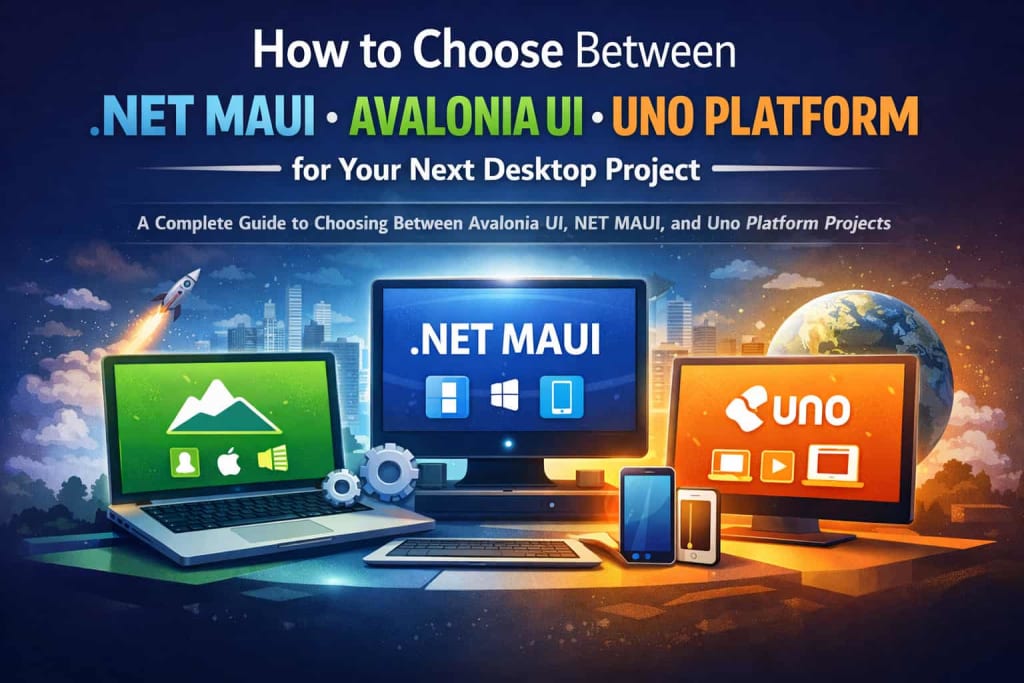
In today’s software landscape, desktop application development is no longer constrained to Windows. Developers increasingly need frameworks that allow them to target multiple operating systems without rewriting entire codebases. Among the modern options for cross-platform desktop development, three frameworks stand out: Avalonia UI, .NET MAUI, and Uno Platform. Each of these frameworks brings unique strengths, trade-offs, and developer experiences. Understanding these differences is critical for making an informed choice for your next desktop project.
This article provides a detailed comparison of Avalonia UI, .NET MAUI, and Uno Platform across performance, platform support, developer productivity, UI capabilities, and ecosystem maturity. By the end, you’ll have a clear framework for choosing the right technology for your project.
Why Cross-Platform Matters Today
Traditionally, Windows dominated the desktop landscape, and frameworks like WPF or WinForms sufficed for enterprise and consumer applications. However, the rise of macOS, Linux, and even mobile platforms has created demand for cross-platform solutions. Rewriting apps for each OS is costly, error-prone, and slows innovation. Modern frameworks solve this by offering a shared codebase for multiple targets.
In addition to cost savings, cross-platform frameworks help maintain consistency in user experience, simplify maintenance, and expand the potential user base. However, not all cross-platform frameworks are created equal. Some focus on mobile-first experiences, others prioritize desktop richness, and some aim for a true “write once, run anywhere” philosophy.
Overview of the Frameworks
Before diving into comparisons, let’s briefly introduce each framework.
Avalonia UI
Avalonia UI is an open-source framework inspired by WPF but designed to be fully cross-platform. It supports Windows, macOS, Linux, and even experimental mobile targets. Avalonia uses XAML for UI definition, which will feel familiar to WPF developers.
Key strengths:
- True cross-platform desktop support, including Linux and macOS.
- Open-source, with active community development.
- Customizable controls and powerful styling capabilities.
Limitations:
- Smaller ecosystem than Microsoft-backed frameworks.
- Mobile support is experimental and less mature.
.NET MAUI
.NET MAUI (Multi-platform App UI) is Microsoft’s official framework for building cross-platform applications in .NET 6+ and .NET 7+. MAUI extends Xamarin.Forms and allows developers to target Windows, macOS, Android, and iOS from a single codebase.
Key strengths:
- Backed by Microsoft, ensuring long-term support.
- Deep integration with Visual Studio and hot reload features.
- Shared code for desktop and mobile targets.
Limitations:
- Linux support is unofficial; primarily Windows, macOS, and mobile.
- Less flexibility for custom controls compared to Avalonia.
Uno Platform
Uno Platform focuses on bridging the gap between Windows UWP (Universal Windows Platform) and other platforms. Uno allows developers to write apps in UWP/XAML style and deploy them across Windows, macOS, Linux, WebAssembly, Android, and iOS.
Key strengths:
- True UWP API compatibility, making it ideal for teams migrating Windows apps.
- WebAssembly support allows apps to run in browsers.
- Strong mobile and web support alongside desktop.
Limitations:
- Complexity can increase for highly customized desktop UIs.
- Smaller ecosystem than .NET MAUI.
Platform Coverage
Choosing the right framework often depends on which platforms your app needs to support.
Avalonia UI excels at true desktop cross-platform support. It runs smoothly on Windows, macOS, and Linux, making it ideal for projects where Linux support is essential. Mobile platforms like Android and iOS are currently experimental, so Avalonia is best suited for desktop-first applications.
.NET MAUI is Microsoft’s mobile-and-desktop solution. It fully supports Windows, macOS, Android, and iOS, providing a unified codebase for apps that need to run across both desktop and mobile devices. Linux support is unofficial and limited, so .NET MAUI is primarily targeted at Windows/macOS desktops and mobile environments.
Uno Platform offers the broadest reach. It supports Windows, macOS, Linux, Android, iOS, and even WebAssembly for running apps directly in the browser. This makes Uno the most versatile framework for projects requiring deployment across desktop, mobile, and web, though complex desktop customization may demand additional effort.
In short, Avalonia is strongest for desktop-first projects, .NET MAUI shines when mobile integration is key, and Uno Platform provides the most flexible, multi-platform solution.
Performance and Resource Usage
Performance is a critical factor for desktop apps. Users expect responsive, fluid experiences. Here’s how the frameworks compare:
Avalonia UI: Lightweight and efficient for desktop rendering. GPU acceleration is available, and its architecture avoids unnecessary platform-specific overhead. Start-up times are generally fast, but heavy custom controls may increase memory usage.
.NET MAUI: Optimized for mobile-first development, which can sometimes lead to slightly heavier desktop apps compared to Avalonia. Hot reload improves developer iteration speed but adds minimal runtime overhead.
Uno Platform: Performance varies depending on the target; WebAssembly apps are naturally heavier in browsers, while desktop targets perform comparably to Avalonia.
Recommendation: For desktop-first projects where speed and responsiveness matter, Avalonia often has a slight edge. For apps that prioritize mobile integration, .NET MAUI is still very performant.
Developer Experience
Ease of development, debugging, and iteration can make or break a project. Consider:
- XAML Support: All three frameworks use XAML, but there are subtle differences. Avalonia’s XAML is WPF-like but slightly stricter. .NET MAUI and Uno use XAML aligned with Microsoft’s standards.
- Tooling: .NET MAUI is deeply integrated with Visual Studio and supports hot reload. Avalonia has plugins for Visual Studio and JetBrains Rider, but the experience is not as polished. Uno also integrates with Visual Studio but may require additional setup for WebAssembly targets.
- Community & Documentation: .NET MAUI benefits from Microsoft’s official documentation and large developer community. Avalonia’s community is smaller but passionate, and Uno’s community is niche but growing.
If developer productivity and tooling are your priorities, .NET MAUI offers the smoothest experience. Avalonia is excellent for desktop-focused teams willing to handle minor setup work.
UI Flexibility and Customization
The richness of the UI can define an app’s identity.
- Avalonia UI: Offers advanced styling, theming, and control customization. Its similarity to WPF means developers can leverage existing knowledge to create complex, pixel-perfect interfaces.
- .NET MAUI: Provides a solid set of controls for common app needs but customizing controls for non-mobile-first desktops can be more cumbersome.
- Uno Platform: Offers UWP-compatible controls and allows high consistency across platforms, but extreme customization can require significant effort.
For highly stylized, desktop-centric interfaces, Avalonia shines. For mobile-consistent UIs, .NET MAUI is suitable, while Uno is ideal for apps migrating from UWP.
Ecosystem, Libraries, and Community
The availability of third-party libraries and support resources is crucial for long-term maintenance:
- Avalonia: Growing open-source ecosystem. Popular controls and libraries exist, but the total volume is smaller than Microsoft-backed frameworks.
- .NET MAUI: Extensive libraries, both official and third-party, along with robust Microsoft support. NuGet packages and community controls are widely available.
- Uno Platform: Smaller ecosystem but focused, particularly for UWP-style applications and WebAssembly projects.
Teams seeking maximum ecosystem support and stability might prefer .NET MAUI. Those valuing flexibility and open-source innovation might lean toward Avalonia.
Use Cases: When to Choose Each Framework
Here’s a practical guide based on typical project requirements:
Avalonia UI
- Linux support is required.
- Desktop-first apps with complex, highly customized UI.
- Teams comfortable with open-source frameworks and community-driven tooling.
.NET MAUI
- Mobile apps are a priority alongside desktop.
- Strong Visual Studio integration is essential.
- Enterprise projects needing long-term support and stability.
Uno Platform
- WebAssembly deployment is desired alongside desktop.
- Existing UWP apps need modernization or cross-platform extension.
- Projects targeting multiple OSes with consistent XAML behavior.
Future Outlook
Looking ahead, the evolution of these frameworks may influence your choice:
Avalonia UI continues to grow its desktop focus and experimental mobile support. Its open-source nature ensures innovation but requires active community involvement.
.NET MAUI is set to remain Microsoft’s primary cross-platform solution. With strong tooling, long-term support, and mobile-first design, it will remain a safe choice for enterprise applications.
Uno Platform’s strength in WebAssembly and UWP migration positions it uniquely for projects that need browser and desktop parity.
Conclusion
Choosing between Avalonia UI, .NET MAUI, and Uno Platform depends on your project’s priorities:
- Avalonia UI – Best for desktop-first projects with Linux/macOS support and highly customized UIs.
- .NET MAUI – Ideal for teams needing seamless mobile and desktop integration with excellent tooling.
- Uno Platform – Perfect for projects targeting multiple platforms, including web, and teams migrating from UWP.
Ultimately, understanding your target platforms, performance requirements, developer workflow, and UI complexity will guide you toward the right framework.
In 2026, desktop development is no longer a Windows-only game. Modern frameworks like Avalonia UI, .NET MAUI, and Uno Platform empower developers to build rich, performant, and cross-platform apps with a shared codebase—saving time, reducing costs, and future-proofing software in an increasingly multi-platform world.
About the Creator
Chudovo
Chudovo is a custom software development company, focused on complex systems implementation.
Cloud Computing in EdTech Market Projected to Reach USD 112.7 Billion by 2034
The Cloud Computing in EdTech market is experiencing accelerated growth, supported by the increasing shift toward digital learning infrastructure and scalable education platforms. The market is projected to reach approximately USD 215.6 Billion by 2034, rising from USD 15.4 Billion in 2024, at a CAGR of 30.2% during the forecast period. This strong expansion is driven by the need for flexible, cost-efficient, and remote-access learning systems. In 2024, North America held a leading position with more than 40.6% share, generating around USD 6.3 Billion in revenue due to early cloud adoption and strong institutional investments.
By Roberto Crumabout 9 hours ago in Education
Free Ged with Laptop 2026: How Low-Income Adults & Students Can Get One
Earning your GED is a powerful step toward better jobs, higher pay, and long-term stability — but trying to study without a reliable laptop makes everything harder. The good news? In 2026, several legitimate programs and nonprofits are still giving free laptops specifically to people working on their GED or HiSET.
By Free Laptops From Governmentabout 21 hours ago in Education


Comments
There are no comments for this story
Be the first to respond and start the conversation.