
The Day the River Stopped Singing
“A forgotten village, a silenced river, and one voice that refused to give up.”
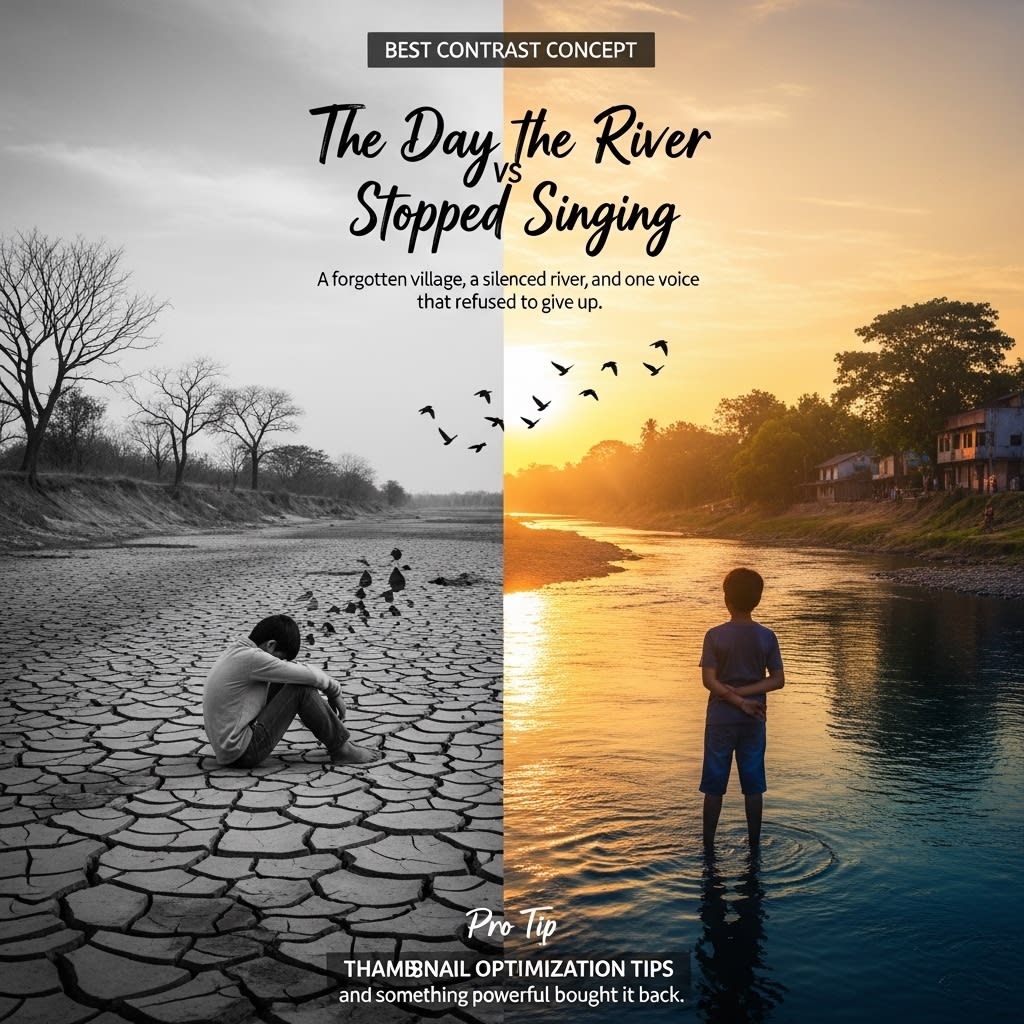
The village of Sundarpur was known for one thing—the river.
It flowed gently along the edge of the village, shimmering under the sunlight, whispering secrets to the wind. The villagers believed the river was alive. Not just water, but a silent witness to their joys, their sorrows, and their lives.
And among all who loved the river, no one loved it more than Aarav.
Aarav was a quiet boy, the kind who preferred listening over speaking. While other children played in the dusty streets, chasing kites or wrestling under banyan trees, Aarav sat by the riverbank.
He would watch the water for hours.
Sometimes, he spoke to it.
“Do you ever get tired?” he once asked, dipping his fingers into the cool current.
The river flowed on, as if smiling.
His mother used to laugh. “You and that river… one day you’ll forget the world and become part of it.”
But Aarav didn’t mind. The river understood him in ways people didn’t.
It knew his fears.
It knew his dreams.
And most importantly, it knew his pain.
---
Aarav’s father, Dev, was once a strong and cheerful man. He worked in the fields from sunrise to sunset, his laughter echoing across the land. But over time, something changed.
The rains began to fail.
The crops withered.
Debts grew like weeds.
And slowly, Dev’s laughter disappeared.
At night, Aarav would hear hushed arguments between his parents.
“We can’t survive like this,” his mother would whisper.
“I’m trying,” his father would reply, his voice heavy.
But trying wasn’t enough anymore.
One evening, Dev sat beside Aarav at the riverbank. It was rare—he hadn’t come there in years.
The sky was painted in fading gold, and the river shimmered softly.
“Do you like this place?” Dev asked.
Aarav nodded. “It listens to me.”
Dev smiled faintly. “That’s a good thing. The world doesn’t always listen.”
They sat in silence for a while.
Then Dev said something strange.
“If I ever go away… will you take care of your mother?”
Aarav frowned. “Where would you go?”
Dev didn’t answer.
He just stared at the river, as if searching for something within it.
---
The next morning, Dev was gone.
At first, they thought he had gone to the fields early.
But he didn’t return.
Not by noon.
Not by evening.
Not the next day.
The village searched everywhere—the fields, the roads, nearby towns.
But Dev had vanished.
As if the earth had swallowed him whole.
Aarav’s mother stopped speaking much after that. Her eyes were always tired, her voice always distant.
But Aarav didn’t cry.
Instead, he went to the river.
“Where is he?” he asked, his voice trembling.
The river flowed on, unchanged.
For the first time, it felt… silent.
---
Years passed.
Aarav grew taller, stronger—but quieter.
He worked in the fields now, doing the work his father once did. Life had hardened him, but it hadn’t broken him.
Every evening, he still went to the river.
But he no longer spoke.
Not because he didn’t want to.
But because he was afraid of the silence.
The river didn’t feel the same anymore.
It no longer “sang.”
---
One summer, the heat became unbearable.
The sun burned the land mercilessly. The soil cracked. Wells began to dry.
And then, something unthinkable happened.
The river started shrinking.
At first, it was barely noticeable.
But day by day, the water level dropped.
The gentle current slowed.
The shimmering surface dulled.
The river was… dying.
Panic spread through Sundarpur.
“If the river dries, we’re finished,” the villagers said.
Meetings were held.
Prayers were offered.
But nothing changed.
Aarav stood at the riverbank, staring at what remained.
“This can’t happen,” he whispered.
For the first time in years, he spoke to the river again.
“Please… don’t leave.”
But the river gave no answer.
---
Determined, Aarav decided to find the source of the river.
“If I can understand why it’s drying, maybe I can save it,” he thought.
No one had ever tried before.
The river had always been there.
Endless.
Eternal.
Or so they believed.
With a small bag of food and a heart full of hope, Aarav began his journey upstream.
The path was difficult.
Rocky hills, dense forests, and long, silent stretches of land.
Days passed.
The river grew narrower.
Weaker.
Like a fading heartbeat.
And then, one evening, Aarav found something that made his heart stop.
A dam.
A massive wall of stone and concrete, blocking the river’s flow.
Behind it, water had collected into a vast, still reservoir.
But beyond it…
Nothing flowed.
The river that once gave life to Sundarpur had been cut off.
---
Aarav approached the structure, his fists clenched.
A group of workers stood nearby.
“Who built this?” Aarav demanded.
One man shrugged. “A company from the city. They said it’s for development.”
“Development?” Aarav’s voice shook. “You’re killing our village!”
The men looked away.
“It’s not our decision,” another said quietly.
Aarav felt anger rise within him—but beneath it was something deeper.
Helplessness.
---
That night, he sat beside the still water behind the dam.
For the first time in years, he cried.
Not just for the river.
Not just for the village.
But for everything he had lost.
His father.
His childhood.
His belief that the world was fair.
“Why does everything leave?” he whispered.
The silence felt unbearable.
But then…
A memory surfaced.
His father’s voice.
“The world doesn’t always listen.”
Aarav wiped his tears.
“Maybe the world doesn’t listen,” he said slowly.
“But that doesn’t mean I should stop speaking.”
---
The next morning, Aarav made a decision.
He would fight.
Not with anger.
But with courage.
---
He traveled to the city—a place he had only heard about.
Tall buildings.
Endless noise.
People who never looked at each other.
It felt nothing like Sundarpur.
Aarav struggled at first.
No one cared about a boy from a small village.
No one listened.
But he didn’t give up.
He spoke to officials.
He wrote letters.
He told anyone who would listen about the river.
Most ignored him.
Some mocked him.
But a few… listened.
A journalist heard his story.
Then another.
Soon, the story spread.
“A village losing its lifeline.”
“A river silenced.”
People began to pay attention.
Questions were raised.
Investigations started.
---
Weeks later, Aarav stood once again before the dam.
But this time, he wasn’t alone.
Officials, engineers, and reporters surrounded the site.
After much debate and pressure, a decision was made.
The dam gates would be partially opened.
Water would flow again.
Not fully.
But enough to bring life back.
---
Aarav held his breath as the gates slowly lifted.
For a moment, nothing happened.
Then—
A rush of water burst through.
Powerful.
Alive.
Unstoppable.
The river had found its voice again.
---
When Aarav returned to Sundarpur, the village gathered at the riverbank.
Tears filled their eyes as the water flowed once more.
Children laughed.
Farmers smiled.
Life returned.
Aarav’s mother held his face in her hands.
“You brought it back,” she whispered.
Aarav shook his head.
“No,” he said softly.
“It was always there… it just needed someone to listen.”
---
That evening, Aarav sat by the river, just like he used to as a child.
The water shimmered under the setting sun.
And for the first time in years…
The river sang again.
Aarav closed his eyes and smiled.
“Did you miss me?” he asked.
The river flowed gently, as if answering.
And in that moment, Aarav realized something important.
Some things may fade.
Some may disappear.
But if you care enough to fight for them…
They can find their way back.
---
And as the stars lit up the sky, the river carried his story forward—whispering it to the wind, the trees, and anyone willing to listen.
Because the river had learned something too.
Even silence… can be broken.
All it takes is one voice that refuses to give up.
About the Creator
Keep reading
More stories from Wasif islam and writers in Earth and other communities.
From Rock Bottom to Rising Strong: My Journey to Self-Belief
There are moments in life when everything seems to fall apart. You find yourself staring at the shattered pieces of your existence, wondering how you even got there. That moment, for me, was my rock bottom. It wasn’t a single event, but a culmination of emotional setbacks, personal failures, and the suffocating weight of self-doubt. I didn’t just lose control—I lost myself. But what followed that low point became the most transformative chapter of my life: the journey to reclaiming my self-belief.
By Wasif islam8 months ago in Motivation
How Bad Is AI for the Environment, Really?
Artificial intelligence is rapidly becoming part of everyday life. From chatbots and image generators to recommendation algorithms and automated customer service, AI systems are now embedded in countless digital tools.
By Navigating the World4 days ago in Earth
How to Determine If Your Biochar is High Quality: A Guide to the Key Indicators
Biochar production is surging in popularity, driven by its applications in agriculture, carbon sequestration, and industrial filtration. However, not all biochar is created equal. If you have just pulled a batch from your kiln or received a shipment from a supplier, how can you tell if it is actually high quality?
By Bestonpyrolysis2 days ago in Earth


Comments
There are no comments for this story
Be the first to respond and start the conversation.