
St. Valentine’s Day Massacre 1929: The Bloody Mystery That Still Haunts History
How seven men were executed in broad daylight—and why the truth remains buried in shadows

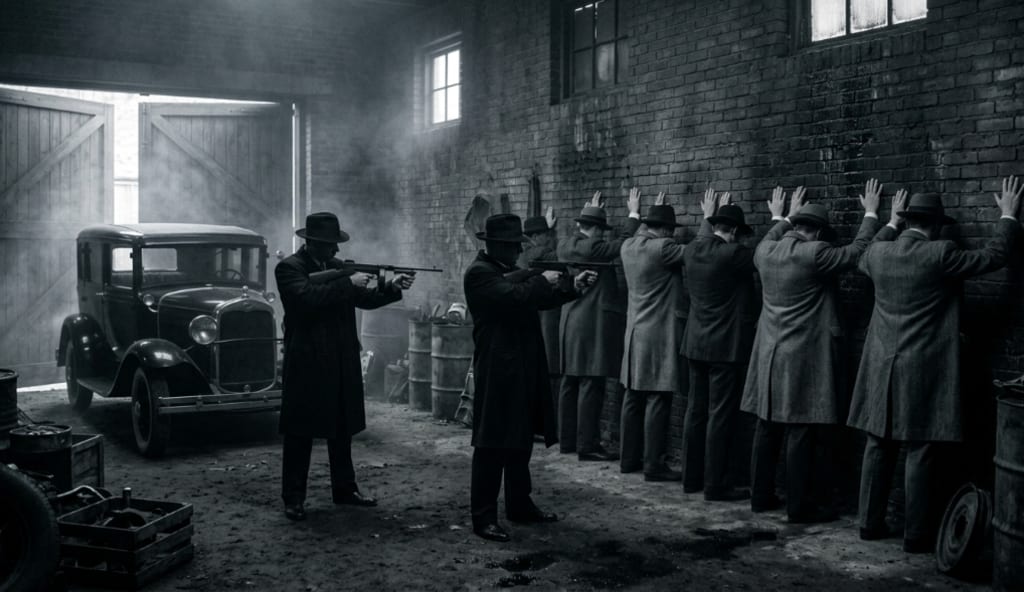
The morning of February 14, 1929, in Chicago didn’t begin like a normal Valentine’s Day. There were no roses, no love notes—only silence, tension, and a crime that would shock the entire world. What happened that day inside a quiet garage would become one of the most chilling and unsolved mysteries in American history: the St. Valentine's Day Massacre.
At around 10:30 a.m., a black Cadillac slowly pulled up outside the SMC Cartage Company garage on North Clark Street. To anyone watching, nothing seemed unusual. But within minutes, the scene would turn into a bloodbath. Four to five men stepped out of the car—two of them dressed as police officers. Their uniforms gave them authority, and inside the garage, seven men obeyed without resistance.
These men were associates of Chicago gangster George "Bugs" Moran, a powerful rival of the infamous crime boss Al Capone. Believing they were being arrested—or at least questioned—the victims lined up facing the wall as instructed. What happened next was brutal and swift. The gunmen opened fire using Thompson submachine guns, unleashing over 70 bullets in seconds. Six men died instantly. The seventh, barely alive, reportedly whispered conflicting words before dying—some say he blamed the police, others say he denied being shot at all.
A Crime Without a Clear Answer
The shocking part? Despite the scale and brutality of the crime, no one was ever convicted. And even more surprising—Al Capone, the man most people believe was behind the massacre, was never even questioned. At the time of the killings, Capone was in Florida, sitting in a courthouse, giving him what seemed like an “airtight alibi.”
But history is rarely that simple.
The Target Who Escaped Death
The real target of the attack was likely Bugs Moran himself. But fate had other plans. Moran was running late that morning. As he approached the garage, he reportedly saw what looked like a police car outside and turned away to avoid trouble. Meanwhile, a lookout for the gunmen mistook another man for Moran and gave the signal to begin the attack too early.
This one small mistake changed everything. Moran survived, but his men paid the price.
Why Were They There?
One of the biggest mysteries still puzzling historians is why those seven men were gathered in the garage that morning. Early theories suggested they were there to receive or distribute a shipment of illegal whiskey—a common activity during Prohibition. But something didn’t add up.
Most of the victims were dressed in expensive suits, not work clothes. They also still had money in their pockets, ruling out robbery as a motive. Some experts believe they were lured there for a meeting—possibly a setup. Others think they trusted the fake police officers and complied, believing it was just another routine encounter in a city where corruption was common.
Who Was Really Behind It?
Even today, the identity of the killers remains uncertain. While Capone had a clear motive—ongoing gang wars and competition over illegal businesses like bootlegging—there’s no solid evidence directly linking him to the crime.
Some historians suggest that Capone hired a group known as the “American Boys” from St. Louis to carry out the hit. According to this theory, the gunmen didn’t even know what Moran looked like, so they killed everyone in the garage to be sure.
Another strong suspect was Fred "Killer" Burke. Months after the massacre, police found weapons in his possession that matched the bullets used in the killings. But despite this major clue, Burke was never officially interrogated about the massacre.
There were also claims from a man named Bryon Bolton, who allegedly confessed to being involved. He even named other participants and described how the plan was organized. But his claims were never properly investigated, and the case remained stuck in uncertainty.
A Revenge Plot?
Years later, another theory emerged—one that added a personal twist to the story. According to a letter found in FBI files, the massacre may have been an act of revenge. A police officer’s son had been killed earlier, and a relative sought vengeance against Moran’s gang. This theory even suggests that some members of law enforcement may have looked the other way—or worse, participated.
While this explanation fills in some gaps, it also raises more questions. Could corruption have reached such a deep level? In 1920s Chicago, the answer might very well be yes.
The Role of Corruption
To understand why the case was never solved, you have to understand Chicago during Prohibition. It was a city overflowing with crime, illegal alcohol, and powerful gangs. There were thousands of speakeasies and hundreds of unsolved murders. Corruption wasn’t just present—it was everywhere.
Police officers, politicians, and officials were often on the payroll of gangsters. According to some reports, even high-ranking detectives were receiving large weekly payments from Capone’s organization. In such an environment, solving a crime like the massacre wasn’t just difficult—it was almost impossible.
Where Was the FBI?
Another puzzling aspect of the case is the lack of involvement from the federal government. At the time, the FBI was led by J. Edgar Hoover, who chose not to intervene. He considered the massacre a local issue and focused instead on other types of crime, such as bank robberies.
This decision likely played a major role in the case remaining unsolved. Without federal support, local authorities—already weakened by corruption—struggled to make progress.
Capone’s Ironic Downfall
Despite being widely suspected in the massacre, Capone was never charged for it. Instead, his downfall came from something much less dramatic: tax evasion. In 1931, he was sentenced to 11 years in prison.
It’s one of history’s great ironies. A man believed to be behind one of the most brutal killings of the 20th century was brought down not by murder charges, but by financial crimes.
A Mystery That Refuses to Die
Nearly a century later, the St. Valentine's Day Massacre continues to fascinate historians, crime experts, and the public. Books, movies, and documentaries have all tried to uncover the truth, but the answers remain hidden.
What really happened that day? Who gave the order? Why were those men chosen?
The truth is, we may never know.
Final Thoughts
The St. Valentine’s Day Massacre is more than just a crime story—it’s a reflection of an era where power, money, and fear controlled everything. It shows how even the most shocking acts of violence can go unpunished when the system meant to deliver justice is broken.
And perhaps that’s why this mystery still haunts us today. Not just because of what happened—but because of what didn’t happen afterward.
No justice. No closure. Only questions.
About the Creator
AngelFace
✨ “I share mysteries 🔍, stories 📖, and the wonders of the modern world 🌍 — all in a way that keeps you hooked!”
The Locked Room in Apartment 304
In the winter of 2022, a quiet residential building on the outskirts of a small Midwestern town became the center of one of the most disturbing criminal investigations the community had ever witnessed, a case that began with what seemed like an ordinary welfare check and quickly evolved into a mystery filled with fear, unanswered questions, and details that investigators still struggle to explain. The building itself was nothing remarkable, a four-story complex built in the late 1980s with narrow hallways, aging carpets, and the faint smell of cleaning chemicals that seemed permanently embedded in the walls, but what happened in apartment 304 would transform that otherwise forgettable structure into a place that residents refused to talk about even years later.
By The Curious Writer6 days ago in Criminal
True Crime
True Crime Of a Girl In Car & Disappeared.. The Vanishing Hitchhiker She Got in the Car and Disappeared Into Thin Air On a foggy October evening in 1982, truck driver Mike Patterson picked up a young woman on Interstate 40 outside Nashville, and what happened in the next fifteen minutes would haunt him for the rest of his life. The girl looked about nineteen, wearing a white dress that seemed too thin for the chilly autumn night, and she was standing on the shoulder waving frantically. Mike pulled over because leaving someone stranded wasn't in his nature, especially not a young woman alone on a dark highway, and when she climbed into the cab, she gave him an address in East Nashville and said nothing else, just stared straight ahead with an expression he later described as "not quite right, like she was looking at something I couldn't see."
By The Curious Writera day ago in Criminal
Everyone Is Acting Normally Challenge Winners
In the Everyone Is Acting Normally challenge, something is clearly wrong, but no one stops to name it. Across the shortlist, that wrongness appears as resurrections, surveillance, disappearance, and denial, each treated as part of daily life.
By Vocal Curation Teamabout 13 hours ago in Resources


Comments
There are no comments for this story
Be the first to respond and start the conversation.