
Wheat and weeds, Part 3
There’s a huge difference between “Christianity isn’t what I was told in Sunday school” and “Christianity is just a plagiarized patchwork and everything about it is a lie.

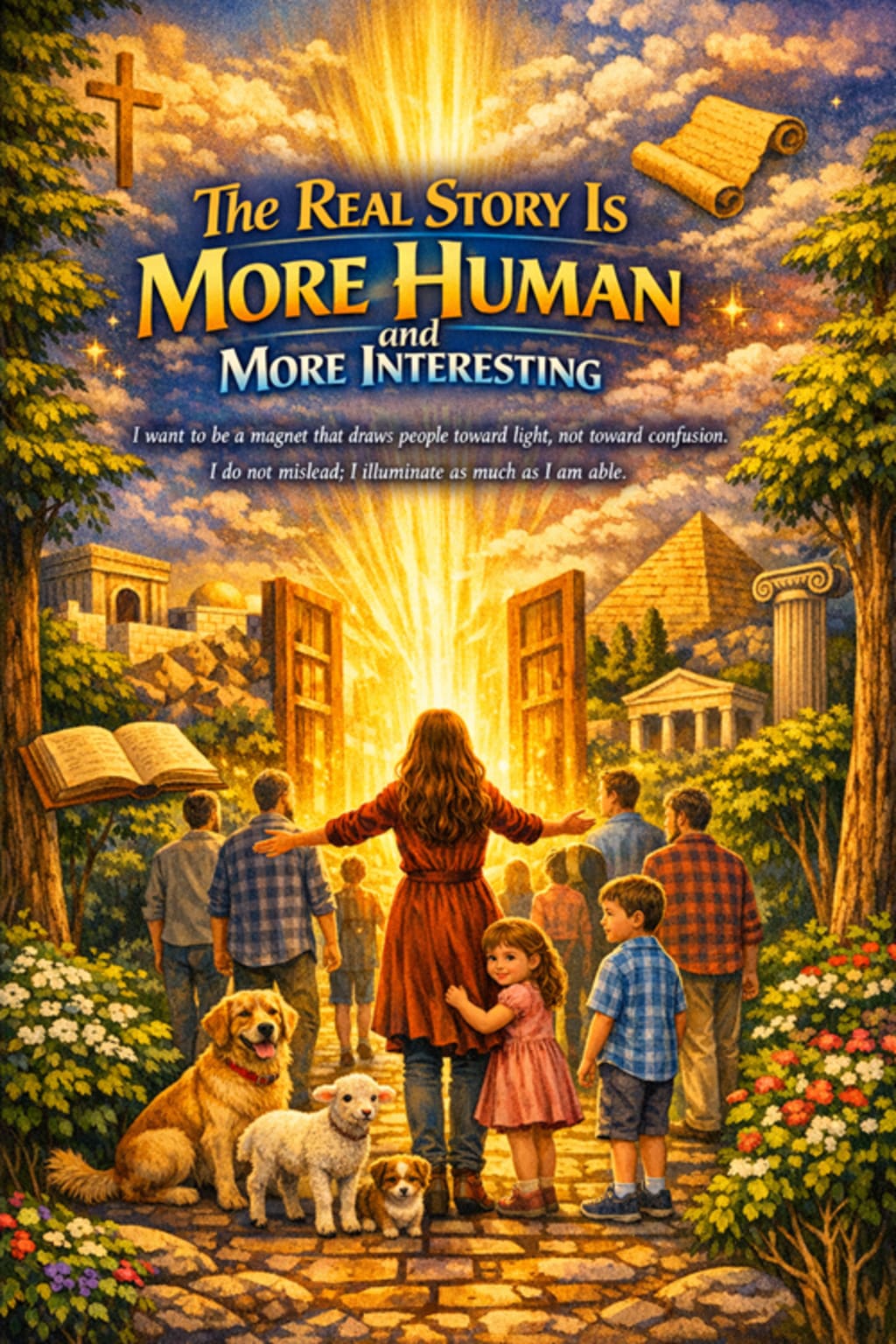
Extra points i thought to bring to your attention:
When I said modern scholarship on heresiology and the Panarion is clear that Epiphanius is polemical, I’m thinking of people like Frank Williams, who produced the standard English translation of the Panarion for Brill, with a long introduction explaining Epiphanius’ methods and biases; of Averil Cameron, who has written extensively on late antique Christian polemic; and of David Brakke, whose work on Gnosticism and heresiology (for example “The Gnostics” and his studies on Athanasius and Egyptian monasticism) shows how heresiologists constructed enemies rhetorically. These are the kinds of names you’d see in university syllabi, not just on Wikipedia.
The Borborites are indeed described by Epiphanius as a Christian Gnostic sect, and he connects them genealogically to earlier groups like the Nicolaitans. The Nicolaitans themselves are mentioned in the Book of Revelation, in chapters 2:6 and 2:15, where the risen Christ says he “hates the works of the Nicolaitans.” We don’t really know who they were; later writers speculate, but Revelation itself only tells us that they were a group whose practices or teachings were rejected by the author.
They are not a “tribe” in the ethnic sense; they are a faction or sect within the Christian milieu of Asia Minor. Epiphanius, writing centuries later, retrofits them into his grand genealogy of heresies. That’s exactly the kind of move modern heresiology scholars warn about: he is not simply preserving neutral data, he is building a story about how error spreads.
Brian Muraresku’s “The Immortality Key” came out in 2020 and made a lot of noise in media and online. He argues for a strong psychedelic component in ancient mystery cults and suggests a continuity into early Christianity. Classicists and historians of religion have engaged with his work critically; some find parts of his evidence intriguing, others think he overstates his case. If you [the reader] want more traditional, cautious treatments of Eleusis and ancient mystery cults, you’d look at Walter Burkert’s “Ancient Mystery Cults,” Kevin Clinton’s work on Eleusis, or the relevant entries in something like the “Brill’s New Pauly” encyclopedia. Those are the kinds of references scholars trust more than a popular book or a random Academia.edu upload.
Greek culture develops over a long arc of time: the Mycenaean period in the second millennium BCE, the so‑called Dark Age after the collapse around 1200, then the Archaic period from roughly the eighth century BCE, when we get Homer, Hesiod, the rise of the polis, and the first stone temples. The Classical period (fifth–fourth centuries BCE) is when Athens, Sparta, the Persian Wars, and the great philosophers appear. The Hebrew people likewise have a long, layered history: Iron Age Israel and Judah in the first millennium BCE, with the earliest biblical traditions probably taking shape in oral and written form during the monarchic and exilic periods. So there isn’t a simple “Greece was born here, Israel was born there” moment; both are deep, evolving traditions that overlap in time.
When I said the Greek world had its own soteriological themes, I meant that Greek religion also developed ideas about salvation, blessed afterlife, and escape from ordinary human fate. In Homer, the afterlife is mostly a shadowy existence in Hades, but there are hints of special fates, like Elysium for a few heroes. Later mystery cults, like Eleusis, promised initiates a better lot after death. Philosophical schools like the Pythagoreans and Platonists spoke of the soul’s purification and ascent.
These are “soteriological” in the sense that they deal with being saved from death, ignorance, or the cycle of rebirth. In Judaism, salvation language is rooted in God rescuing Israel from enemies, exile, sin, and ultimately death. Christianity inherits that Jewish framework and adds its own Christ‑centered interpretation. So there are parallel and sometimes intersecting streams, but they are not identical.
About the catacomb frescoes: the dating to the third century comes from archaeological context, style, and comparison with other securely dated material. The Roman catacombs were used mainly from the second to the fourth centuries. Art historians and archaeologists date specific frescoes based on the strata in which they are found, the style of painting, inscriptions, and associated burials. The images of a youthful, beardless Christ raising Lazarus with a rod are part of that corpus. The rod is visually similar to the staff of Moses in other Christian art, and to the general iconography of authority and miracle‑working in late antiquity.
Moses’ staff in the biblical narrative is a stick, not a “wand” as in the Harry Potter sense. The point is that in ancient art, a rod, staff, or wand is a flexible symbol: it can be a shepherd’s staff, a philosopher’s pointer, a magician’s tool, or a sign of office. To jump from “Jesus is shown with a rod” to “early Christians thought he was a Dionysian magician” is a leap that the evidence does not force or sustain.
The thyrsus of Dionysus is the staff carried by the god and his followers in Greek art and literature. It is typically a long rod topped with a pine cone or a bunch of ivy leaves, sometimes wrapped with vines or ribbons. It symbolizes Dionysus’ power, fertility, and ecstatic rites. It is possible to be seen it, also on vase paintings, reliefs, and statues. It is not a pineal gland symbol in any ancient text; that connection is a modern imaginative overlay.
When I mentioned Eleusis and Samothrace as important mystery cults, I meant that they were major centers of initiation in the Greek world. The Eleusinian Mysteries, near Athens, were rites in honor of Demeter and Persephone, involving a procession, ritual actions, and secret experiences that initiates were forbidden to reveal. They promised some kind of blessedness in the afterlife.
The Samothracian Mysteries, on the island of Samothrace, were associated with the so‑called Great Gods and were especially popular among sailors and elites seeking protection. For solid references, we can look at Walter Burkert’s “Ancient Mystery Cults,” Kevin Clinton’s articles on Eleusis, or the entries on Eleusis and Samothrace in the “Oxford Classical Dictionary” or “Brill’s New Pauly.”
Why Gnostic movements arose in the second century and how that happened. In short: the second century was a time of intense religious and philosophical experimentation in the Roman Empire. Christianity was spreading and diversifying; Judaism was redefining itself after the destruction of the Temple; Greek philosophy, especially Platonism, was influential. In that environment, some groups combined Christian language and figures (like Jesus, Mary, the apostles) with elaborate mythologies about emanations, aeons, and a flawed creator.
They read Genesis in a radically symbolic way and saw the God of the Old Testament as a lower being. Scholars debate whether “Gnosticism” is a single movement or a family of related tendencies, but most agree that these groups are later reinterpretations of Christianity and Judaism, not the original form of the faith.
Finally, the “sexual‑ritual Eucharists” Epiphanius attributes to the Borborites. In the Panarion, he accuses them of gathering, engaging in sexual acts, collecting semen and menstrual blood, mixing them with bread, and consuming this mixture as a kind of Eucharist. He also claims they used aborted fetuses in their rites. These are shocking accusations, and they are exactly the kind of thing ancient polemicists loved to say about their enemies.
Pagans said similar things about Christians; Christians said similar things about pagans and Gnostics. Modern scholars are very cautious here. Some think Epiphanius may be distorting or moralizing symbolic language about “seed,” “blood,” and “birth” that had a more metaphorical meaning in those groups. Others think he is repeating rumors or inventing slanders to make them look monstrous. We have no writings from the Borborites themselves to check his claims. So yes, there is a real confusion, or better, a real asymmetry: we only hear about them through their enemies.
I would say, in a very traditional way to express myself, using though the Romanian language here, for who has the advantage of different languages, a phrase “o răutate pusă cu tot dinadinsul” . This fits the suspicion many scholars have — a certain malice and exaggeration in their description. Like Epiphanius here.
So, to pull it together: there are serious, careful scholars and reference works left behind. Epiphanius is real and important, but polemical. Mystery cults are real and fascinating, but not simple prototypes of Christianity. Early Christian art is real and symbolically rich, but not proof of Jesus as a Dionysian magician. Gnostic movements are real and historically interesting, but they are later reinterpretations, not the root of the faith. The video i watched takes all these things and pushes them to the most sensational reading. Definitively, i am not wrong to feel that there is “rautăte” {malice/ maliciousness} in that approach.
*********************************************************************
©Ca De Luce> MINDFUL MIND Medium Blog 2025. Unauthorized use of text or media is not allowed. All images and photo are fulfilling the copyrights regulations. Much obliged to you all!

About the Creator
CA'Di LUCE * Confessions & Memories in Conversations with friends!/ It’s not a revolution—it’s a quiet evolution.
I speak of spirit, soul, and flame,
Of humanity’s quest, our endless aim.
*Please, support this author, effortless for you:
https://buymeacoffee.com/ca_de_luce_blog/
https://ko-fi.com/cadeluce/
.
Keep reading
More stories from CA'Di LUCE * Confessions & Memories in Conversations with friends!/ It’s not a revolution—it’s a quiet evolution. and writers in Confessions and other communities.
I was in a Toxic Relationship, with my Workplace
“You got that?” My ex yelled. His hands were balled into fists at his side. At six foot three, he towered over me. A normal person would have been afraid, but I looked up a video of George Lopez repeatedly saying, “I got this,” and showed it to him. I had grown used to this treatment, so much so that I didn’t blink when he ripped the phone from my hand and threw it across the room.
By Jade M.23 days ago in Confessions
The Fae King
It began with a girl. Black-haired and sweet and gone too soon. It is the way of mortals to die, of course. Most pass within a few decades, unless they can be tempted away to fairyland and persuaded to stay there. Even then, mortals live only as long as they can go without visits to friends or family that allow time and the weight of years to catch up to them.
By Natasja Roseabout 22 hours ago in Fiction



Comments
There are no comments for this story
Be the first to respond and start the conversation.