
Lost Islamic History
Reclaiming Muslim Civilisation from the Past

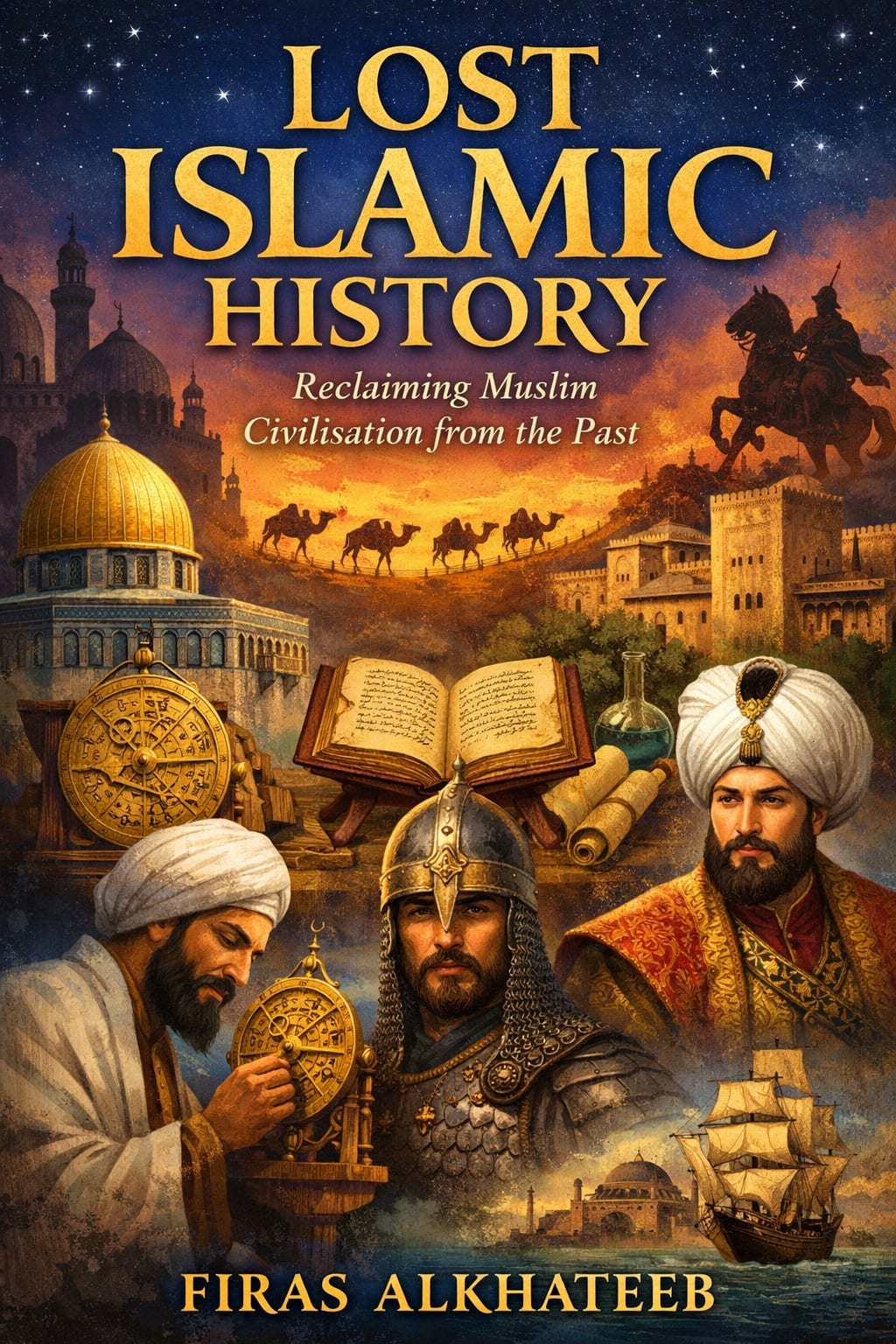
In recent years, the book Lost Islamic History: Reclaiming Muslim Civilisation from the Past has The book was written by Firas Alkhateeb, an American researcher, educator, and historian who specialises in Islamic history and thought. First published in 2014 in the United Kingdom by Hurst & Co., it has since been republished in expanded editions (including a 2017 revised version) and translated into several languages including Urdu, Turkish, Bengali, and Indonesian.
Alkhateeb’s declared intention is not to write an exhaustive academic tome, but rather to create a concise, engaging, and comprehensible overview of over 1,400 years of Muslim civilisation — from its origins to the modern world. It serves as a primer for readers who may be unfamiliar with Islamic history or who want a coherent introductory narrative.
Central Themes and Structure
Unlike traditional textbooks that focus narrowly on battles, dates, or dynasties, Lost Islamic History aims to reconnect readers with the broad arc of Islamic civilization: how it began, how it spread, how it flourished culturally and intellectually, and how it eventually encountered internal and external challenges.
The book is arranged around key periods and themes that shaped Muslim civilisations:
1. Pre‑Islamic Arabia – Setting the stage by sketching the social and cultural context into which Islam emerged.
2. The Life of the Prophet – Muhammad’s life and mission as the foundation for the later expansion of Muslim society.
3. The Rightly Guided Caliphs – The early era of leadership following the Prophet’s death and the consolidation of the Muslim state.
4. The Establishment of the Muslim State – How Muslim governance took shape across wider territories.
5. Intellectual Golden Ages & Islamic Sciences – Highlighting periods of scientific, philosophical, and cultural advancement where Muslim scholars played pivotal roles.
6. The Rise and Decline of Empires – Chronicles of powerful Muslim empires — from the Umayyads and Abbasids to the Ottoman and Mughal realms — and their impacts on global civilization.
7. Al‑Andalus and Global Influence – The story of Muslim Spain and broader influences on European and African societies.
8. Modern Muslim World – A concluding look at how Islamic civilisational narratives transitioned into contemporary nation‑states and global contexts.
Across these themes, the book emphasises contributions that are often overlooked in popular histories — such as advances in science, medicine, architecture, philosophy, and governance, as well as interactions between the Muslim world and other cultures.
Approach and Style
What distinguishes Lost Islamic History from many academic histories is its readable, narrative style. Instead of dense footnotes and archival debates, Alkhateeb adopts a storytelling voice, weaving together personalities, events, and ideas. This approach makes the material accessible to non‑experts, students, and general readers.
The book also aims to correct simplistic or misleading perceptions about Islamic history that circulate in both Western and non‑Muslim contexts. Rather than treating history as a series of disconnected facts, it places ideas, culture, science, and moral questions at the centre of its narrative.
Reception and Impact
The response to Lost Islamic History has been varied. Many readers and commentators in the Muslim world appreciate its attempt to present Islamic civilisation’s achievements and challenges in a coherent overview. Its recommendation by political figures like Imran Khan brought it wider attention, especially among young readers seeking to understand their cultural heritage better.
At the same time, some critics point out that the book’s narrative — while informative — is not comprehensive, and that it sometimes simplifies complex historical debates. Others have noted that the book does not aim to be a scholarly reference work but rather an accessible introduction.
Conclusion
Lost Islamic History: Reclaiming Muslim Civilisation from the Past stands as a popular and readable introduction to the long story of Muslim civilisations — their rise, innovations, contributions, interactions with other cultures, and evolution into the modern era. Recommended by voices like Imran Khan, it has become a frequent starting point for readers curious about the deeper past of the Islamic world.
If you’re seeking a coherent overview that bridges ancient, medieval, and modern Islamic history in a narrative style, this book is positioned as an inspiring first step into that journey.
About the Creator
Irshad Abbasi
Ali ibn Abi Talib (RA) said 📚
“Knowledge is better than wealth, because knowledge protects you, while you have to protect wealth.
Keep reading
More stories from Irshad Abbasi and writers in BookClub and other communities.
The Book Lost in Time
In the summer of 2025, an unassuming cardboard box arrived at the doors of the National Archives in Washington, D.C. The box was dusty, tape yellowed with age, marked only with an old library catalog number and the faint signature of its donor. Inside, wrapped in layers of paper that had become brittle with time, was a book—a manuscript so remarkable that scholars around the world paused in disbelief. What made it extraordinary was not just its age or condition, but the fact that it had been missing for 43 years.
By Irshad Abbasi about 18 hours ago in BookClub
7 Life-Changing Books That Will Make You Think Twice
In a world overflowing with information, few things have the power to reshape the way we think like a truly transformative book. Books are more than stories—they are lenses through which we can examine our beliefs, challenge our assumptions, and discover perspectives we never considered.
By Diana Meresc6 days ago in BookClub


Comments
There are no comments for this story
Be the first to respond and start the conversation.