
What Jobs Will AI Replace by 2030?
The Roles Most at Risk And 10 That Are Completely Safe

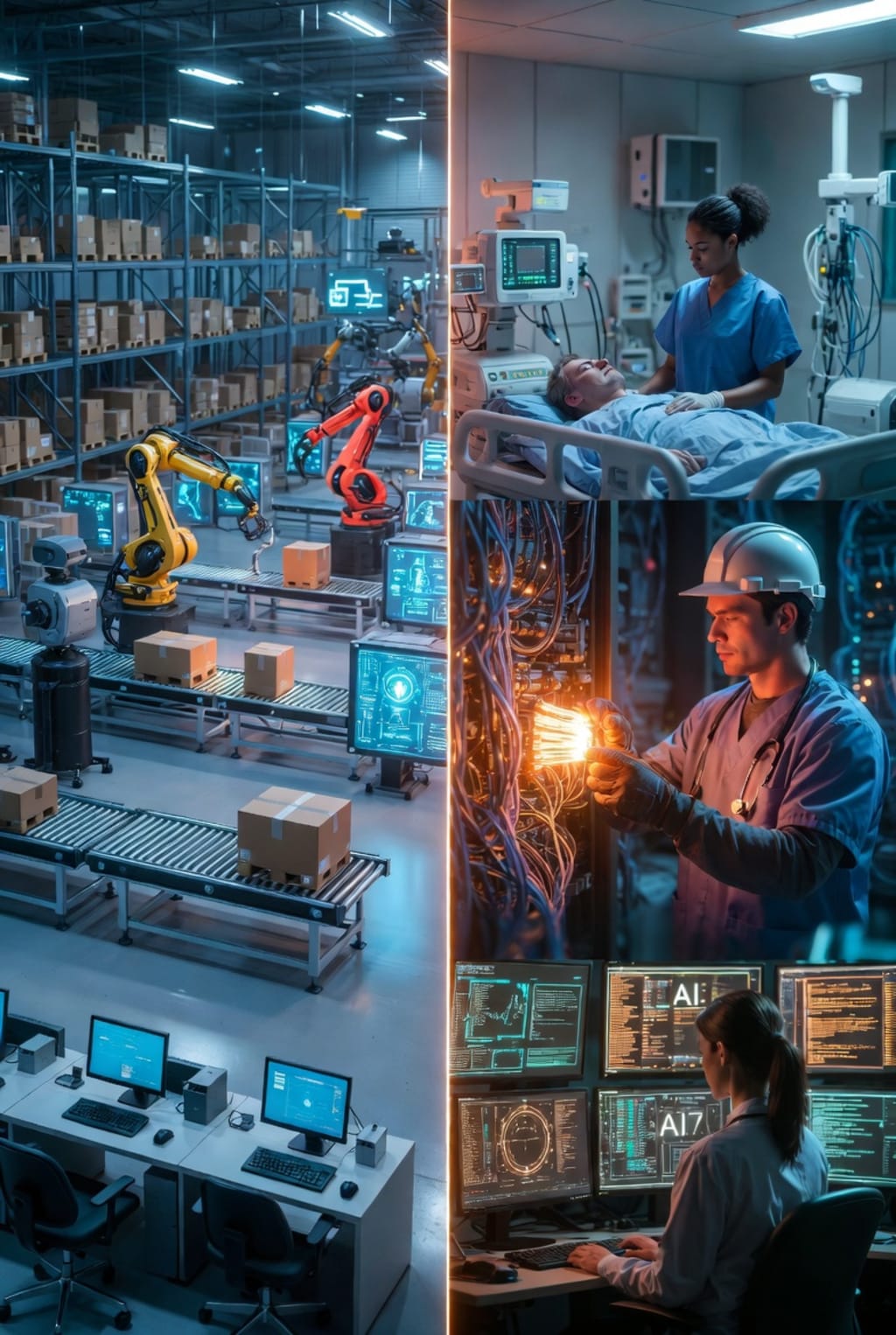
This article was created with assistance from Grok AI by xAI.
AI is transforming the workforce faster than expected.
Here’s a clear breakdown of jobs most likely to be automated by 2030 — and the ones that will stay strongly human and AI-proof.
Artificial intelligence is no longer science fiction — in 2026 it’s already reshaping how we work. Major reports from McKinsey, Goldman Sachs, Forrester, and the World Economic Forum predict that AI could automate or fundamentally transform up to 30–45% of work tasks by 2030. That’s the equivalent of hundreds of millions of full-time jobs impacted globally.
But here’s the important distinction: AI mostly replaces tasks, not entire jobs. Routine, repetitive, and predictable work is disappearing fastest. Roles that rely on creativity, empathy, physical dexterity in unpredictable environments, ethical judgment, and complex human interaction are much safer.
This guide breaks down what jobs AI will most likely replace (or heavily reduce) by 2030, and highlights 10 roles that remain strongly AI-proof.
Jobs Most at Risk from AI by 2030
These positions involve high volumes of repetitive, data-driven, or standardized tasks that AI and automation tools can handle more efficiently and cheaply:
Data Entry Clerks and Administrative Support Workers
Routine form filling, scheduling, and basic data processing are already being taken over by AI tools and RPA (robotic process automation).
Cashiers and Retail Checkout Roles
Self-checkout kiosks, mobile payments, and computer vision systems continue to reduce the need for human cashiers.
Basic Customer Service Representatives (Phone/Email/Chat)
AI chatbots and voice assistants now handle the majority of simple inquiries 24/7. Only complex or emotional cases stay with humans.
Entry-Level Software Developers & Junior Coders
AI coding assistants (like GitHub Copilot, Cursor, and Claude) can now generate basic code, debug, and even build simple applications.
Telemarketers and Cold Callers
AI voice agents can make thousands of calls simultaneously with perfect scripting.
Assembly Line and Manufacturing Workers (Routine Tasks)
Robots and AI-powered automation are taking over repetitive factory work, especially in automotive and electronics.
Basic Accountants and Bookkeepers (Routine Filing)
AI tools can handle standard tax preparation, invoicing, and bookkeeping with high accuracy.
Market Research Analysts (Routine Data Collection)
AI can scrape, analyze, and summarize large datasets much faster than humans.
Proofreaders and Basic Content Editors
AI grammar and style tools are becoming extremely sophisticated for standard documents.
Warehouse Pickers and Stock Clerks (Non-Complex Roles)
Autonomous robots and AI inventory systems are rapidly scaling in large fulfillment centers.
Forrester estimates that around 10.4 million U.S. jobs could be fully displaced by 2030, with many more significantly changed. The common thread? Predictable, rule-based work.
Why Some Jobs Are More Vulnerable Than Others
AI excels at:
Pattern recognition
Repetitive calculations
Processing large amounts of data quickly
Following clear rules
AI still struggles with:
Genuine empathy and emotional nuance
Physical work in messy, unpredictable real-world settings
Ethical decisions with real consequences
Creative strategy and original thinking in ambiguous situations
How to AI-Proof Your Career Before 2030
If you’re currently in a vulnerable role, don’t panic.
Here’s how to adapt:
Upskill in human-centric areas — Focus on emotional intelligence, leadership, or hands-on trades.
Learn to work with AI — Become the person who directs AI tools instead of being replaced by them.
Move into strategy or client-facing roles — Revenue-generating and relationship-driven positions are safer.
Consider high-income skills without a degree — AI SEO expertise, trade certifications, or high-ticket sales can be learned relatively quickly.
Build passive income streams — Digital products, investments, or side consulting reduce reliance on a single job.
The Bottom Line for 2026–2030
AI will eliminate many routine tasks and reduce demand for certain entry-level or repetitive roles. However, it will also create new opportunities in AI infrastructure, healthcare, skilled trades, and strategic oversight.
The winners won’t be those who fear AI — they’ll be the ones who understand it, use it as a multiplier, and double down on uniquely human strengths.
Start assessing your current role today. If it’s heavy on repetitive tasks, begin building adjacent skills in AI-resistant areas like healthcare support, trades, or AI-powered SEO strategy. The future of work belongs to adaptable humans who partner with technology rather than compete against it.
About the Creator
Sandy Rowley
AI SEO Expert Sandy Rowley helps businesses grow with cutting-edge search strategies, AI-driven content, technical SEO, and conversion-focused web design. 25+ years experience delivering high-ranking, revenue-generating digital solutions.
Keep reading
More stories from Sandy Rowley and writers in 01 and other communities.
15 High-Paying AI-Proof Jobs in 2026
This article was created with assistance from Grok AI by xA AI is changing work fast, but these careers rely on human skills AI still can't replicate. Discover the top AI-resistant jobs with strong salaries and growth through 2030 and beyond.
By Sandy Rowleyabout 9 hours ago in 01
NFT Marketplace Apps: What 2023 Taught Us in 2026
The blockchain landscape of 2026 looks very different today. It has changed since the volatile cycle of the early 2020s. For those building NFT Marketplace Apps, 2023 was a vital year. It served as a definitive "cleansing" period for the entire industry. This period fundamentally reshaped how we trade digital assets now. We have moved past the era of profile-picture (PFP) speculation. We are now in a phase of high-utility functionality. Cross-chain capability and legal compliance are now standard requirements. Marketplaces must now provide real-world value to survive.
By Del Rosario2 days ago in 01
How AI-Powered Digital Experience Solutions Are Transforming Museums
Museums face a clear demographic shift in 2026. Younger audiences, specifically Generation Z, interact with information digitally. They expect immediate, visual data. They rarely read long, printed text cards attached to walls. To keep these visitors engaged, cultural institutions use AI-powered digital experience solutions. These software systems replace static displays with interactive, data-driven environments. They force the physical museum space to adapt to the human visitor.
By ViitorCloud Technologies4 days ago in 01


Comments
There are no comments for this story
Be the first to respond and start the conversation.